Showing posts with label fantasy. Show all posts

Friday, August 16, 2013

Review: Vessel by Sarah Beth Durst

Tags: young adult, fantasy, magic, desert, POC

Summary

Liyana has trained her entire life to be the vessel of a goddess. She will dance and summon her tribe's deity, who will inhabit Liyana's body and use magic to bring rain to the desert. But when the dance ends, Liyana is still there. Her tribe is furious--and sure that it is Liyana's fault. Abandoned by her tribe, Liyana expects to die in the desert. Until a boy walks out of the dust in search of her.

Korbyn is a god inside his vessel, and a trickster god at that. He tells Liyana that five other gods are missing, and they set off across the desert in search of the other vessels. The desert tribes cannot survive without the magic of their gods. But the journey is dangerous, even with a god’s help. And not everyone is willing to believe the trickster god’s tale.

The closer she grows to Korbyn, the less Liyana wants to disappear to make way for her goddess. But she has no choice--she must die for her tribe to live. Unless a trickster god can help her to trick fate--or a human girl can muster some magic of her own. [summary from Goodreads]

Review

I wanted this to be AMAZING. Because it’s Sarah Beth Durst. And there’s a stunning Asian model on the cover. But VESSEL didn’t blow me out of the water, though it was still a fine and unique fantasy geared more towards younger fantasy fans rather than jaded, crotchety SFF readers with high demands for world-building, plot, and characterization (a.k.a. me).

Right out of the gate, VESSEL stands a head above others of its ilk because of its protagonist, Liyana. With her slightly snarky sense of humor, especially when she’s with family, Liyana drew me to her immediately…which helped through the rougher periods of the book, when the features that often drag down a quest-based plot—new characters introduced much too quickly to fully capture readers’ support, a whiplash-inducing quick pace that makes it more difficult for readers like me to remain invested in the story—reared their heads.

As with one of Durst's previous books, Enchanted Ivy, in VESSEL, I sometimes found that I had difficulty keeping the thread of what was going on. Didn’t they just arrive in Place B, and why do they have to move on to Place C so quickly? Weren’t he and she fighting only a few pages ago? The constant barrage of questions going on in my head as I struggled to figure out which of the many minor characters introduced were truly significant, what romance to focus on, which interactions were actually important to the overall plot, really took me out of the story, so that at the end of this swashbuckling desert magic tale I closed the book with a little, “Huh.” It was a decent enough read for me, but several months on from when I read the book, I’m not sure how much of it stayed with me at all.

Similar Authors
Juliet Marillier

Cover discussion: Do I even have to say anything? Do I really have to explain to you why I like--nay, love--this cover so much?

Margaret K. McElderry Books / Sept. 11, 2012 / Hardcover / 432pp. / $16.99

Review copy received from author and publisher. Thank you for giving me the opportunity to review it!

Tuesday, July 30, 2013

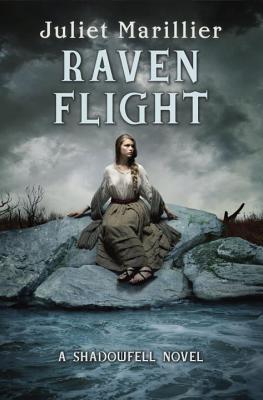
Review: Raven Flight by Juliet Marillier

Shadowfell, Book 2
Book 1: Shadowfell review

Tags: young adult, middle grade, fantasy, magic

Summary

With an accelerated timeline, Neryn is ready to seek out the four ancient Guardians of Alban to ask for their help in teaching her to become the best Caller she can be, in order to help the Rebel forces (and her friends) of Shadowfell to overthrow King Keldec. But the learning is not easy: Neryn struggles to come to terms with her power and influence, and can’t figure out where her feelings for Flint fit into this greater cause…if they can at all.

Review

RAVEN FLIGHT was not as engaging for me as Shadowfell—but the thing is, they’re not all that different from one another. Neryn is still this can-do-no-wrong protagonist who, if not liked instantly by all she meets, at least can quickly win them over with her earnest naivete. The plot is straightforward quest involving long distances traveled and new characters met.

In RAVEN FLIGHT, we learn more about what exactly makes Keldec so evil. And boy is the man frightening! In one of the most riveting scenes in the story, Neryn is forced to witness Keldec’s cruelties to his subjects from front-row seats. This insight into Keldec’s rule is horrifying, yet really upped the stakes for me as a reader in cheering the painfully perfect Neryn on to success.

Unfortunately, perfection gets old, and Neryn’s personality grated on me a lot more in this installment than previously. I think I’m past the age when I can immerse myself in a protagonist who’s flawless—not in that put-together way, but in the one-girl-can-defeat-the-whole-world way. This is a straightforward fantasy geared, I think, more towards readers new to fantasy than to any others.

Cover discussion: *looks at it for the first time* Hah, kiddingbutnotreallykidding. Ah, I get it. It depicts a scene from the book, which is decent... but to be honest, I really just picked this up because it had JM's name on the cover. We should do a test to see what having JM's name on a book cover will enable me to overcome in terms of outrageous cover designs...

Knopf / July 9, 2013 / Hardcover / 416pp. / $16.99

e-galley received for review from publisher and NetGalley. Thank you!

Tuesday, July 2, 2013

Review: Scarlet by Marissa Meyer

Lunar Chronicles, Book 2

Book 1: Cinder review

Tags: young adult, sci-fi/fantasy/dystopian, France, retelling

Summary

Scarlet Benoit’s grandmother has gone missing. Everyone tells her to not worry about it, there’s nothing she can do, her grandmother is an individualistic kind of person, but Scarlet thinks there’s something more insidious behind her grandmother’s disappearance. The only person who will help her is a soft-spoken street fighter named Wolf, whom Scarlet hopes she can trust, but who may have an agenda of his own. Answers are discovered, but more questions raised, when they cross paths with Cinder, whose recent and widely publicized escape from a New Beijing prison just might start the war that the ruthless Lunar Queen has been waiting for.

Review

Cinder was my unexpected enjoyable find of last year. After experiencing how effortlessly Marissa Meyer can weave together a convoluted yet exciting tale, I had high demands for the sequel, SCARLET. And in a way, SCARLET fulfilled them. In a way, it didn’t.

The good first: everything we liked about Cinder is in here, except perhaps even a notch better. In particular, the characters, old and new, major and supporting, are easy to cheer on. I mean, there are exceptions. Kai’s role is reduced to that of beleaguered new and helpless emperor under international pressure. Wolf, I’m sorry to say, did not appeal to me so much, not because I didn’t like his soft and shy personality (I did) so much as I have known many misunderstood love interests with wounded hearts of gold (see: many adult romance male leads). But when you weigh the slightly annoying—Kai and Wolf—against the good—Cinder’s resourcefulness and empathic internal struggle, Scarlet’s ferocity at protecting her loved ones, Thorne’s much-appreciated airheaded charm lightening the mood)—the good comes out on top.

That being said, one of the issues that some reviewers noted as a weakness in Cinder is even more apparent in SCARLET, and that is the world-building. I remember thinking the world-building in Cinder was decent, but in SCARLET I found it lacking. Don’t get me wrong: Meyer does a Richelle Mead-worthy job of setting up an elaborate yet believable backstory to the world’s current state, the one involving the Lunars and Princess Selene. But settings-wise, inadequate research and/or thought was glaringly apparent. At no point did the scenes in France distinguish themselves from what could’ve been going on in any other place in a future Earth. I wanted the book to show me its vision of what a future Earth divided into regions like the Eastern Commonwealth and European Federation, and experiencing strained relationships with Lunar, would look, feel, hear, taste, and smell like. What distinguishes Rieux, Scarlet’s hometown, from other places in the world? How does Paris fare several centuries from now, and how does its altered cityscape affect the characters’ movements and experiences?

Still, SCARLET was fast-paced and exciting. My attention started wavering around the end when everyone was running around killing each other in a very blankly drawn future Paris, but I’m still curious enough about how the Lunar/Princess Selene conflict will play out that I think I’ll continue to hang around this series. Read at the surface level, SCARLET is a successful rollicking good read. But I hope the series will pick up a bit on its world-building, for fear that those cracks will end up pulling the books down.

Similar Authors
Richelle Mead

Cover discussion: Oh hey, look, a publisher that didn't feel compelled to arbitrarily change the cover from hardcover to paperback. Hooray! I do like how this cover matches the one for Cinder, which I felt was memorable and powerful in its simplicity.

Feiwel & Friends / Feb. 5, 2013 / Hardcover / 464pp. / $17.99

Personal copy.

Monday, May 20, 2013

Review: Yellowcake by Margo Lanagan

Tags: young adult, fantasy, short story collection

Summary

Yellowcake brings together ten short stories from the extraordinarily talented Margo Lanagan--each of them fiercely original and quietly heartbreaking.

The stories range from fantasy and fairy tale to horror and stark reality, and yet what pervades is the sense of humanity. The people of Lanagan's worlds face trials, temptations, and degradations. They swoon and suffer and even kill for love. In a dangerous world, they seek the solace and strength that comes from family and belonging.

These are stories to be savored slowly and pondered deeply because they cut to the very heart of who we are. [summary from Goodreads]

Review

Quick—someone teach me how to review a short story collection. I’m afraid I didn’t take notes on individual stories as I read this, so just a few words on the collection as a whole.

The book’s afterword explains not only Lanagan’s inspiration for each of these stories, which I found interesting to read, but also that the majority of these stories have been previously published elsewhere. If you’ve been a dedicated YA short story anthology reader, particularly of the SFF kind, then you may have read some of these stories already. It’s probably a good idea to know this, in order to avoid buyer’s disappointment.

The best audience for YELLOWCAKE is devoted Lanagan fans, or readers who have read a book or two by her and are curious for more. I fall into the latter, perhaps moving into the former. Like her other books, the stories in YELLOWCAKE don’t seem like they should work, but they do. In each of them is a vague echo of something familiar: I felt like I had read the essence or the ideas of some of them before. But in Lanagan’s uniquely skillful hands, the ideas turn into phantasmal sights, old and new at the same time.

I’m not sure if there’s a connecting thread running through all these stories. Sometimes I felt like I could catch hold of a connection, but then the next story comes along and dashes my tentative theories into pieces. The best I can come up with is that this short story collection persuasively argues, in a peripheral, is-it-or-is-it-not kind of way, the importance of having a little more magic—however you define it—in our lives.

Cover discussion: In this age of movie-poster-clone book covers, this quiet and slightly mysterious one stands out.

Knopf / May 14, 2013 / Hardcover / 240pp. / $16.99

e-galley received for review from publisher and NetGalley.

Monday, April 22, 2013

Review: Quintana of Charyn by Melina Marchetta

Lumatere Chronicles, Book 3
Book 1: Finnikin of the Rock
Book 2: Froi of the Exiles review

Tags: YA, fantasy

Summary

Princess Quintana, carrying the child that prophecy predicts will be the one to break Charyn’s 18-year curse of barrenness, is in hiding. Numerous groups are trying to seek her out, whether it’s to kill her or take her unborn child in the power struggle for Charyn’s throne. But no one is looking for her more desperately than Froi, father of Quintana’s child, and whose recent discoveries about his own family history make him more confused than ever about his loyalties toward Lumatere, Charyn, and Quintana.

Review

How do you follow up perfection? It’s usually impossible—but this is Melina Marchetta we’re talking about, and she can do anything she wants to when it comes to writing. Still, when she actually managed to write a second book in a trilogy that was so astoundingly amazing, it was going to be a hard one to follow up for sure. While QUINTANA OF CHARYN didn’t do it for me as Froi of the Exiles did, it was still an overall satisfying ending to one of the most emotionally draining and ambitious YA fantasy series in recent publishing history.

QUINTANA OF CHARYN made me think for the first time in this series of why I like these characters when most of them can be so horrible, to themselves and to one another. Because in this installment, I think I was removed enough from their situations to be appalled at how they talked to and treated one another. If they were real, they’d be given restraining orders. We’d think they are off their rockers. We’d hiss in their faces about how they should be ashamed of themselves, about how saying you’d be willing to destroy yourself and others out of your love for her is more scary than romantic. Marchetta’s characters often seem like they’re acting out a dangerous dramatization of romance, one that borders on mentally abusive.

So how come Marchetta gets away with writing arguably abusive characters that we (hopefully) intelligent readers support fiercely, when we’re the ones who skewer portrayals of abusive characters as love interests in YA fiction? I don’t know. I’ve been turning this over and over in my head ever since I finished reading, and I still haven’t figured out why I’m okay with loving Froi, Quintana, Lucian, Isaboe, and the others, when in any other circumstance I would’ve condemned the sympathetic portrayal of such characters. Is it because I sympathize with their horrifying childhoods and feel that their experiences explain the way they interact with one another? (But the children of abusive upbringings can grow up to be positive role models.) Is it because they are good with no one except the few that they love with all their broken hearts? Possibly. Quite possibly that.

Reading what I’ve written, this probably doesn’t qualify as an actual review, more like my musings on my confusion over my feelings for the book. Stylistically and emotionally, QUINTANA was a lot like Froi of the Exiles for me: in the beginning I was frustrated with how unlikable so many of the characters were, and in the last hundred pages I was tearing up at every sentence on the page. While it didn’t have that Punch for me as Froi did, it’s still Melina Marchetta. It’s still the Lumatere Chronicles. It is so worth reading and falling for.

Cover discussion: I like the Australian cover a lot more than the US one. This is a pretty, calm, bashful model pretending to have the eerily raw fierceness that Quintana possesses. It's Quintana's strength that makes her alluring, not her outward appearances. And the Australian cover gets that.

Candlewick / April 23, 2013 / Hardcover / 528pp. / $18.99

e-galley received from publisher and NetGalley for review.

Monday, April 15, 2013

Review: The Emperor's Edge by Lindsay Buroker

The Emperor's Edge, Book 1

Tags: fantasy, assassins

Summary

Amaranthe Lokdon is one of the few female enforcers working for her emperor, but when she gets in the middle of a sinister plot that threatens the emperor’s life, she’s forced to drop everything from her old life in order to save herself—and possibly save the emperor. Amaranthe amasses a ragtag team, including Sicarius, a lethal assassin, to execute her crazy plan. But what if she can’t trust even her own team to have her back?

Review

To give credit where credit’s due, I kept on returning to this book after every time I decided to put it down because I found problems with the writing. So as far as self-published books go, this is a real nice free find. It has some of the problems that I’ve experienced in other self-published books—notably in pacing, world-building, and plot—but at its heart is a very delightfully strong protagonist and some chuckle-inducing dialogue.

Amaranthe is the type of woman that many protagonists think they are but aren’t really. With her enforcer training, she’s more than physically and intellectually competent. She’s also capable of getting herself out of sticky predicaments with creative thinking. Instead of saying all the time that she’s resourceful and smart and badass, she actually IS. Whenever I thought I was done with this because of some writing weaknesses, Amaranthe comes out with something that impresses me.

About those writing weaknesses… Well, it’s just the stuff that I’ve generally found to appear in self-published books. As in, the world makes sense in the author’s mind, but somewhere down the line, the author’s intended world doesn’t align with the words that actually end up on the page. THE EMPEROR’S EDGE claims to be a fantasy with steampunk elements, but besides for a few mentions of engines and mages and whatnot, it was difficult to distinguish what made this world so different than a medieval/contemporary mashup of our own. (At one point one of the characters calls out, “Yo!” I facepalmed like it was the end of the world.)

I also haven’t warmed up to the Amaranthe-Sicarius romance yet, primarily because Sicarius himself doesn’t demonstrate even a HINT of romantic gestures throughout the whole novel. Amaranthe, girl, you are really deluded if you’ve spotted anything even remotely resembling him caring for you in this episode of your life. However, I believe that the potential for romance is there, and it can pay off in the end, if that’s something that motivates your reading.

Nevertheless, THE EMPEROR’S EDGE exceeded my expectations for a free self-published novel. It’s got its flaws, but they’re not deal-breakers, not with great characters and an admirable female protagonist leading the charge. I may even consider reading on in the series sometime in the future. Snap up this free e-book and be prepared to be impressed with how much heart it’s got.

I got this e-book free on Amazon.

Wednesday, March 13, 2013

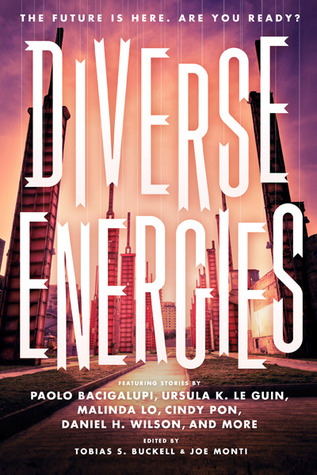
Review: Diverse Energies edited by Tobias Bucknell and Joe Monti

Tags: science fiction, fantasy, dystopian, POC, short story anthology

Summary

“No one can doubt that the wave of the future is not the conquest of the world by a single dogmatic creed but the liberation of the diverse energies of free nations and free men. No one can doubt that cooperation in the pursuit of knowledge must lead to freedom of the mind and freedom of the soul.” —President John F. Kennedy, from a speech at University of California, March 23, 1962

 In a world gone wrong, heroes and villains are not always easy to distinguish and every individual has the ability to contribute something powerful. In this stunning collection of original and rediscovered stories of tragedy and hope, the stars are a diverse group of students, street kids, good girls, kidnappers, and child laborers pitted against their environments, their governments, differing cultures, and sometimes one another as they seek answers in their dystopian worlds. Take a journey through time from a nuclear nightmare of the past to society’s far future beyond Earth with these eleven stories by masters of speculative fiction. Includes stories by Paolo Bacigalupi, Ursula K. Le Guin, Malinda Lo, Cindy Pon, Daniel H. Wilson, and more. [summary from Goodreads]

Review

DIVERSE ENERGIES is like a Halloween trick-or-treat bag: you get some real good ‘uns, but you also get some duds that you always kind of throw back into the bag and hope that you don’t pull out again in your next swipe. It’s definitely a worthwhile read for those interested in the intersection of SFF with POC (hah, so many acronyms), particularly if you enjoy or don’t mind short stories. However, I’m not sure it had the comprehensive punch required for it to break out of its niche for the time being.

Here are some thoughts for most (though unfortunately not all) the short stories:

“Last Day” by Ellen Oh - I felt like this story didn't add anything new to the category of "tales about Japanese people in wartime." The "shocking reveal" towards the end was too sudden to actually move me. 3/5

"Freshee's Frogurt" by Daniel Wilson - Rebellious, murderous robots! Quick, intense, eerily believable. 4/5

"Uncertainty Principle" by K. Tempest Bradford - Attention-holding storytelling. The science aspect felt a little underexplained, though. 4/5

"Pattern Recognition" by Ken Liu – So that’s how one can write about modern China's characteristics. The timeline jumped around a little too abruptly for me, but I felt the idea of this was quite realistic. 3.5/5

"Gods of Dimming Light" by Greg van Eekhout - Bad. Ass. Viking legends? Genomics? Short and fast, but fun! 3.5/5

"Next Door" by Rahul Kanakia - I liked the characters and the world but the pacing was uneven, especially towards the end, when it felt like things rushed to a premature conclusion. 3/5

"Good Girl" by Malinda Lo - Good, controlled balance between emotion, plot, and world-building. Little actually happened and questions were left unanswered at the end, but in a way that felt natural to the MC's understanding of things. 4/5

"A Pocket Full of Dharma" by Paolo Bacigalupi - Great worldbuilding; recognized a lot of elements of the modern China I know in here. The concept of having a person's consciousness in a datacube was fascinating, and the villains were scary. 4/5

"Blue Skies" by Cindy Pon - It's cool to read about a future version of Taipei. Unfortunately, the kidnapping plot felt a bit contrived, which lessened the impact the story's setup could've had for me. 3/5

"What Arms to Hold" by Rajan Khanna - Really wished the story had been slightly more specific as to its setting. 'Twas okay, but forgettable. 3.5/5

"Solitude" by Ursula K. LeGuin – This is the best of the bunch, even though it’s a reprint. But I’m glad the editors decided to include this, because I don’t know if I would’ve heard of this short story otherwise, and it’s brilliant. This is spot-on, a chilling yet fully understandable depiction of communication problems ("CP") between different cultures. 5/5

Cover discussion: I kinda like how the cover doesn't attempt to do anything fancy in terms of designs or symbolic representations of the future, and just lets the focus be simply on the title and the names of authors.

Tu Books / Oct. 1, 2012 / Hardcover / 368pp. / $19.95

e-galley received for review from publisher and NetGalley.

Thursday, February 28, 2013

Review: The Brides of Rollrock Island by Margo Lanagan

Tags: YA, magical realism, selkies, families

Summary

Review

When you read a Margo Lanagan book, you expect it to both confuse and enthrall you. And THE BRIDES OF ROLLROCK ISLAND delivers that head-spinning, gut-churning, fizzy-brained mixture of “what in the world is going on?” and “did she really go there?” and “oh my goodness she is a genius.”

You can read THE BRIDES OF ROLLROCK ISLAND as a nontraditionally narrated snapshot of an island’s history, with no straightforward plot and no answers to what’s right or what’s wrong in this world. That’ll either confuse the hell out of you, or you will be delighted at the amount of space Lanagan allows readers to bring in their own values and interests to the story. Those who want to find a depiction of the complex meanings of domestic loyalty get that. Or you can also read it for its marvelous craft, its characterization and worldbuilding. It’s a story that gives no clear answers, and is all the more special because of that.

Much like Thisby Island of The Scorpio Races, Rollrock Island feels like an entity of its own. Lanagan skillfully weaves a picture of an island suffocated by yet dependent on its claustrophobic living conditions, neighbors knowing one another’s businesses and knowing who marries who and who’s doing what with who else’s woman. I find stories contained in a small area, where each inhabitant must be developed with his or her unique idiosyncrasies, so much more interesting and realistic than plain-Jane YAs set in Anywheretown, America. The people and the island setting force one another to reveal their imperfect, weird aliveness.

For those who appreciate great writing and are tired of the repetitious plots and characters that appear in so much YA, THE BRIDES OF ROLLROCK ISLAND will renew your faith in the magic of writing.

Similar Authors
Maggie Stiefvater

Knopf Books / Sept. 11, 2012/ Hardcover / 320pp. / $17.99

e-galley received from NetGalley and publisher.

Monday, October 1, 2012

Review: Ironskin by Tina Connolly

Ironskin, Book 1

Tags: steampunk fantasy, fairies, retelling

Summary

Jane Eliot is an Ironskin: she wears an iron mask to cover the fey scar on her cheek, a physical remnant of the recent Great War between fey and humans, in order to prevent her curse from affecting others. Jane takes a job as governess/nanny to the unusual fey-touched child of the artist Edward Rochart. But Rochart is no ordinary artist, for the rich women he lets into his studio come out looking stunningly, inhumanly beautiful.

Jane wants nothing more than to have a normal, unscarred face. But, as she gets more and more entangled in Rochart’s doings, she must learn to see the gift that the fey curse has also given her…especially in the face of an ominous adversity.

Review

IRONSKIN took an…interesting approach to retelling Jane Eyre with fantastical elements. Inconsistent with everything from its plot to its characterization, IRONSKIN will probably be a temporarily intriguing but ultimately forgettable entry in the category of classic retellings.

Readers who love Jane Eyre will probably find fewer things objectionable in IRONSKIN. I, however, was never a fan of the bland heroine, brooding, self-deprecating hero, and the melodramatic secrets unveiled at the end of the story. IRONSKIN actually does quite a good job of sticking to the original and necessary elements of JE. Mr. Rochart channels all of Edward Rochester’s self-deprecating comments and tortured moodiness. Which, you know, if you like that sort of self-pitying thing is all well and good. The setting of the house and the mysterious woods and moor surrounding it are played up and given dark life of their own. Surface-wise, things look good for IRONSKIN to be a great, loyal retelling.

It’s when the fantastical elements are added in that IRONSKIN loses some of its credibility with me. The tricky thing about retellings is that the progression of the characters’ decisions and actions has to make sense independent of the story it’s retelling. This is why superficial retellings of Pride and Prejudice have always bothered me: one can’t just “conveniently” bring up the existence of an impending high school “ball” in order to bring the separated lovers back together, or have one if the characters arbitrarily do something inconsistent to his or her character, just to set them back onto the path of the original story. IRONSKIN suffers from this in some regard too: little happens in the first half of the book besides for Jane struggling to teach Dorie and having cryptic encounters with the moody Mr. Rochart, which means that the book had to make lots of dramatic events happen in order to bring everything to its proper, dramatic conclusion in time. The pacing was clumsy, which resulted in some of the characters’ decisions feeling contrived for the sake of sticking to the original. It really took me out of the story, the constant awareness that IRONSKIN was adhering to the plot of Jane Eyre at its every twist and turn, and kind of smushed the original JE elements and new steampunk fantasy elements together when necessary.

I realize that I talked about a lot of my critiques of this book in my review, but really, IRONSKIN wasn’t a bad read…except for that I was a bit confused about some messages regarding beauty and “normalcy” that this book seemed to be sending. The trajectory of characters’ outcomes seems to suggest that it’s okay for women to base their worth upon their physical looks. Or something. I don’t know. I couldn’t quite put my finger on the implications. IRONSKIN was an interesting steampunk fantasy take on Jane Eyre, but I think I won’t be picking up the next book, because I felt myself skimming, my eyes wandering, too often for me to feel emotionally connected enough to the characters and their story.

Similar Authors
Daphne du Maurier
April Lindner
Charlotte Bronte

Cover discussion: Stunning, stunning, all those metallic shades of gray and blue and swirlies. I can kind of see Jane being like the cover model, too.

Tor Books / Oct. 2, 2012 / Hardcover / 304pp. / $24.99

e-galley received for review from publisher and NetGalley.

Tuesday, September 25, 2012

Review: Shadowfell by Juliet Marillier

Shadowfell, Book 1

Tags: YA, fantasy, romance, fairies

Summary

On the run from the dreaded Enforcers of the king of Alban’s terrifying rule, 16-year-old Neryn has no one left. Her only option is to travel north to a place called Shadowfell, where rebellion against King Keldec is rumored to be brewing. Shadowfell may be the only place Neryn can be safe…for she holds a rare, magical talent that the king is determined to destroy…or, even worse, possess.

Review

I write this review from the point of view of a Juliet Marillier fan who, shamefully, has only read a handful of her books (so far!). SHADOWFELL, the first book in her new YA fantasy series, may not be as canonical as some of her other works, but it is still a solidly good fantasy read that will please fantasy and non-fantasy readers alike.

SHADOWFELL’s strengths lie, strangely enough, in its great use of common fantasy tropes. Say what? But you hate tropes, Steph! Yeah, well, sometimes you just need a story in your favorite genre with a bit of feel-good predictability. SHADOWFELL does that primarily with its straightforward quest plot, angelic heroine, and simmering romance.

The primary thing that Neryn does in this story is walk…all the way…to her destination. Rather than be bored, however, I was fully engrossed in the many adventures she encountered along the way: the people she talked to, the Folk she befriended, the constant tense threat of encroaching Enforcers. Marillier doesn’t spend too much prose describing the landscape of Alban, but you know enough to envision Neryn traversing dark forests thick with thousand-year-old trees, bleak rocky landscapes, and mountain ridges with the sharp autumn wind conspiring to push her off the edge of the world. Neryn may only do one thing throughout SHADOWFELL, but the story purrs along in that smooth, pleasant way of good rides.

Neryn is a sympathetic heroine, despite her being almost too good to be true. As she unwittingly completes more and more of the “tests” that determine her (ahem) calling, she maintains a sort of golden-heartedness that seems only to exist in literature. Neryn follows her late grandmother’s mantra of “You always have something to give others” so carefully that some readers might be prone to rolling their eyes. Nevertheless, she makes for the perfect protagonist for a quest plot, as she encounters, and overcomes, a number of scenarios and obstacles.

Last—but certainly not least—we have what probably makes all of Marillier’s fantasies stand out the most: the romance. Huzzah, no insta-luv! Flint and Neryn’s attraction develops almost painfully slowly. Neither one of them had an upbringing that endears them to easily trusting others. Perhaps the thing I appreciated most in SHADOWFELL was how we readers, alongside Neryn, never knew whether or not we could trust Flint. That man sure walks the line between two sides so talently. The uncertainty of Flint’s loyalty adds a refreshing uncertainty to this literary romance.

SHADOWFELL probably doesn’t break any new grounds in fantasy, but it’s the sort of story that could’ve easily gone wrong at the hands of a less talented author. Marillier fans, this book may not be your new Marillier favorite, but it is worth your time. And as SHADOWFELL’s voice runs a little younger, this may be the perfect book to give to young readers who have received devoured all of Tamora Pierce’s books and are begging for more.

Similar Authors
Maria V. Snyder
Sherwood Smith
Tamora Pierce

Cover discussion: I am underwhelmed by this cover. The eye skips off it; there is nothing to hold one's attention.

Knopf / Sept. 11, 2012 / Hardcover / 416pp. / $16.99

e-galley received for review from publisher and NetGalley. Thank you!

Monday, September 17, 2012

Review: Stormdancer by Jay Kristoff

The Lotus War, Book 1

Tags: steampunk fantasy, Japanese, griffins, rebellion

Summary

Ruthless Yoritomo, latest in a long line of shoguns of the Kazumitsu Dynasty, rules the Shima Isles with a tight fist. Every day, more and more precious land is used to grow the blood lotus flower, which poisons the land, turns the sky red, and makes the air hard to breathe.

When Yoritomo orders Yukiko and her hunter father to find and capture the mythical thunder tiger for his personal enjoyment, she fears this will be their end. After all, how can they capture something that hasn’t been seen in a hundred years? But seeking the thunder tiger is only the beginning of Yukiko’s amazing journey, one that may influence the entire course of Shima’s totalitarian future…

Review

I’m scared to write my review for this book. I never like writing reviews for the ones that blew me away. How can I do the author’s words any justice with my words? Couldn’t you just install some sort of webcam in my eyes and brain and witness for yourself the emotions and amazement I felt as I read STORMDANCER?

Don’t just this book by its first few chapters. Because STORMDANCER is set in such a different fantasy world than ones we’re used to reading about—one in which there is so much Japanese influence that the details are nearly debilitatingly overwhelming—it requires a lengthy and unwieldy exposition to get you into the feel of things. So much detail is given to descriptions of clothing, hairstyles, city layouts, machinery, and more that the story is nearly drowned in it all.

Is all this description necessary? It’s hard to say. Did I appreciate Kristoff’s attention to detail in the exposition later as the plot picked up? 100 percent. Kristoff picked the difficult task of setting STORMDANCER in a world that not only drew from the complex and fascinating culture of Japan but is also complete in its own steampunkish way. With all the details laid down as they were, and with Kristoff’s naturally cinematic writing, it felt like I was reading this story in high-definition, watching every character’s actions, every one of their subtle tics, on a big, flawless screen.

Cinematic and soaring as STORMDANCER can be, it is also one of the most human books I have read in a while. The characters in STORMDANCER exist in a world where to let down their guard is to court death, and thus we can only see one side of them. Yet Kristoff gives us smatterings of glimpses that hint at more to them than what they show the world: a stiff gesture from Lady Aisha, a too-long pause in Hideo’s words. How much more realistic can it get than these smallest of details, often overlooked except for when someone astute spots them and knows how much meaning they can convey?

Rather than burdening readers with a plethora of meaningless details, STORMDANCER gets us to care for the characters and their predicaments, so that all that we know about them we find valuable. And nowhere does this quality of STORMDANCER show itself more clearly than in the relationship that develops between Yukiko and Buruu. Appropriately wary of each other at the beginning, the two grow to form a human-creature bond that will rival the most famous of such bonds in literature. From a mindless creature who can barely speak in one-word phrases, Buruu becomes the greatly welcome comic relief in this book, delivering laugh-out-loud one-line observations that counterbalance STORMDANCER’s intense nature.

For, for all its fantastical imaginings, STORMDANCER is a deeply serious book with a message for humanity that is never more relevant than it is now. The Shima Isles, practically brainwashed by the Lotus Guild and ruled by the ruthless and corrupt Kazumitsu Dynasty, reflects the steampunk path our own world can take if we don’t act now to save the Earth from greed at the cost of our environment and self-gain at the cost of stagnant or declining living conditions for the general society. This is not a message that Kristoff directs only to a certain country or culture; this is one that applies for everyone. So read this. And heed it.

Is STORMDANCER for everyone? No. The first several chapters will catch those who are less patient with worldbuilding. Others might focus on the action and plot and miss the relevant message altogether. But I think that STORMDANCER has the potential to make a difference. And I want to be a part of it by spreading the word.

Similar Authors
Christopher Paolini
Robin McKinley
Patrick Rothfuss

Cover discussion: Hands-down one of my favorite covers of 2012. Because it's self-explanatory.

Thomas Dunne Books / Sept. 18, 2012 / Hardcover / 336pp. / $24.99

Requested and received for review from publisher. Thank you so much!

Monday, September 3, 2012

Review: The Wise Man's Fear by Patrick Rothfuss

The Kingkiller Chronicle, Book 2
(Book 1: The Name of the Wind review)

Tags: fantasy, magic

Summary

As the morning of the second day dawns on Waystone Inn, Kvothe continues to recount his incredible life story to Chronicler and Bast. The University goes on as ever but Kvothe is beginning to realize that, in order to find the answers about the Amyr and the Chandrian that has been obsessedly searching for, he may need to leave his beloved University—nay, even leave familiar lands completely—and travel to the far-off land of Vintas, where he dabbles in court politics, robber-hunting, Fae relations, and more.

Review

Those who loved The Name of the Wind will not be disappointed: THE WISE MAN’S FEAR is as meticulously plotted and beautifully written as the first. Which means that you should just read my review of The Name of the Wind for all the reasons why you should read this series, and in this review I will talk instead about some of the things I found, well, a little lacking.

I found myself making a Star Wars comparison as I closed the cover to THE WISE MAN’S FEAR. Specifically, that this book served all the purpose of Episode 2: Attack of the Clones: it was exciting and adventurous, but hardly answered any of our questions from the first story. In THE WISE MAN’S FEAR, Kvothe pretty much remains the same and does exactly the same sorts of things he did in the first book: he verbally spars elegantly with his superiors, gets into nearly impossible situations and gets himself out or through by dint of his cleverness, and on and on. Oh, and in THE WISE MAN’S FEAR Kvothe adds to his overflowing litany of good qualities some mad skillz in the sack. Kvothe is this perfect hero who experiences no growth throughout books one and two, and it’s finally begun to grate a little on my nerves.

Kvothe goes on his adventure under the pretext of learning more about the Amyr and the Chandrian, but narratively speaking, that seems like just an excuse for him to get into increasingly unbelievable mini-adventures, none of which seem to aid him on his ultimate quest of avenging his parents’ death. Which is why I made the Star Wars comparison: I’d be curious to find out if, at the end of the series, his side journeys into Vintas and beyond are actually essential parts of his path to the Chandrian.

For the most part, Patrick Rothfuss characterizes beautifully: supporting characters such as Simmon, Wil, and Vashet stole my heart and demanded more page-time than they were allotted. However, I simply cannot get behind Denna as the love interest. It’s almost like Rothfuss wrote a lifetime’s worth of frustration over females into this impossibly beautiful, charmingly clever, woefully haunted woman. She represents the embodiment of unattainable female perfection, and therefore Kvothe is living out the male population’s dream by getting closer to said unattainable female perfection than anyone has before. Their dynamic is unrealistic, self-delusional, and more than a bit annoying. (Don’t get love lessons from Kvothe: you don’t win over your perfect partner by never giving them any indication that you like them as more than friend, because you’re scared that they don’t like you back in the same way. This leads to unhealthy cases of unrequited love, in which you can’t move on in your life.)

With all that’s been said, however, I will still devotedly read the third and last book in the series when it comes out. Fans will appreciate this installment that’s chock-full of Kvothe’s diversionary adventures, but boy, I hope questions will actually be answered in the next book!

DAW Trade / March 6, 2012 (reprint) / Paperback / 1008pp. / $19.00

Personal copy.

Friday, August 10, 2012

Review: Jonathan Strange and Mr. Norrell by Susanna Clarke

Tags: fantasy, historical fantasy, magic, Regency England

Summary

At the turn of the 19th century, it seems like no magic remains in England. But then a practicing magician named Mr. Norrell turns England upside-down when he performs the first bit of magic in England in several centuries, and immediately shoots his way up the social ladder. Norrell wants to use magic to do England good, but he’s particular about how to regulate magic—which is why the sudden appearance of a second English magician, the charismatic Jonathan Strange, rocks Norrell to his core.

Whereas Norrell’s squirrelly looks and socially awkward demeanor are a disappointment as the face of magic, Strange’s carriage and behavior earn him the goodwill of a fair number of Englishmen. Yet even as tensions between Norrell and Strange continue to develop, a long-simmering magic plot to take over England keeps threatening to come to light.

Review

Widely regarded as one of the best works of the modern fantasy canon, JONATHAN STRANGE AND MR. NORRELL was a book I’ve been meaning to read for a while. And while every one of these 1000 or so pages is evidence of literary brilliance, it wasn’t something I was fully emotionally invested in. Still, though, I’m glad I finally read it.

Susanna Clarke takes the subgenre “Regency fantasy” to a whole new level with her superb command of that time period’s language. Think Austen with a heavy dose of magical elements: not only was the language reminiscent of Regency England times, but Austen’s almost insidious portrayal of ridiculous people had a heavy showing in JONATHAN STRANGE AND MR. NORRELL. While Strange and Norrell are arguably the main characters of the eponymous novel, we readers don’t really like them the way we usually do protagonists, because most of them are not good people: Norrell in particular manipulate nearly everyone out of fear of a loss of influence, meanwhile letting his even-less-appealing “friends” manipulate him in turn. All the unsavory characters in the book make Jonathan Strange look very good indeed, but he’s no real “wounded hero,” just another self-centered guy who does not give enough consideration to others in his life.

That, I guess, is what ultimately disappointed me about this book: it doesn’t break any conventions or tread new ground in terms of genre or sociohistorical issues. Clarke crafts an alternate, magician-focused history for England, but, with the exception of head-scratchingly long footnotes showing just how in-depth Clarke has got with her alternate history creativity, JONATHAN STRANGE AND MR. NORRELL didn’t blow me out of the water with originality in its fantasy genre.

Additionally—and this may just be me—I found it a bit off-putting how small a role women played in the novel. For a book written by a female author, I had expected a bit more subversion of historical attitudes toward the role of males vs. females in society; yes, the book doesn’t attempt to focus on the inequality and tensions between different parties, but I was surprised that the book didn’t take such a step with potentially strong and interesting female characters such as Arabella Strange and Mrs. Pole. No, at the end of the day, things and people seemed to be pretty much what they had been before the book started, which results in reader’s confusion along the lines of, “I just spent three weeks reading 1000 pages…and did anything significant really happen?” Hrmph.

So, in some ways, reading JONATHAN STRANGE AND MR. NORRELL was for me like reading a classic that the “great authorities of literature” say is a must-read but on a personal level was a slog to get through. While I certainly appreciated Clarke’s Austenian writing style, I closed the book realizing that 500 pages could’ve been cut out and I would have thought nothing was amiss.

Cover discussion: Win! Straightforward. Iconic. Recognizable.

Tor Books / Aug. 1, 2006 (reprint) / Mass Market Paperback / 1024pp. / $9.99

Personal copy.

Monday, July 30, 2012

Review: The Scorpio Races by Maggie Stiefvater

Tags: YA, fantasy

Summary

Once a year on the island of Thisby, tourists from all over the world come to watch the Scorpio Races, where locals participate in a race on capaill uisce, mysterious and dangerous horses from the sea that will hardly hesitate to attack and kill human beings. The reigning champion, 19-year-old Sean Kendrick, has been racing for years, but this year there’s more on the line for him: his freedom, and access to his beloved capaill uisce. On the other hand, Puck Connelly is about to be both the first female participant in the race, and the first to race on a regular horse, for the sake of her family and house. Lots are on the line, but as everyone knows, Thisby and the Scorpio Races don’t make things come easily.

Review

This book is everything that people have said it is and more. There is not a single part of this book that’s weak; everything is crushingly beautiful and rarely matched.

Maggie Stiefvater was never a shabby writer, but in THE SCORPIO RACES, her way with language combined with a lingering emotional resonance that I hadn’t quite fully experienced in her books until now. THE SCORPIO RACES is deliberately set neither here nor there, now nor then, with the result that it carries a timeless and universal feel. Broken into multiple small parts, it would be hard to pinpoint exactly what makes this book work so well—so I won’t. All I know is that somehow, Puck’s near-desperate spirit; Sean’s otherworldly skills with the capaill uisce and his unenviable conflicts; and the magical, addicting, dangerous, and mysterious island of Thisby all combine together for a book that’s to be loved and indulged in like a bar of the highest quality chocolate: slowly, lovingly, and satisfactorily with each bite.

THE SCORPIO RACES proves to us all that great books don’t have to come in series or trilogies. Oh, how I can’t wait to read this one again.

Similar Authors
Melina Marchetta (Jellicoe Road)
Franny Billingsley (Chime)

Cover discussion: Probably one of my favorite covers of 2011, effortlessly combining streamlined simplicity with rich texture.

Scholastic Press / Oct. 18, 2011 / Hardcover / 416pp. / $17.99

Personal copy.

Thursday, July 26, 2012

Review: The Queen of Attolia by Megan Whalen Turner

The Queen's Thief, Book 2
(Book 1: The Thief review)

Tags: YA, fantasy, politics, war

Perhaps because I found The Thief so fun and heartfelt, and was enthralled by numerous others’ lavish praises on the sequels, that I had extremely high expectations for THE QUEEN OF ATTOLIA. It pains me to say that I didn’t like THE QUEEN OF ATTOLIA as much as I did The Thief, but it’s still a good read in fantasy literature that will appeal across age ranges.

THE QUEEN OF ATTOLIA is altogether different from The Thief. It’s told in third-person instead of first. Eugenides seems older; the events and the premise of this book are a lot darker, dipping into the disturbing at times. THE QUEEN OF ATTOLIA focuses a lot on the political tensions between the kingdoms, to the point where long sections of the book are dedicated entirely to dry accounts of political and military events. While I go gaga for books that are smart, yet interesting to read, I couldn’t help but feel that all that information could have been presented to readers in a more engaging way.

Maybe this decision to report war news in such a dry way was a deliberate decision on Turner’s part. In any case, it also affected by connections I had with the characters. Which is to say, I felt that the characters saw me, but instead of coming over to chat, decided to head to another room on the other side of the soundproof glass, where they continued to be aloof and secretive and unfriendly. Not quite how I wish to interact with characters.

As for the romance…eh. Well. It’s not as if there weren’t hints as to what would happen, and the turning point was kind of cute in a romantic-movie-swoon kind of way, but the characters’ aloofness throughout the story up to that point took away from the impact of that scene, at least for me. I hope they’ll be good for one another, even though I can’t quite see how that will happen from the rest of the book, but hey, it would go beyond my realm as reviewer to question the decisions of the characters and author, so I’ll just leave them to do their thing.

THE QUEEN OF ATTOLIA didn’t sweep me off my feet as The Thief did, but perhaps I was in the wrong mindset when I read this book (ten years too late, perhaps?). I’ll still continue with the series, though, since it’s gotten so many rave reviews from every reviewer I respect. Perhaps, however, by toning down my expectations, I will get more out of my reading experiences.

Cover discussion: I love all of the covers in this series. They're very distinctly related to one another, and have just the right touch of glamor to hint of court intrigues.

Greenwillow Books / Jan. 24, 2006 (reprint) / Paperback / 368pp. / $6.99

Personal copy.

Tuesday, July 24, 2012

Review: Among Others by Jo Walton

Tags: epistolary, historical fiction, fairies, reading

Summary

Following a tragedy that killed her twin sister, Morwenna Phelps leaves her childhood home of Wales, the fairies she “befriended there,” and her mad mother in order to meet her father’s family and attend a boarding school in England. England is unfamiliar and unfriendly, and Mori finds refuge in her voracious science fiction-reading appetite. But even as she slowly connects with her long-absent father, explores the libraries and bookstores available to her, and finds friends with whom she has a love of SF in common, Mori still struggles to escape her mother’s ever-encroaching magical madness…

Review

You don’t need to be an SF fan—or know much at all about SF history, really—to love Mori and AMONG OTHERS. This is a book that everyone who has been or is still a bookworm can relate to and delight in.

Mori represents the kind of bookish teenager you want to be, your best friend to be, your teenage daughter to be. She drinks up books like water and then writes about them in her journal—not in-depth academic analyses, but the kind of meandering way that most bookworms do naturally. I admit to knowing hopelessly little about SF, but I could definitely relate to Mori’s somewhat scattered comments on the books she’s finished. She’s not trying to write a SF novel or be a SF expert; she’s just enjoying herself wholeheartedly as an avid reader, and you can’t help but love that.

Due to its diary format, AMONG OTHERS is filled with bits and pieces of the sort of things that teenage girls wonder about: sex, their sexuality, people they meet, their future. It makes the book so genuine that there is no one primary plotline. Because it’s like life in that way: we have many interests and thoughts and curiosities, and they all make up a part of who we are.

I loved the bookish aspect of AMONG OTHERS so much that I was rather put off by its fantastical element, which I felt was almost unnecessary. The main plot, if you must name one, is Mori’s relationship with fairies and her crazy mother. I have no problem with how fairies work in Mori’s world: like other things that Mori writes about, the fairies are just a part of her life, just a part of her. But I do feel like the magical aspect was not the driving force of this novel, and so, in making it a significant part of the ending, I felt…unsatisfied.

AMONG OTHERS is classified as fantasy, and Mori loves SF, but it doesn’t mean that SFF fans should be its only readers—nor, perhaps, its most significant. AMONG OTHERS is, in my opinion, above all other plotlines, a love letter to books as salvation, and so if ever you love books, you should check this one out.

Similar Authors
Dodie Smith (I Capture the Castle)

Cover discussion: Oh, I love, in a gentle sort of way. I like how it defies any genre conventions and you can read whatever you want into it.

Tor Books / Jan. 3, 2012 / Paperback / 304pp. / $14.99

Personal copy.

Thursday, July 19, 2012

Review: The Hedgewitch Queen by Lilith Saintcrow

Romances of Arquitaine, Book 1

Tags: YA, fantasy

Summary

Orphaned Vianne de Rocancheil serves as lady-in-waiting and confidante to the princess at the royal court of Arquitaine. But when a treacherous act destroys the court, Vianne is forced to team up with the Tristan d'Arcenne, the mysterious Captain of the Guard. For Vianne possesses something the traitors need in order to properly take the throne, and for the sake of her slain friends, Vianne will do anything to protect it.

Review

I really wanted this to be the next Crown Duel, in terms of story style, characters, romance, and fantasy world. And on the surface, THE HEDGEWITCH QUEEN certainly seems promising in all those fields: Vianne is a humble minor noble lady who gets tangled up in the political court intrigue of a magical world that takes its inspiration heavily from a bastardized version of France and the French language. There's the strong and silent love interest who believes in the heroine long before she believes in herself. Doesn't that just remind you of Crown Duel and all that goodness?

Alas, the similarities end there. Vianne is no Meliara. I didn't get far into the story before Vianne was tripping over herself in an effort to prove herself to be the most tearful, pathetic, and un-self-confident female in all of Bastardized France. Vianne suffers from that literary syndrome I suppose I shall have to give a name to from here on out: the Anti-Histrionic Female Character Syndrome, in which the female MC goes out of her way to convince readers that she is worthless, plain, boring, uninteresting, by virtue of her lowly status, ordinary looks, absolute lack of character, (lack of intelligence), etc. Far from gaining my readerly sympathies, these females simply goad my ire. For this syndrome is wish fulfillment; it's trying to say that females don't have to actively improve themselves mentally, intellectually, or emotionally--because, of course, the hot guy loves them just the passive and pathetic way they are!

The way in which Vianne and Tristan d'Arcenne interacted simply made me feel tired. Everything they said to each other was riddled with misunderstandings--misunderstandings that didn't seem to be necessary to the main plot but rather only served to further the romantic intrigue. What's so romantic or intriguing about constant misunderstandings brought about by Vianne's lack of self-confidence, may I ask? Yeah... that's what I thought.

In the end, my lack of feelings for either of the main characters led to this being a DNF for me. I give Lilith Saintcrow props for trying, but the blandness and patheticness of the main characters could not hold my attention for the duration of the story.

Cover discussion: That model is so not Vianne, but maaaan, I am foolishly attracted to that dress, the title font, and that emblem thingy. And, oh, hey, doesn't this cover look very similar to this one?

Orbit / Dec. 1, 2011 / e-book / 360pp. / $2.99

e-galley received for review from NetGalley and publisher.

Monday, July 9, 2012

Review: Seraphina by Rachel Hartman

Tags: YA, fantasy, dragons, music

Summary

The fortieth anniversary of an uneasy peace treaty between humans and dragons is approaching, and tensions are high as the kingdom of Goredd prepares for the arrival of the dragon leader. Even in their human shape, the dragons stand out in court, and the humans find it difficult to treat them with ease and respect.

In the midst of the racketed tensions, newly appointed court music master’s assistant Seraphina Dombegh struggles to main aloof in order to hide her terrible secret: she is half dragon, and if anyone found out. But it gets harder and harder for Seraphina to stay apathetic as she gets to know the royal family and discovers a shocking personal connection to a long-brewing plot to destroy the peace treaty.

Review

High fantasy is my favorite genre, but it doesn’t mean that I’m an easy customer. It takes a lot for a fantasy to become a favorite of mine: in addition to nearly impeccable world-building, it also has to have empathic characters and enough action to satisfy the baser part of me. I had heard positive things about SERAPHINA before I was finally able to read it, but rave reviews often make me wary, worried that the book will never live up to the reviews’ promises. Happily, for me and the whole world, SERAPHINA is worthy of its high praise. Rachel Hartman writes with a sureness of hand and mind that sweeps readers into Seraphina’s complex and fascinating world.

In SERAPHINA, dragons and humans have made an uneasy peace treaty, but the social tensions are still apparent and painfully recognizable in its similarities to the prejudices that minority groups in our world still suffer. I love that “real” aspect of the book, and feel that the countless instances of anti-dragon sentiment in SERAPHINA are authentic as a result.

The social tensions aren’t the only thing that make SERAPHINA’s world-building so astounding. It’s clear that Rachel Hartman did research on her Medieval-inspired fantasy world, from the clothing to the instruments to the layout of court (physical and human). If an aspiring cable TV channel *cough HBO and Game of Thrones crew cough* were to consider adapting this story, they would have plenty to go off of.

Splendid world-building by itself isn’t enough to get me to love a fantasy, and that’s where SERAPHINA’s wonderful characters come in. Seraphina, Seraphina, you amazing protagonist. You’ve had such a rough life and it in no way is going to get easier after the events of this book, and yet you handle it with an aplomb that those twice your age cannot often claim as their own. Seraphina’s personality is the direct product of her difficult and isolated childhood, but it does not weigh her or the story down. The girl is resilient, ethical, intelligent, and determined…and she is not the only awesome character. Supporting characters are allowed a full range of thoughts and reactions, so that where we think we’ll find potentially stereotypical character roles—in the spoiled princess, or the love triangle—we instead find refreshment.

Debut authors like Rachel Hartman show me that literary talent is not in danger of being swamped by the mediocre hype-fueled masses. Hartman has the detail-oriented skills to be a fixture in the fantasy genre, and the understanding of human beings and society to make her mark in any other genre she’s interested in dabbling in. SERAPHINA was a heck of a debut, one that I sincerely hope marks the very beginning of a long and beautiful writing career.

Similar Authors
Juliet Marillier
Rachel Neumeier
Rae Carson
Zoe Marriott
Kristin Cashore
Melina Marchetta

Cover discussion: I swoon, I swoon. It's so unique and detailed and eye-catching and breathtaking and appropriate.

Random House / July 10, 2012 / Hardcover / 480pp. / $17.99

e-galley received for review from the publisher and NetGalley. Thank youuu.

Thursday, May 17, 2012

Review: Ordinary Magic by Caitlen Rubino-Bradway

Tags: middle grade, fantasy, family, magic

Summary

On Abby Hale’s twelfth birthday, she tests as an “Ord”—a person who has no magical abilities at all. In Abby’s world, to be without magic is almost unheard of, and Abby’s newfound status as an Ord makes life quite difficult for her and her family.

Fortunately, Abby hears about a school for Ords like hers. At school, she continues her general education but also learns how to survive in the world of magic as an Ord. King Stephen’s recent proclamations offer more protection for Ords, but there are always people who prize Ords’ imperviousness to magic, and would do practically anything to get their hands on an Ord…

Review

Oh, oh, oh, oh, oh. “Charming” doesn’t even begin to cover the magical delight that is ORDINARY MAGIC. From a fascinating magical world to laugh-out-loud character interactions, there is nothing ordinary about this book at all!

ORDINARY MAGIC is as good as a Pixar movie in terms of having both kid and adult appeal. Young readers will be fascinated by the colorful, yet familiar, world that Rubino-Bradway creates, replete with magic carpets, boarding schools, and kickass family members.

What makes ORDINARY MAGIC truly extraordinary, however, is its rare quality of appealing to a wide age range of readers. The story zips back and forth with witty banter, and it is the more experienced reader that will be delighted with how Rubino-Bradway mashes together so many almost stereotypical features of magical worlds to create one that is unique and not at all stereotypical. There are a whole bunch of cute romantic undercurrents throughout the story that will make you squeel with suppressed glee.

Readers will surely get a heck of an experience out of ORDINARY MAGIC. This is truly one of the most memorable middle-grade novels I’ve read in recent years.

Similar Authors
Stephanie Burgis
Lindsay Eland

Cover discussion: A delightful, colorful, and approachable cover to match the book's content!

Bloomsbury / May 8, 2012 / Hardcover / 288pp. / $16.99

e-galley received from NetGalley and publisher.

Friday, May 4, 2012

Review: The Name of the Wind by Patrick Rothfuss

The Kingkiller Chronicle, Day 1

Tags: fantasy, boarding school, music

Summary

At the unassuming and immaculate inn just out of town, you’d never expect to find a contemporary legend in the quiet, red-haired, green-eyed innkeeper. But he is Kvothe, and when he finally tells his true story for the first time, it is one of love and loss, childhood inquisitiveness and hard-knock-life resilience, boarding school pranks and events that will change the course of the world. You don’t believe in magic? You’ve never heard Kvothe tell his own story.

Review

You’ve all felt it at one point or another. The desire. The craving. The urge to go to bed with a book. The new hardcover whose jacket you’ve taken off for safekeeping; falling asleep with one hand splayed over its naked, embossed cover. An old favorite, its edges worn and soft to the touch; it fits perfectly in the space beside you on your wrinkled sheets.

At around 700 pages, THE NAME OF THE WIND is the perfect shape and story to sleep with.

(At least, I assume it would be, as I read this on an e-reader.)

Even without the tangible reassurance of a physical copy, THE NAME OF THE WIND easily slid into its position as my new favorite book. Somewhere in an alternate universe, J. K. Rowling and George R. R. Martin had a literary lovechild, who somehow stowed away on a ship bound for Earth, assumed the human name of Patrick Rothfuss, and, after wandering, bard-like, through many years of higher education, discovered the secret to turning words and ideas into gold.

Remember those sleepaway camps and public library programs you attended when you were young, the ones where the performer would gather you and the other kids round the sleepy campfire or colorful hand-sewn rug? Remember how, at first, you were suspicious of this stranger with the odd hair or scruffy beard or clothing that audibly ruffled whenever he shifted positions? Remember how his voice sounded unfamiliar at first, unlike the dulcet tones of your own parents telling you bedtime stories? And then remember how, before you knew it, you were so far immersed into the story you forgot who was telling it and found yourself leaning forward, hanging on to his every mesmerizing word?

That’s kind of how THE NAME OF THE WIND was for me. The third-person beginning section was a little awkward, as I wasn’t sure how I was supposed to feel about this Kote/Kvothe character. But as Kvothe stretched out his long-unused storytelling muscles and the book eased its loving way into first-person narration, I found myself as entranced as Chronicler and Bast were, sitting in that inn and listening to the never-before-told story of a contemporary legend.

He has a sexy voice, what can I say?

I could mention some minor quibbles I had with the book, like Kvothe’s unfortunate near-“perfect-ness,” or how Denna skirts the edge of geeky-adolescent-boy’s MPDG wet dream, but it totally and completely doesn’t even matter because don’t you know that the greatest artists can break all the rules? THE NAME OF THE WIND is an epic novel, part memoir, part boarding school tale, part wild adventure, and I just know that Kvothe’s world is only going to expand from here in future installments. Recommended for anyone and everyone anywhere—except for maybe that hipster classmate of yours with the I-just-got-out-of-bed-no-really-I-just-did messy hair and black Free Trade coffee perpetually in hand who refuses to read anything that hasn’t won the Nobel, Pulitzer, or Man Booker Prize. But who wants to be reading buddies with them anyway?

Similar Authors
J. K. Rowling
George R. R. Martin
J. R. R. Tolkien

DAW / April 7, 2009 (reprint) / Paperback / 672pp. / $17.00

Personal copy.

LinkWithin

Related Posts Plugin for WordPress, Blogger...