Showing posts with label discussion. Show all posts

Saturday, April 20, 2013

Reading for Solace or Escape?


This weeks' events have been, objectively speaking, horrifying. Boston, the failed Senate vote for gun control, Texas, and now another earthquake in China... and these are just the events that I've heard of. Who knows how many countless other tragedies less public have occurred?

For sure, times like these are not meant to be borne alone. The blogging community is just one of the many communities each of us belongs to that can help us bear the weight of knowing how much evil or senseless wrongdoing there is in the world at times. But, being the bookworms that we are, we also know how comforting a good book can be when the world makes you want to cry.

Books serve many purposes. They can entertain. They can educate. They can comfort us and make us feel less alone by sharing with us characters who we relate to, who have gotten through the situations that we're currently struggling with with wisdom to share. And they can take us away when our lives, our emotions, our problems are a little too overwhelming for us to deal with for the moment.

Yesterday, while I continuously refreshed Reddit to check on the latest updates about the manhunt for the Boston marathon bombers, I kept one hand firmly on the comforting cover of my Kindle, glad to know that, at any time of day, there were always books for me to turn to. And that made me wonder the question that I'd love you to answer as well: In hard times, do you tend to read books for solace or for escape?

Me, I think I'm an escape kind of reader. In particular, when the world is going crazy and I need to take a break from it, I devour fantasies like no one's business. The more intricate the world-building--the more characters whose unusual names and social positions I have to remember--the better. (The Song of Ice and Fire books are great for this task.) The time I can take away from the world refreshes and energizes me for when I return to deal with it.

It's your turn now, because I'm curious. How do books help you through your tough times? Are they dispensers of advice through relatable characters and their situations, or are they a temporary refuge so that you can recharge? Does it differ according to the scenario?

Friday, March 29, 2013

On Recent Disputes and Acquisitions in the Book World

There was some gloomy news for authors and indie-lovin' readers this week. First we got wind of the Simon & Schuster / Barnes & Noble financial dispute that is causing B&N to drastically reduce their orders of S&S titles, to the point where they are no longer stocking some smaller-name authors' books. Next, I woke up this morning and learned that Amazon is acquiring Goodreads. Is nothing safe from the Great Corporation anymore?
Calvin and Hobbes explains corporate greed. Click to embiggen.
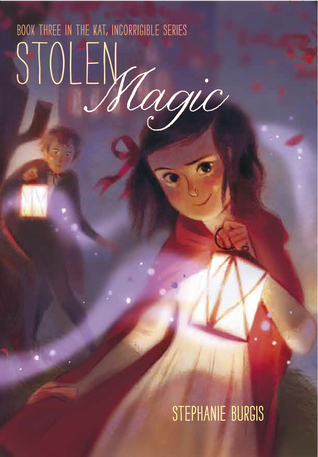
S&S author Stephanie Burgis' blog post is a heart-rending explanation of the S&S/B&N dispute and how it affects writers like her. I still recommend her MG historical fantasy series (first book: Kat, Incorrigible [US]; A Most Improper Magick [UK]) to anyone whom I think would have the slightest interest in MG historical fantasies, even though it's been almost three years since I read and loved it. I'll even admit to being randomly stalkerish: every time I find myself in the Middle Grade section of a bookstore, I inadvertently check to see if I can find her books.

By industry standards, Stephanie is a lesser-known author; by personal standards, what Stephanie writes is better than half of what I see on the shelves. Which is why it tore at me so when I read about her wrenching search of B&Ns that were still stocking her books after the dispute was made public:
For context, about half the B&Ns in the country, from what I could tell last year, stocked the paperback of Kat, Incorrigible and the hardcover of Renegade Magic. I think it might be normal to expect those numbers to go down a bit this time round, but I was hoping that at least 1/4 of the B&Ns I looked at would stock Renegade Magic.

Instead, I found...zero. Absolutely zero B&Ns, in any of the zipcode areas I looked up (and I looked up a LOT) were carrying the paperback of Renegade Magic - even stores that had always carried high stocks of the Kat, Incorrigible paperback and the Renegade Magic hardcover.
When large, profit-oriented corporations clash, it's usually the ordinary, hard-working individuals that slip through the cracks and are affected most. (No CEOs have to give up their multimillion-dollar mansions, maid service, and fancy cars as they're cajoling, threatening, or warning other companies of what will happen to them if they get in the way of profitization.) And this is sad, in the way that reading about the ordeals of homeless child soldiers in war-torn countries is sad--in a momentary, far-off, unrelatable way. But what Stephanie describes is how it affects us, our friends, our family, all the people we hope to influence with our words:
It really hurts that this has happened, through the sheer bad luck of being an author caught in the middle of a larger power struggle. My publisher will move on from this. So will B&N. But my book may have slipped through the cracks by then.

And the reason I am talking about this in public...

...is that when I walk into a bookstore, as a reader, I rarely notice the books that aren't stocked there. Maybe, if I'm looking for one book in particular, I'll be disappointed if I don't see it, but I won't really think anything of that. I'll just think, oh, well, this particular store didn't stock it.
You are an average, non-book-blogging consumer.
When you walk into a bookstore, what's going to
catch your eye? [Image from cafepress.com]
Customer Philosophy #1: The harder it is to find something, the less people are going to try to find it. If you're read this, you are probably either a book blogger or someone who appreciates book bloggers. Sadly, our numbers combined make up only a very small portion of the population: you're not going to find the majority of Veronica Roth or Cassandra Clare fans active on Goodreads or the blogosphere. Put yourself in the shoes of a non-blogger for a minute. You walk into your local bookstore. Perhaps you are a teenager forced to enter because your parents threatened to not give you car rights unless you read three books on your summer vacation; perhaps you are an adult, just popping into air-conditioned haven as a brief respite during your errand run; or you've just celebrated your tenth birthday (double digits!) and have a couple giftcards to use. You randomly browse the shelves, reading titles and summaries here and there. What's going to catch your eye? Most likely the large stacks of a single bestselling title displayed prominently in the center of the store; that, or a jacket summary that strikes a chord with you. Like Stephanie said, you are not going to notice what's not there. And if what's not there are some great books that will make you laugh and cry and want to read them over and over, the average, casual consumer is going to have no chance to even consider those books. Because he or she does not know those books even exist.

One of my favorite indies is Children's Book World in Haverford, PA. They've got the requisite displays of popular bestsellers, but they've also got beautifully colorful, lovingly stocked shelves that seem to contain exactly one copy of every single children's, middle grade, and YA book published within the last ten years. Even if I've already read most of the books I see there, I delight in the possibility that another reader can stand where I stand and find those lesser-known books that I love.
Book 3 of Stephanie Burgis' MG historical fantasy series is out on April 2 from Atheneum Books.
If you're interested in buying a copy, please consider buying from IndieBound.

The other big book-related news this week that Amazon has acquired Goodreads. I don't think that this acquisition is going to change individuals' daily actions on Goodreads (I hope not), and it seems like the main reason for the acquisition, at least according to that article, is to "Kindle integration" and to get the leg-up on Apple regarding social media. So if day-to-day Goodreads use isn't going to change, and if a convenient Kindle integration system is to be implemented (which all sounds good), how is this acquisition going to affect us? Author Kate Messner wrote a great (and much more succinct) blog post about the matter, in which she notes:
People who use GoodReads are book lovers who like to keep track of their reading and share great books with one another. And soon, they’ll be supporting Amazon whether they chose to or not.

I understand that lots of people like buying books online, and there’s nothing wrong with that. But if you like bookstores — real brick-and-mortar bookstores that smell like paper, with smiling people who know your kids — then you need to support them, or they won’t be here for long.
forbes.com
A world without brick-and-mortar bookstores? Noooooooooooo. And yet this is what Amazon is directing the market towards: transitioning all business into online-only. A wave of the mouse and the click of a button; as soon as possible, your order in your hands.

A fair number of you are probably like me in terms of my complicated relationship with Amazon: I dislike their profit-driven, community-squeezing, capitalist philosophy and actions, but invariably end up purchasing some of my stuff from them anyway. It's gotten to the point where it's hard to NOT use Amazon in some portion of our lives. So no, I'm not going to say you should avoid Amazon completely. I just think that all of us should sit down for a bit and rethink our relationship with Amazon. Is it...

...Nonexistent? Congratulations! You are a better and more self-motivated person than I am.

...Dependent? You probably have a retail problem and/or don't know about the socioeconomic effects of Amazon's Amazonian (d'oh!) dynasty on nearly everything.

...Measured? That's where I'd like to be, and hopefully you'd like to party in this category with me too. It's like a form of dieting: you don't need to cut it entirely out of your life, but you should learn to have it in moderation, and balance your intake with a variety of others.

How should we express our support for brick-and-mortar and indie bookstores while still enjoying Goodreads? I like Kate's suggestion:
Write your reviews. Log your reading and recommend your books. And end each review with a link to IndieBound....My review [of Linda Urban's THE CENTER OF EVERYTHING] ends like this now:

I support independent bookstores. You can use this link to find one near you or order THE CENTER OF EVERYTHING on IndieBound: http://www.indiebound.org/book/9780547763484
This is a great way to still use Goodreads for what you love about it while making it clear your support and valuing of indies. Nice!

Common reasons for why people are not buying indie is money: Amazon has, compared to pretty much all brick-and-mortar stores, lower price, and also that super-appealing Free Shipping option. It's hard to resist the call of perpetual discounts and free shipping. But you CAN, and you SHOULD try! Here's a semi-mathematical argument for why it's not hard to switch from buying Amazon to buying indie:

Say you want to buy five books. Recently published books on Amazon tend to be approximately 25-33% off their list price. If you pare off a book from your original five, that gets you down to within a few bucks of the Amazon price. Shipping might cost you between $4 and $10; some indies, like my other favorite, Doylestown Bookshop in Doylestown, PA, have nifty discounts like 10% off all online orders and free shipping for orders over $30.

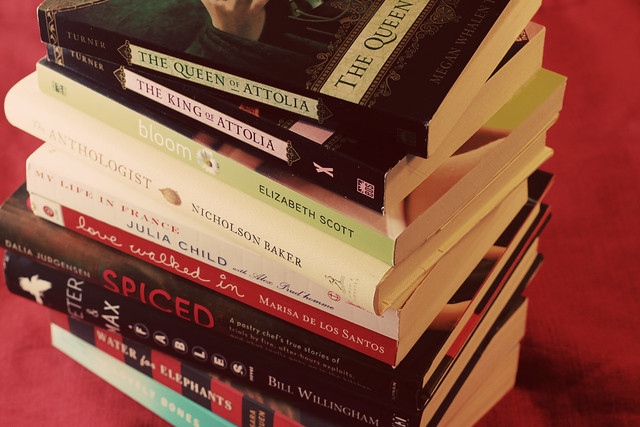
Does your TBR pile look like this or maybe even ten times worse?
If so, you probably don't need to buy that new book
as badly as you think you do.
Sure, you get one fewer book than you'd get if you bought from Amazon, but look around you: you're probably surrounded by brand-spanking-new books you bought months or even years ago when you told yourself you just couldn't live if you didn't buy that book right then. And now it's still lying there, unread, among dozens of other books in the same situation. You don't need that one book immediately; read the ones you already own, put that one on your shopping list for next time, and see if you still need that book as badly the next time you buy books. Frugal Retail Therapist advice: Before purchasing that thing you think you absolutely must have, put it back "on the shelf" for a week, thus giving you the time to think about whether or not you truly need that item ASAP.

Furthermore, when you buy from Amazon, little to none of your money goes toward your community; when you buy indie, more than 40% of what you pay goes back into that bookstore so they can stay in business and do cool things do make your bookwormy self happy, like author signing events, book clubs, etc. And, as I've said before, these community-oriented features are really what make indies so precious and worth keeping around.
Does Amazon throw you Mockingjay midnight release parties?
OR BAKE YOU TEAM HUNGER GAMES COOKIES???
To wrap up this long post: we need to be aware of these goings-on in the industry, and of how our consumerist choices affect our community. Games played by corporate bigshots may not seem to directly affect our everyday lives, but everything is connected. Support community; buy indie. You CAN do it. We're all behind you.

Tuesday, October 4, 2011

Battling Publisher Prejudice

I'm going to admit something that probably will make some people angry: I am kind of biased when it comes to deciding which books to review or read, based on their publisher. I give much more consideration to books published by the three or four biggest publishing companies, and rarely, if ever anymore, accept for review books published by smaller publishing houses or via self-publication.

I'm conflicted about this decision process of mine. On the one hand, there has to be some way for me to sort through the plethora of books that are published each year: I can't possibly read all the thousands of books published annually, and so I have to narrow my pool somehow, and the ways in which I do this may not be the fairest, or the best way. But it is a way--it is my way. And after my first year of blogging, experience taught me that the books I enjoyed the most were the ones that were published by the major publishing houses.

In a way, I think that my "sorting system" makes sense, because the major publishing houses are the ones that have the money to snap up those rare but precious high-quality books that I love: the people who work at those houses are the ones who can recognize quality (and, okay, yes, financial success as well, but since my opinion on most YA bestsellers doesn't match that of the majority, I'll just be talking about my own reading preferences here), and who are in a position where they have the luxury of being able to choose the best of the best, the cream of the crop. Naturally, whether we readers, authors, and publishers wish to admit it or not, not everyone has equal amounts of talent, and not every book is equal in quality, which is extremely subjective anyway. So the major publishing houses get first pick of the potentially critically and/or commercially successful manuscripts (unfortunately those two elements are not mutually inclusive, sigh) and have the capacity to ensure that those chosen manuscripts receive the largest readership; smaller publishing houses get to choose from the remaining pool, and so on.

On the other hand, I do still feel bad that, in a way, I am judging books by elements other than simply the quality of the story and writing, by leaving it up to the (mostly) capable hands of professionals to do the "pre-selection" for me. For the most part, this decision of mine has worked well for me. Exceptions do occur: I have enjoyed books published by smaller houses in the past, and authors have opted out of the traditional publishing track for a successful attempt at self-publication and self-promotion. However, the writer in me doesn't feel too great about the fact that I cannot give each and every author's each and every book an equal chance to be read by me, because of the basic fact that I do not have infinite amounts of time, energy, or patience; I barely even have enough energy left over after work to keep up my blog.

Nowadays, more small and independent publishing houses are coming out with their own YA imprints, but I have yet to be motivated to pick up any of their books. (I admit that one small publishing house nearly gets me with their absolutely breathtaking covers every time, but I have resisted, which turned out to be a good decision when I had a spare moment in a bookstore one day, picked up one of the house's books, and read the first chapter.) I have just found most of my experiences with independently published books to be a disappointment: those publishing houses, I think, either cater to a very specific audience, or they seek to ride the wave of YA's everchanging genre successes. Neither of which appeal to me very much. I admit that I am the worst publicist because I cannot find it in me to promote something that I don't strongly believe in--but, of course, when I do find that special and uncommon book, I will talk about it to all those whom I feel share my reading tastes, and who I want to share a good book with.

I've rambled on for long enough about a potentially divisive topic in a manner that I can't even tell is comprehendible or not. I'd love to hear what you think. Do you find yourself "biased" towards a particular publishing house, or group of publishing houses? How do you sort through all the review requests that you get, or the books available for you to read? How do you feel about smaller publishing houses, or self-publishing? If you're an author and have experience either with the major or smaller publishing houses, what insights would you like to share?

Thursday, September 1, 2011

Why New Adult Lit is the Next Cool Thing

Awesome bloggers Nic from Irresistible Reads and Linds from Bibliophile Brouhaha have teamed together to host Kirsty Eagar Week, in which a bunch of bloggers, of which I am one, are posting to promote this lovely Australian author. Check out Nic's introductory post here! I had the fortune of reading Raw Blue a while ago and it was stunning, so I'm honored to be a part of this week. My post is on older YA--or, as it has been referred to, New Adult Literature.

"Why New Adult Lit is the Next Cool Thing"

Recently I reread Anne of the Island, the third book in L. M. Montgomery's eternally lovely series. This is the book in which WONDERFULLY ROMANTIC THINGS happen because hey, guess what? Anne is old enough to go through those emotions. She finally realizes that she's actually in love with her best friend, Gilbert Blythe, and things that we were desperately waiting for three books to happen finally happen. Life is well in Anne's (and my) romantic dreams.

Anne of the Island spans Anne's college years, where she blossoms from a poised but still emotionally young 18-year-old to a 22-year-old woman with a much better understanding of her emotions. The entire Anne series is generally considered children's literature, but, age-wise, Anne in this installment fits neatly into the infant literary sub-genre some are calling "New Adult Literature."

It’s not quite an officially recognized genre just yet, always faltering in shelf placement between the YA or adult sections, but I think it’s only a matter of time before New Adult Lit takes off. Just like teens benefit emotionally, mentally, and intellectually from having their own literary genre, so can real-life young adults benefit from books that feature people their own age, who are going through what they are going through. I am a recent college graduate and distinctly feel that my reading tastes have shifted from primarily YA to…what? Thus far, there is no “other” where I feel like I belong. I want stories of growth and discovery in the college years. I want adventures of recent college graduates, stressing out over the instability of the job market or being overwhelmed by the newness of their first fulltime job. Much like how, 40 years ago, teens demanded literature that represented what life was really like for them, I want the same for my newly minted “young adult” status!

Pragmatically, new adult lit is a definite potential market. Many of the age groups we now take for granted, such as toddlers, were actually coined by companies to launch a new line of products for their new age groups as recently as 50 years ago. Why couldn’t, or shouldn’t, the same apply to book publishing? Ten years ago you would be hard-pressed to find a YA section in a bookstore. Now, a bookstore without a YA section feels almost out-of-date. As the generation of teenagers who coincided with this most recent explosion of YA literature graduate high school and enter college, what will there be for them to read? A separate bookstore section for New Adult Lit might be difficult to imagine now, but I predict that by 2020 there will be more than a handful of stores featuring a distinct shelf for a burgeoning genre nestled between YA and adult fiction.

Hopefully, within the next few years, authors will not be asked to lower the ages of their protagonists to better fit the established YA lit parameters. Publishers will take the leap and tap into the overdue potential of stories featuring college-age characters and the unique arena of freedom and fear that coexist during these years. Readers are already clamoring for stories set in college—and, as we know, the customer is always (okay: mostly, usually) right.

So why shouldn't there be a New Adult genre?


Be sure to check out the Kirsty Eagar Week schedule on Nic's blog to hear what other bloggers have to say about Kirsty, Kirsty's books, older YA lit, and more. There are also giveaways, so go go go! :)

(Oh, and also, pick up Kirsty's books if you have the opportunity. You won't be sorry.)

Friday, August 19, 2011

"How We Met": Initial Meetings Between Us and Our Favorite Books and Authors

Just like every couple has a “how we met” story, I’m sure that nearly everyone has a story for how they first “met” an influential author or book. You can sometimes tell from a review how the reviewer and the book or author “met”, but some of my favorite “encounters” happened so long ago that my reviews for those books don’t encompass the sweet initial meeting. So, just for fun, here are the stories behind how I “met” some of my favorite authors and books!

Melina Marchetta

I sometimes suspect that I don’t have the best taste in book covers. Faces on covers are so overrated, but the model’s piercing green eyes—how I wished I had eyes like hers!—were what drew me to pick up an otherwise unassuming book on display on the public library’s YA shelf, called Saving Francesca. Talk about being the best find of the year. With unassuming YA contemporary prose, Francesca drew me into her ordinary yet extraordinary fictional world (Will Trombal!). This was back in the day where I’d check out the same book multiple times for delightful rereads, and I found myself doing this with Saving Francesca, before the paperback was released and bought my own copy.

Sarah Dessen

In eighth grade Reading & Writing class, we were assigned a book project where we had to make a brochure for a book we felt would make for a good whole-class read. As the example, my teacher held up the brochure she made for a book I had never heard of before: Dreamland, by Sarah Dessen. Initially I was turned off by the cover (an awkward mishmash of collage-like illustrations) and premise (dating abuse?! How can I relate if I’ve never even been kissed??) but, wanting something new to read, I decided to pick it up at the library and give it a try. The premise still unsettled me, and I was very glad when Sarah’s publisher decided to reissue the book with a new cover, but how fortuitous that, in using Dreamland as the example of the assignment she was giving us, my teacher led me to one of the greatest YA authors of our time.

Megan McCafferty

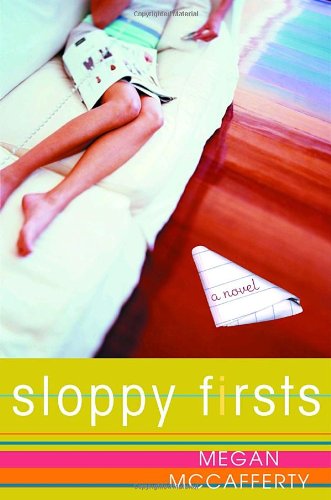
“Listen to this,” my eleventh-grade creative writing teacher announced in class, shaking the computer printout in her hand. “’Harvard student author accused of plagiarism.” It was the infamous event of 2005, in which She Who Will Not Be Named was found to have plagiarized passages from the books Sloppy Firsts and Second Helpings, by some author named Megan McCafferty. As my teacher read aloud the plagiarized passages alongside the original passages, I thought to myself, “Hah! The original passages are pretty damn funny. Who is this Megan McCafferty person and where can I get me more doses of snarky humor?” and it was off to the library after school for me. Perhaps Jessica Darling and I can say that we became acquainted through dubious connections, but when it’s a relationship this wonderful, who cares how it started, really?

-

Blog readers, lend me a moment of your time and energy and share with me your favorite “how we met” stories, if you will. Hmm, perhaps I may even turn this into a meme of sorts; who knows?

Saturday, May 21, 2011

Discussion: Beyond Classifications

I am not a YA reader.

I am a reader, who likes YA.

degreedirectory.org
There is a difference, however slight. For instance, I might consider myself a writer who is Asian American, not an Asian American writer. In my opinion, labeling myself as an Asian American writer would pigeonhole me into a genre of expectations. It would be like me working with a certain set of parameters for a certain audience in mind. I'd rather my Asianness be just one part of the complex being that is me, and not an inflexible label.

This thought was inspired by the Diversity in YA event I attended last Saturday, during which the writers on the panel, all of whom are and write books about people of color or different sexual orientations, were asked if they felt like they had to represent their community in the publishing world. (I could be getting the wording of the question wrong, but that's the jist of it.) And one of the authors, I think it was Olugbemisola Rhuday-Perkovich, talked about how she thinks about all her writer identities, like she is a writer who is black, as well as a writer who likes cheese.

A writer who likes cheese? Bemi's answer struck me as being one of the wisest things I have heard lately. For what are we but a conglomeration of a million different things that make up who we are, and who's to tell us that one of those things has to define us at the exclusion of all others? I am a writer who is Asian American and a writer who loves chocolate. Does me being Asian American mean I can't write about my love of chocolate?

journalstar.com
I am a reader who likes YA because, above all, I search for literary quality and emotional resonance in the books I read. I want to be awed when I read the book. It happens rarely enough, finding that one book that awes me, but when it does it is so, so worth the 200 other books I read before finding that one. And those 201 books that I read range across all genres and reading age groups. So I am a reader, first and foremost, and it just so happens that the majority of books I read, the genre with which I feel most comfortable, is YA.

I have a suspicion that most of my blog readers out there are also readers who like YA. This could be because YA itself is a genre of crossovers. Ever notice how readers of YA fiction are much more willing to venture into the other sections of a bookstore, whereas a lot of readers of adult fiction are much more reluctant to do so? This gives the publishing industry extraordinary migraines, and sometimes writers justifiably fear that their book being marketed as YA will limit its audience. But I think that, while a lot of us read YA as our primary genre, we are also not unwilling to try out an adult book, or even a children's book. And I love that about readers of our genre.

So play a game with me, if you will. A game of identities. Fill in the following sentence: "I am a reader/writer/etc who ____________, and a reader/writer/etc who ____________." The first blank is something about your identity that is "obvious" or "classifiable;" the second blank is something about your identity that is far less obvious and may even be surprising to others.

Here is mine:
I am a writer who is Asian American, and a writer who is interested in astrophysics.
And by "interested" I really mean more like "obsessed." Bet most of you didn't see that one coming, huh? But yes, if I were to have a second shot at college, I would've probably stuck to an astrophysics degree this time around. Me = nerd FTW!

It's your turn now. Will you play?

Thursday, March 31, 2011

"Tru Luv" Teen Romance: Pulling YA Down One Genre at a Time?

sexualfuturist.com
The Book Lantern blog's recent post about YA dystopias, combined with the responses I have gotten so far to my YA lit questionnaire for teens (if you're a teen, you should read about that here and participate!), got me thinking about what it is about YA lit that doesn't work for me. It's been a while since I've been impressed by a YA paranormal romance, which I thought was just me being burnt out by the overabundance of YA paranormal romances that have been published ever since Twilight. But THEN, I started--and continued--to be underwhelmed by most of the recent bestselling YA dystopias. Wait a minute, Steph, I said to myself. This can't be just a sign of genre burnout! You LOVE dystopias! So what's going on??

I think this is what's been bugging me about the bestselling titles in these two genres (and in some ways this is going to sound terrible, but it's true): they all have love as their main conflict or theme.

Look, I love love and romance. I love when it appears in literature, and movies, and, uh, well, life. (Maybe. The verdict is still out on the last one.) I love romantic stories and gestures of love. But I think it is safe for me to say that my life does not revolve around love. I do not exist simply in hopes of one day finding the guy I want to marry. I have other dreams too. And I bet that most other people feel this way.

(This is not to say that there aren't people out there who live just to fall in love and get married. They exist too. But I have not yet reconciled myself to the fact that theirs is a lifestyle that I would be willing to promote to others, and therefore, we're going to leave them out of this discussion for now.)

I get super irritated when a YA book portrays teen love as the be-all and end-all of all love ever in life. Do you know the percentage of teen relationships that DON'T last into and through adulthood? I don't, but I'll bet all of the books I own that it's a really, really, really high percentage. I'm not saying that teen relationships never blossom into fully mature and lasting relationships. There are a good number of people who end up with their high school sweethearts and have a wonderful relationship. And yes, when you're in love you can't help but think of the possibility that you might end up with your partner, the likelihood that he/she is The One for you. That's a pretty natural result of being in love. In the moment, a relationship may seem like perfection, something you want to hold on to forever.

dancewithshadows.com
I do not want to discount the fact that there are many YA stories out there with realistic romances. But I would like to see more bestselling YA books portray more variety in teen romance. I like a happy ending myself, and if I choose to imagine that the characters live happily ever after in love past the last page of the book, then great. But I DON'T want it to be pushed on me that these characters will be in love 4evah, that their lives cannot go on without the other, denying all possibility that, in fact, their relationship could have a very normal end in the future. That attitude is, quite simply, childish. It represents to me the kind of all-consuming infatuation that ends many relationships instead of preserving them.

"But YA lit is my escapism," some people argue to me. "I don't read YA lit to read about the literary equivalent of my own dull, normal, and unimpressive life." Fair enough, I say. (Although I also want to tell these people that YOU and you alone are the one who can make your life special and fascinating and wonderful. But that's another rant for another day.) I read books for escapism too. But I don't read ALL books for escapism, and I'm fairly sure that most people don't do that either. Oftentimes I read books because I want to get something out of it, whether I realize it or not. I turn to books for life advice, witty comments I can inject into real-life conversations (admit it: I can't be the only one who does this), effective ways to deal with serious issues. I turn to books to research how best to proceed in matters of human interactions as much as I turn to them for a wish-fulfillment portrayal of love.

I still like the paranormal genre. I do. And I still like dystopias. But I don't read dystopias for the romance. I'm much more a fan of the paranormal or dystopian story in which love does not make up the main plot. I'd rather read about the speculative fiction protagonist who slays the dragon, saves the community, overthrows the government, defeats the physical manifestation of evil, or whatever else they can do, AND gets the hot guy/girl somewhere along the process. Or, the protagonist who does all of that with the help of said eventual love interest, but hey! he/she didn't need the love interest's help to accomplish his/her goal, he/she was perfectly capable of doing it on his/her own, but it did make things easier, more enjoyable, more effective, etc.

This is opposed to, say, the bland everygirl protagonist who doesn't realize how little joy there was in her life until she meets Godlike EveryBoy (hey, look, oxymoron!), whose dimples, sparkling eyes, and enigmatic philosophical commentary on life bring scintillate her previously meaningless existence or open her eyes to everything that is wrong about her dull, dull, colorless world. First of all, it's heteronormative. Second of all, it's perpetuating outdated models of femininity that have encouraged females to think of their lives as incomplete and meaningless without the love of a strong man. Gack. Quick, pass me the nearest container so I can throw up, please. We live in the 21st century, people! Why are we still subliminally encouraging females to pull a Bella Swan and sum up the five months following her breakup with literal blank pages in a book until, miraculously, she is "brought back to a semblance of life" by--surprise, surprise--yet another strong, supernatural, protector-role guy? Why are books with these kinds of romantic plots the bestsellers?
Kind of worried about your respiratory system and life philosophy, Bella.
I dislike when a story uses a subgenre to distinguish its tru luv teen romance plot. "It's a dystopian with romance!" the book will proclaim. Um, no. It's a romance set in a poorly conceived future world where the elements that typically trouble relationships--such as disapproving friends, geographic disparity, and finances--and the satisfaction one feels when a lasting romance overcomes all obstacles are tangibly represented by a Big Bad Wrong Social System and love's ability to open your eyes to said Big Bad Wrong Social System as well as all that is wrong with your world, your life, your dreams, you...whatever. These stories read to me as a pretty typical fictional romance, except that literally the entire world as the characters know it is against them. That doesn't make it dystopian for me. I think it's possible to write a dystopian love story, but I don't think anyone has done it yet, recently.

Although I believe really strongly in my stance that bestselling YA lit's on "tru luv" teen romances is limiting, I also recognize that it's a slippery stance to hold on to. Most of the people I've talked to about this issue feel similar to me, that they, too, are tired of the love-centric plots in lots of bestselling YA books. But whether you're a teen or not, when you're in love, of course you're going to resent anyone who tries to convince you that, uh, you're not really in love, it's just a passing phase. Furthermore, one appealing aspect of YA lit is that it takes teenage concerns and thoroughly explores them in a realistic, relatable, and nontrivializing manner. Loving and being loved is a big deal to teenagers. Why wouldn't it be a big deal--in fact, the biggest deal--in literature that is written for teens?

Furthermore, teens make it very clear that they don't want to be talked down to, and that controlling their access to "triggering" influences (e.g. book censorship) doesn't do anything, is in fact completely unnecessary, because almost all teen readers know that a book that discusses, say, suicide is not promoting suicide, nor will it increase their likelihood of committing suicide. So, following that logic, reading books that feature tru luv teen romance shouldn't necessarily increase teens' belief in the prevalence of real-life tru luv teen romance...right?

josephinewall.co.uk
So what's the best way to approach the topic of teen love in literature? I'm not saying that we should all go out, grab the nearest teen, and shout in their face, "AH, YOUNG LOVE. IT'S NOT GOING TO LAST. DON'T GET TOO INVOLVED." Gosh. We've read about enough adults in YA lit who try that to know that this imposed rationale has no effect whatsoever on the teen in love. And I don't think that YA lit should preach to readers that the idea of true love sprouting from teen romances is impossible, because we know that sometimes that happens, and it's wonderful (see: high school sweethearts). I think that, basically, YA lit shouldn't preach at all, and should just portray as believably as possible the many different trajectories that teen romances can take... and all of these different portrayals should receive the same amount of attention and consideration. Instead of our bestselling YA lists being dominated by not so realistic, not so healthy portrayals of teen tru luv, there should be more of a mixture. Stories in which the romance is a swoony sideplot. Stories in which romance doesn't appear at all. Stories in which teens *GASPOMGTHENERVE* break up.

I just want the critical and commercial acknowledgment that there is not just one way to tell a teen love story.

Wednesday, March 16, 2011

Discussion: Finishing Books, and the Importance of First Pages

borofsky.com
The other day, fellow bloggers Jamie, Jess Lawlor, and I met up to hang out at a nearby Barnes & Noble. As we were browsing the shelves, we pointed out or mentioned books that I had to admit I couldn't finish. I say "I," because it turns out that Jamie and Jess are total book finishers: when they start a book, they have to finish it, even if the book turns out to be only so-so. Whereas I declared that I usually knew whether or not I want to finish a book by the end of its first chapter. I also do not have qualms about not finishing a book even if I am, say, three-fourths of the way through the book.

I can understand both reading habits. Reading a less-than-impressive book is a learning experience, too. If you're a writer, it helps you figure out what elements of a story work or don't work for you, in order to decide what you'll want to incorporate into your own writing. If you're not a writer, you can still figure out what things you like or dislike as a reader, which will help you in future reading selections as well as when you give book recommendations to a variety of readers.

Generally, I'll read the first chapter or two of a book to see if I'm interested in reading the rest of it. If I'm in a particularly unforgiving mood, or if I reach that oft-reached point of being overwhelmed by the sheer number of books I own that I have yet to read, I might read only the first page or two in order to sort the book into "keep" or "don't keep." I do this several times a year, and unfortunately, because I acquire soooo many books all the time, I also have to give many away, often without being able to read them first.

shopsavannahs.wordpress.com
There are problems with my method, I know, but let's be honest: as much as we'd like to say that writing is an art, the fact of the matter is that it is also a business. With the sheer volume of books out there that are available for us to read, one can't afford to have a crappy opening. Gone are the old days when writing was a specialized profession that only a small number of people would do. Today almost anyone can write a book. Seriously. Even if you suck at writing. Even if you don't realize that you suck at writing. You can still write a book that can be read by people.

I realized the other day that no matter how little we understand about ourselves or our identities--for instance, no matter how many journal entries I write about the fact that, at almost 22 years old, I still don't think I know enough about myself, how I work, what I want, how my experiences have shaped me, etc.--no matter how little we think we know about ourselves, we are still a solid entity to people who know us. Everybody has their individual quirks or philosophical outlooks or manners of speech that will make others say, "Yup, that's him/her. That's something he/she would say."

library.thinkquest.org
Applying this concept to reading, we avid readers have a fairly strong grasp of what we enjoy reading. We have a pretty solid conception of the field--if not specific knowledge on every single title out there, then at least an understanding of overarching trends and tropes. So, for me, the first page of a book already tells me so much about what I can expect from the rest of the book, and whether or not this book is for me. Writing style, characterization, and setting in particular are recognizable from the first page, and very rarely does the rest of the book deviate from that. Because as complex as a book can be, it is also one entity, and (generally) a randomly chosen one-page excerpt from any part of the book (yes, even the beginning) is a legitimate sample of what a reader might be able to expect from the rest of the book. (Or it should be. I see no reason why certain sections of a book should be allowed to be weaker than others.) And thus, I should be able to figure out whether or not a book is for me from its first pages.

So that's why I'm comfortable with not finishing a book. Along the way, I also ended up talking about why I think the first page of a book is so essential and representative. I'm curious now as to your policies when it comes to finishing a book. Do you make it a point to finish every book you start? At which point will you stop reading a book? And how important are a book's first couple of pages to you? A ready, set, aaand...answer!

Wednesday, March 9, 2011

eBooks and the Book Lover

Buzz and debate about eReaders and how it's affecting the publishing industry and the nature of reading and its community structure has been going on for a while. Most recently, Nathan Bransford has written a great post about "99-cent Kindle millionaires" (yes, it's legit), and over at The Broke and the Bookish there was a recent discussion post about HarperCollins' 26 check-out limit for e-books.

This post is part of a mini-series of blog posts in which I will talk a little about ebooks, eReaders, and their effects on the current book publishing and consuming world. Today's topic is: eBooks and the book lover.

Note the difference between a reader and a book lover. A reader (and we'll limit it to fiction, since that's 98% of what I read) likes stories. Verbal, written, slow, fast, escapist, thought-provoking--for the reader, it matters less how the story was created than what the story contains. A reader gets equal pleasure from reading a story and from hearing it. The medium in which the story is conveyed is less important than the story itself.

artsjournal.com
A book lover is typically also a reader, but s/he also wants to know about the craft behind the story. How does the story succeed in stirring up the emotions that it does in me? How am I affected by the presentation of the book? For a book lover, it matters in what medium one reads a story, and s/he is also concerned with spreading the word to other book lovers and readers. The book lover wants a library filled with all of his or her favorite books. The actual appearance of the books that s/he has read is important.

For me, a book lover as well as a reader, the issue of e-books boils down to one important question: Where do eReaders and e-books fit into my lifestyle? And my answer is equally succinct: It complements my bookworm habits. It expands the horizons of my bookworminess.

People often worry that e-books will replace p-books in the near future, and that the book publishing industry will basically collapse because the e-book format will negate the necessity of a physical publishing house and all the professionals who work therein.

I'm not sure I agree. For the true book lover, e-books will never be able to replace p-books. Notice how I didn't say "reader," because I think it's entirely possible that for someone who doesn't take note of the texture of the page under your thumb as you turn it, or the way the images and text on a book cover shift from matte to glossy and back again, e-reading can replace all the p-reading in his or her life.

librarything.com
Book lovers know that there is a difference between the story and the book. The story is the intangible, magical element that comes to life through the act of reading. It existed long before it became mass-printed words on a page, when it was just a child playing around in the author's head. It can exist outside the text, as oral traditions of storytelling show us. The book encompasses everything that makes the story presentable to us in tangible form. It's the texture of the pages, the image on the cover, the feel of the cover, the chosen font, the size of the book, the interior hardback color. Theoretically you could argue that the story is more important than the book, and I would probably agree, but the book itself is a form of art, and as I am a book lover, the book is a form of art that I adore.

My eReader feeds the insatiable habit of the reader in me, but physical books can never be replaced, in my heart or on my shelves. That's the reason why books have been around for so many centuries, even while vinyl records, CDs, and videocassettes have come and gone in a matter of decades. Because the book is not merely a vehicle for the story within, but a piece of work in itself. A reader could theoretically separate the story from the book and cram all of his or her stories into one electronic device, but for the book lover, the way the story is presented is also important in a different way. Holding that work of art in your hands feels like an almost necessary milestone in the journey of being an author, in the journey of transferring one's story from one's head out to the world.

Anyway, that's just one of my thoughts about why physical books are still here to stay.What about you? What do you think of my distinction between a reader and a book lover? If you own an eReader, how do you feel that owning one has changed your view of your physical books?

Friday, February 25, 2011

The Jeopardy! IBM Challenge and What It Tells Us About Language


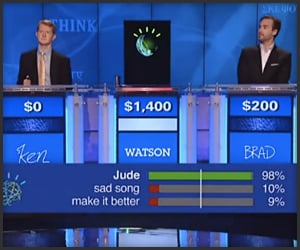
So who caught the Jeopardy! IBM "Man vs. Machine" Challenge that aired for Feb. 14th, 15th, and 16th? It should be, like, required viewing for all nerds, trivia geeks, etc. I mean, I like Jeopardy, and trivia, on a normal basis, but the IBM Challenge took Jeopardy to the next level--which, apparently, includes science, as well as a little bit of what most people might consider sci-fi as well.

A little background for those who don't know anything of what this is about: for the past few years, IBM has worked on creating a computer that can answer questions by reproducing the way human beings answer questions. "Watson," the computer's name, is loaded up with a ton of data, and has algorithms that allow him to pick out the key words in the Jeopardy clue, sift through his data for possible answers, and predict how likely the terms his algorithms picked out might be the answer. The scientists' hope is that one day this sort of artificial intelligence would be beneficial to, say, doctors working in an extremely isolated area, who may not have access to medical textbooks and other informational resources, may be able to plug symptoms into the database and have the computer spit back the diagnosis and its treatment. You can watch the entire 3-day challenge through Youtube if you'd like.

Varying opinions on artificial intelligence aside, I found the whole thing so very fascinating. It was not that Watson knew more than Ken Jennings or Brad Rutter; I'm fairly certain that they were all very capable of answering the majority of the questions. I'd be curious to see how they programmed Watson to, shall we say, "buzz in" to answer. Because when it comes down to it in Jeopardy, it doesn't matter how quickly you figure out the answer to the clue so much as how fast your reflexes are. So where did the IBM scientists draw the line at Watson's reflexivity? There would be no doubt that a computer's so-called "reflexes" would be much faster than a human's hand-eye coordination. I suspect that Watson answered so many questions correctly not because he knew more than Ken or Brad, but because, with his computer reflexes, he was able to buzz in more quickly than either man. This frustrates me quite a bit because it totally messes with anyone doing scientific observations, augghhhhh!

But that is an issue for IBM to consider for the future, and not what I want to focus on here.

How, you might ask, is what Watson does any different than one of us plugging a question into Google and getting back possible answers? And that's a very good, legitimate question. The difference is in how the data is stored. The Internet as we know it right now is not raw data: instead, it's data that has already been organized into "un-break-down-able" webpages by other human beings. When you type a question such as "How many U.S. presidents had/have a daughter as their oldest child?" into Google, you'll only get an answer back if someone else has already sorted through the data and written up the answer. Otherwise, you'll notice, you'll get hits for related sites, such as "children of U.S. presidents," "geneologies of U.S. presidents," and so on. It's possible, of course, to figure out how many U.S. presidents have eldest daughters via those related sites, but that takes the usual amount of time it takes a human being to solve such data organization questions.

Lots of really smart people have, in TED talks, proposed the project of something like "Internet 2.0," in which all of the data in the world is just put out there for anyone to access and play with as they want. In such a case, typing the question "How many U.S. presidents had/have a daughter as the oldest child?" will prompt the system to sift out the keywords in the question--U.S. presidents, daughter, oldest child--and then limit the data shown to just that which fits those keywords. This is essentially how Watson works. Internet 2.0 would mean that all of this data in its pure unadulterated form would be available, and if we wanted to find an answer to something via an Internet search, we wouldn't have to rely largely on earlier people already answering those questions.

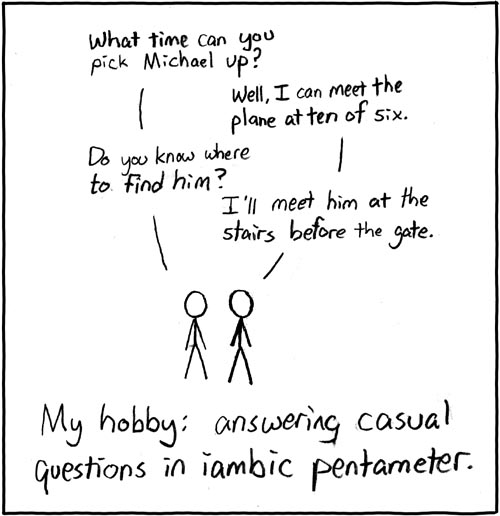
The thing is, most people don't realize until it is explained to them that the way we process language and information is NOT like Internet 2.0, but much more similar to a Google search. We humans loooove patterns: we organize information in them, make patterns out of nothing if need be, remember better if given mnemonics. We remember simple childhood nursery rhymes far better than passages of prose, because rhyme and meter organize the data of language into patterns that we have a much easier time memorizing.

xkcd.com
If I asked you to recite the letters of the alphabet, nearly all of you would start, "A, B, C, D...". (Some of you might even sing it!) No one ever considers saying the alphabet "out of order," even though if I gave you all 26 letters eventually, that technically still counts as reciting the letters of the alphabet. If I asked you to finish the ditty, "Hearts, stars, and horseshoes..." you could probably rattle off the rest of it without much conscious thought. If I told you to put the Lucky Charms marshmallow shapes in alphabetical order, it would probably take you at least a minute to do so. If you asked me to tell you which animal follows the Rabbit in the Chinese Zodiac, I could tell you... but only after I'd recited through the previous animals in the Zodiac, in Chinese. (It's dragon, by the way: long.) And so on; I'm sure you can think of more examples now.

Artificial intelligence as it currently stands does not do this. For Watson and others, they are aware of the most common way of reciting the alphabet, but if asked to recite the alphabet in random order, they could probably do it with no much more effort than they could do it in the "traditional" way. This has both its pros and cons. On the plus side, Watson can much more easily sift through raw data and come up with brand new ways to organize it. On the downside, natural language processing is really a blindingly fast mental process, as we humans take shortcuts to get to answers much more effortlessly than if we had to go through what Watson has to go through every time we wanted to get answers. And, if you watch the Jeopardy episodes, occasionally Watson does some really stupid things that no human would do, and I'm sure the IBM scientists are now scrambling over themselves trying to figure out why oh why Watson did that. (Seriously, watch it. It only takes an hour. It's incredible.)

When a human answers questions on Jeopardy, we don't do it as Watson does, sifting through all the data we possess and ranking possible answers in order of their likelihood to be correct. I don't even know how a human does it, because I haven't taken enough linguistics or cognitive science classes. All I know is that, thus far, a computer has not been able to replicate natural language processing.

onlineeducation.net
Can it ever? I'm not sure. Natural language processing is what allows us to enjoy reading. It's the emotional and aesthetic connections we make while our minds process text that allows for enjoyment. We might laugh when a character makes a social blunder because we, or someone we know, have done something like that before. We cry when a character's loved one dies because we, too, know the pain of a loss of life. We sit up straighter at attention when we recognize a parallel between one text and another we read long ago. And sometimes, if we recognize too many of the same parallels between texts, that becomes a trope or a cliche, and that can diminish our enjoyment of the texts as well.

There are some things that computers are not yet able to replicate, and one of them is the interactive experience between the reader, the text, and the world in which both of them exist.

I challenge you to think about that the next time you open a book.

Wednesday, February 2, 2011

Discussion: A Case for Rereading

My English teachers and professors always used to say that if they had all the time in the world to teach their students, they would tell everyone to read the assigned books at least twice before discussing them. I had always kind of generally agreed, but never realized the significance of rereading until the end of last semester, when I reread, for the first time since August, Mockingjay in preparation to write my Hunger Games paper.

Like most other insane Hunger Games fans, I bought a copy of Mockingjay at midnight on August 24, and preceded to spend most of the night and the next day reading it. Okay--I wouldn't call it "reading." More like guzzling, perhaps. I guzzled Mockingjay, swallowed it so fast I practically choked a few times. My eyes devoured the words on the page at such a frantic page they blurred and I got a headache. I closed the book at around 9:30 the next night, feeling like I had run a marathon, and with a large dose of "what the heck just happened?".

I appreciated Mockingjay when I first read it, I guess. I wasn't as angry and disappointed as other readers were, but I had this feeling like I had missed something important in the book. I had, after all, just consumed the book the way a contestant might inhale food in an eating competition. Obviously I can't have remembered details or nuances, only the big, broad strokes--and those had been unexpected and unnerving.

But oh man, when I reread Mockingjay in December, it was like a whole new reading experience. Now that I knew how it ended, I was reading to more closely examine the path that Suzanne Collins took to get us there. I discovered so much that I had missed the first time around, details that led up to the therefore very appropriate conclusion: "that character got what was coming to him/her," or "wow, that character is much more subtly sinister than I realized."

I also noticed the larger themes of the lose-lose situation that is war; the fragility of relationships in the face of decisions that question one's definitions of humanity. There is no black-and-white in war. War twists people so that even those whom we'd consider "good" may do abhorrent acts in the name of their creed.

And the biggest revelation, of course, was that Mockingjay ended exactly the way that it had to. It was a conclusion that had the entire series had been building toward. I finished it for the second time, finally coming to terms with the course that Collins had set for all her characters. I don't think I like it as much as the first book (the pacing! the thrill! the anticipation!), but I like it more than Catching Fire now. It's also definitely a book that I will go back to, again and again.

The point of my Mockingjay anecdote? Rereading gives you the opportunity to notice things you might not have on your first read-through, especially if you were busy poring over the pages, flipping them at screamingly high speeds in anticipation of what's going to happen. Now that you know the big events that await you in the plot, you can focus instead on all the delightful things about the book that you missed: the wit, or the language. For English class, you will notice the symbolism or themes--yes, it took me a reread before I noticed even the painfully obvious symbolism in The Scarlet Letter (which, for the record, I actually like).

I wonder how often or how much my opinion of a YA book I read would change if I read it twice before reviewing. I can think of several books to which rereading was kind. I can also think of a few to which my rereading it would not be so kind. (And that's probably a reason I haven't reread them: I'm scared of how dramatically my opinion of the book might change.)

Some questions that I have, then, after all this thinking about rereading, are:
  • Should a book review be based solely on one's first and/or only readthrough of the book? Can it capture the fullness of the book?
  • What are the benefits to reading a book at least twice before reviewing it? What are the drawbacks?
  • Should I really take the time to reread a book that I disliked, to see if I might like it more after a reread?
  • When someone says that a certain book is their favorite, does that mean that it stands up to rereads, or that it impressed the hell out of the reader the first time through? If your opinion of a book changes with rereads, what then is the definition of a "favorite book"? (This is something I obsess about because, y'know, I like making and updating lists to keep track of the relatively inane things in my life, such as my all-time favorite books ever. This is also something that I've been thinking about recently because I'm in the middle of rereading some old favorites right now and they're just not doing it for me, which makes me sad and also makes me doubt my stability as a reader.)
  • What are the complexities involved in recommending a book that you once loved, but, upon rereading, you no longer liked that much?

The one thing that I know for sure, though? We crazy book people will rarely, if ever, have the time to reread every single book we read. And that makes me a little sad. I have that in common with English teachers. :)

Saturday, December 11, 2010

Discussion: Professionalism, Presence, and Their Influences on the Reading Experience

Back when I started reading YA in the early 2000s, authors were still unapproachable mythical figures to me. They were usually nothing more than a bio blurb and still photo on the back jacket flap of a book, plus maybe a website if he or she had it. All I knew about them was that, in my mind, they were celebrities, but they were celebrities with no trashy tabloids following their every moves, exposing all their secrets to the whole wide world. In those days, authors were pretty much equivalent to their books, and that was that.

hotdesign.com
Of course, that's hardly the case nowadays. Nearly every YA author now, especially debut authors, have blogs, Twitter accounts, and Facebooks on top of just the standard noninteractive author website. Author presence on the Internet is often incorporated into a publisher's marketing plan for books: if a debut author does not have a blog prior to their book being published, they are often encouraged by their publishers to start one. Even authors who have written dozens of award-winning books over several decades practically need to establish an online presence, else they will likely not capture the attention of the modern audience.

It is because of this shift in book publicity, more so than because I started blogging about books, that has caused my reading experience to change. Very rarely now can I read a book and have it stand on its own. When I read now, I almost always think about what I know about the author, either from my personal interactions with him or her, or the way he or she presents him/herself online. Nowadays I often get to know the author through Twitter or their blog posts before I read his or her book. This is totally different from my reading experiences even just a few years ago, when finding out more about an author came only after I had read his or her book.

This has both a positive and negative effect on a number of reading- and blogging-related things, but for this post I am going to stick only to the reading experience itself--that is, the act and enjoyment of reading the author's book. It's positive because an author's online presence may actually do as the publishers want and cause me to pick up a book. It may be that the author's tweets make me laugh, or I find their blog posts well-written or thought-provoking. Sometimes I'm surprised when I finally read their book and discover that it's so different from their online presence. This has been both a good or bad thing in the past.

It's negative when an author's online behavior causes me to rethink my support of them through reading, buying, or reviewing their books. There have been instances in the past when I've really enjoyed an author's book(s), only to discover in some not-so-obscure corner of the Internet that he or she has behaved in ways I find deplorable: immaturely ragging on people they disagree with almost to the point of online harassment, expressing their opinions in a narrow-minded or offensive manner, belittling the intelligences of their YA audience.

What do you do when you come across something like that? I can no longer not let it influence my decision to support that author's books...and it is my opinion that neither should I, as a consumer, be expected to separate the two. Publishers should know that with their push to incorporate authors' online presence into marketing and publicity, they run the risk of it having the opposite effect on readers. I am a firm believer that there is no such thing as good publicity vs. bad publicity: it's what you choose to do with the available opportunities for publicity that determines its effect on my reading decisions. If you choose to assert your right to mouth off, insult people, and express your controversial opinion on a sensitive subject--and I am not saying you don't have the right to do so--just keep in mind what the consequences regarding your public image and royalty statement may be.

Consider how this occurs in other forms of media and entertainment. Does hearing about Lindsay Lohan's messy and rehab-oriented behavior, or Nicholas Cage's debt and tax evasions, or Tiger Woods' adulterous behavior influence the way you approach their more professional performances? For me it unequivocally does. I can no longer rewatch The Parent Trap or Mean Girls (and both are movies I love, by the way, no shame) without thinking about how Lindsay has gone downhill since then. And I'm less inclined to watch any of Nicholas Cage's future movies because of the fact that I now know he is an extravagant spender with poor finance skills. I mean, dude, you're a multimillionaire. I don't know whether to be more impressed or embarrassed for you that you are able to blow through your seven-figure paychecks.

I'm not trying to say that, because of their authorly status, authors should only be considered their public persona. Of course you are human beings as well, individuals who are also entitled to your personal opinions. But anything that involves a public sphere such as the Internet requires self-policing. Even bloggers--all bloggers, regardless of site traffic or your blog's focus--cannot escape this fact. For example, I am not going to write ranty, ill-informed, and offensive posts about things that irritate the heck out of me. I try to limit my use of profanity online (okay, and in person too). I don't start prolonged arguments in comments that spiral into passive-aggressive personal attacks that have very little to do with the original point of dissention. In fact, I prefer not to make personal attacks online, period. (I'll save ranty moments for in-person conversations if they are necessary, thanks.)

This does not mean I'm Switzerland. Of course I have opinions and make them; you, dearest blog readers, of all people, would know that. But it's about presentation. It's about the way you make your point. And it's also about the willingness to be open to dialogue and dissenting viewpoints, but that's another topic for another post, don't worry I'm already working on that. I may even agree with your opinion, but if you choose to present your opinion in a close-minded, unintelligent, and vindictive manner--in other words, if you choose to be disrespectful when speaking your mind--then you lose my respect. And this has happened to me before, with both authors and bloggers, so it's not just a hypothetical situation.

Yes, the Internet allows for more anonymity, and people are always bolder with the safety of anonymity. Sometimes, this anonymity turns into bad, even terrifying, situations, such as with the influx of cyber-bullying that has caused too many people to commit suicide this year. But don't forget that things on the Internet are very rarely truly anonymous. There are always ways to track down who said what, if you have the time and resources. Things published on the Internet will stay there forever, even if you choose to delete them later. The Internet has given us more freedom, but freedom does come at a price, and if you're not careful, you may be paying dearly for it.

So...what do you guys think? Have you ever been influenced, either positively or negatively, by an author's online presence? Can you separate an author's behavior from your enjoyment of his or her book? Should you? Does this professional/respectful online presence apply to bloggers as well? Should it?

Monday, December 6, 2010

What is love, anyway?

I'll be 22 in the spring. Don't worry, this is NOT a post about me complaining about my relationship status. Related thoughts, though, just can't help occurring when you're a twenty-something-year-old female with female friends. Topics like marriage (ahhhhhhhhhh) just seem to inevitably crop up. The scary thing is, some of my friends want to get married around 25. Allowing a year for the engagement, that gives us less than three years to meet someone, get to know them, realize you want to spend forever with them, AND convince them/find out that they feel the same way about you.

I get tired just thinking about it.

The truth is, I have so little experience in the romance department that I have no freaking clue what I'm doing or what to do. This past week I've made some pretty big self-discoveries regarding what kind of guys I fall for, what I'm looking for relationship-wise, the difference between a casual crush of mine and a serious one, and so on. But I still feel like I'm, I dunno, Lewis & Clark or someone like them, plunging down an utterly unknown river, swollen with spring runoff, with only a flimsy low-grade plastic paddle in my hand to fend off alligators and loose logs.


Usually when I need help I often look towards books first, but lately that's just been frustrating, because books always seem to, well, romanticize romance. Somehow, some way, things work out, usually with this big, swoony scene at the end where the guy confesses his love to the girl or the girl admits to the guy that he was right about her, and they kiss and everyone's happy, the end. And how about all those books that have enviously smooth "getting to know you" romantic progressions, eh? The first encounter goes well, the love interest continues to approach the MC, there is no doubt in either of their minds that they like each other. When in real life (or my life, at least) it usually goes: initial encounter goes well, subsequent encounters are much more ambiguous (does he/she like me as just a friend, or as more than one? or do I not even cross his/her mind at all?), until eventually you are suffocated by a plague of uncertainty and confusion.

Where is the doubt in YA romances? Where is the ambiguity of interactions? Why is there a sad lack of examples that could give me any sort of insight into the way "real" romances progress, at least in my opinion?

I know, I know, I know that in telling a story--whether it be entirely fictional or your own real-life tale--one tends to emphasize the good points and deemphasize the bad. And as a reader we are also relatively passive observers with the benefit of an outsider's perspective to the very things that so confuse us when we're actually participating in them. You know how in movies there might be this big misunderstanding scene where neither character says what they truly mean to one another, only they don't know that, so they both think that what the other is saying is how they're really feeling, and then they turn away and the camera shows them making a miserable face at how much it just killed them to lie to the other person like that? Yeah. We're the audience, so we get the benefit of this camera view and get to see the true feelings that the other character doesn't see.

I want to be that "me" audience member for my own life. Maybe then I'd be able to figure some things out.

Or maybe I simply watch too many of those kinds of movies.

I used to be more worried that I'd end up alone. Now, I'm not so worried about that, but I do wonder often what it is I should look for in whoever I end up with. How will I know when I have found the right one? If the one that I can see myself with forever has some serious flaws that usually break relationships, how much should I excuse them for those? I hope I don't settle for anyone less than the one who is right for me--note that I say "right for me" and not "perfect"--but I worry that I may not recognize him when I find him.

It's also becoming clearer and clearer to me that I don't want to waste time with relationships that I don't think have a chance of lasting. It may sound harsh, or too cynical, but I believe that I can tell pretty early on in my acquaintance with someone whether or not I feel like a hypothetical relationship between the two of us has a possibility of lasting. That's one of the big things I realized last week: that I may be attracted to a number of people, but that doesn't mean I necessarily want to date them. I'd rather be contentedly single than be in a casual relationship for the sake of, I dunno, having something to do on the weekends or whatnot. I'm not actively looking for The One, nor am I unhappy that I'm not with him yet. I approach things very pragmatically, but believe deep down that eventually, sooner or later, but most likely later, and maybe even a lot later, I will find him. I've watched too many Disney movies and read too many romances to not believe in the idea that maybe, just maybe, I will find someone who likes all of me, who can challenge me intellectually, and who can inspire me to try to make each day the best I've ever lived.

It seems that so many authors and bloggers I know are either happily married or otherwise in wonderful relationships that seemed to have had fairy-tale beginnings, or courtships, or whatever. Can I ask you if that was really how it went, though? Did you have moments of doubt and uncertainty as to whether or not your partner was the right person for you? How did you know that he/she was The One? Who initiated the relationship? Did your own love story unfold like a standard YA romance, or did it have its tough moments, stuff that never gets told in the stories? Are the romances you write into your stories reflective of your real-life experiences, or are they more wish fulfillment? Where, I guess, does the inspiration for those fictional romances come from?

I wanted to save these questions for closer to Valentine's Day, maybe even make a feature out of it (who knows? I could still do it?) but they have been weighing me down for quite some time now so I thought I'd just put it out here.

Peace, love, and happiness, as always.

LinkWithin

Related Posts Plugin for WordPress, Blogger...