Showing posts with label publishing. Show all posts

Friday, March 29, 2013

On Recent Disputes and Acquisitions in the Book World

There was some gloomy news for authors and indie-lovin' readers this week. First we got wind of the Simon & Schuster / Barnes & Noble financial dispute that is causing B&N to drastically reduce their orders of S&S titles, to the point where they are no longer stocking some smaller-name authors' books. Next, I woke up this morning and learned that Amazon is acquiring Goodreads. Is nothing safe from the Great Corporation anymore?
Calvin and Hobbes explains corporate greed. Click to embiggen.
S&S author Stephanie Burgis' blog post is a heart-rending explanation of the S&S/B&N dispute and how it affects writers like her. I still recommend her MG historical fantasy series (first book: Kat, Incorrigible [US]; A Most Improper Magick [UK]) to anyone whom I think would have the slightest interest in MG historical fantasies, even though it's been almost three years since I read and loved it. I'll even admit to being randomly stalkerish: every time I find myself in the Middle Grade section of a bookstore, I inadvertently check to see if I can find her books.

By industry standards, Stephanie is a lesser-known author; by personal standards, what Stephanie writes is better than half of what I see on the shelves. Which is why it tore at me so when I read about her wrenching search of B&Ns that were still stocking her books after the dispute was made public:
For context, about half the B&Ns in the country, from what I could tell last year, stocked the paperback of Kat, Incorrigible and the hardcover of Renegade Magic. I think it might be normal to expect those numbers to go down a bit this time round, but I was hoping that at least 1/4 of the B&Ns I looked at would stock Renegade Magic.

Instead, I found...zero. Absolutely zero B&Ns, in any of the zipcode areas I looked up (and I looked up a LOT) were carrying the paperback of Renegade Magic - even stores that had always carried high stocks of the Kat, Incorrigible paperback and the Renegade Magic hardcover.
When large, profit-oriented corporations clash, it's usually the ordinary, hard-working individuals that slip through the cracks and are affected most. (No CEOs have to give up their multimillion-dollar mansions, maid service, and fancy cars as they're cajoling, threatening, or warning other companies of what will happen to them if they get in the way of profitization.) And this is sad, in the way that reading about the ordeals of homeless child soldiers in war-torn countries is sad--in a momentary, far-off, unrelatable way. But what Stephanie describes is how it affects us, our friends, our family, all the people we hope to influence with our words:
It really hurts that this has happened, through the sheer bad luck of being an author caught in the middle of a larger power struggle. My publisher will move on from this. So will B&N. But my book may have slipped through the cracks by then.

And the reason I am talking about this in public...

...is that when I walk into a bookstore, as a reader, I rarely notice the books that aren't stocked there. Maybe, if I'm looking for one book in particular, I'll be disappointed if I don't see it, but I won't really think anything of that. I'll just think, oh, well, this particular store didn't stock it.
You are an average, non-book-blogging consumer.
When you walk into a bookstore, what's going to
catch your eye? [Image from cafepress.com]
Customer Philosophy #1: The harder it is to find something, the less people are going to try to find it. If you're read this, you are probably either a book blogger or someone who appreciates book bloggers. Sadly, our numbers combined make up only a very small portion of the population: you're not going to find the majority of Veronica Roth or Cassandra Clare fans active on Goodreads or the blogosphere. Put yourself in the shoes of a non-blogger for a minute. You walk into your local bookstore. Perhaps you are a teenager forced to enter because your parents threatened to not give you car rights unless you read three books on your summer vacation; perhaps you are an adult, just popping into air-conditioned haven as a brief respite during your errand run; or you've just celebrated your tenth birthday (double digits!) and have a couple giftcards to use. You randomly browse the shelves, reading titles and summaries here and there. What's going to catch your eye? Most likely the large stacks of a single bestselling title displayed prominently in the center of the store; that, or a jacket summary that strikes a chord with you. Like Stephanie said, you are not going to notice what's not there. And if what's not there are some great books that will make you laugh and cry and want to read them over and over, the average, casual consumer is going to have no chance to even consider those books. Because he or she does not know those books even exist.

One of my favorite indies is Children's Book World in Haverford, PA. They've got the requisite displays of popular bestsellers, but they've also got beautifully colorful, lovingly stocked shelves that seem to contain exactly one copy of every single children's, middle grade, and YA book published within the last ten years. Even if I've already read most of the books I see there, I delight in the possibility that another reader can stand where I stand and find those lesser-known books that I love.
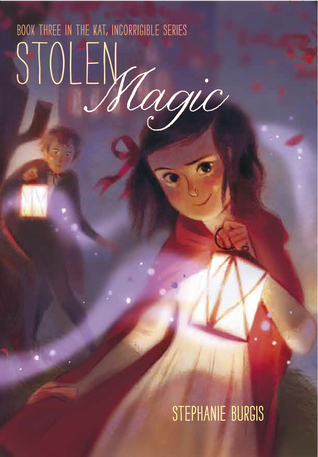
Book 3 of Stephanie Burgis' MG historical fantasy series is out on April 2 from Atheneum Books.
If you're interested in buying a copy, please consider buying from IndieBound.

The other big book-related news this week that Amazon has acquired Goodreads. I don't think that this acquisition is going to change individuals' daily actions on Goodreads (I hope not), and it seems like the main reason for the acquisition, at least according to that article, is to "Kindle integration" and to get the leg-up on Apple regarding social media. So if day-to-day Goodreads use isn't going to change, and if a convenient Kindle integration system is to be implemented (which all sounds good), how is this acquisition going to affect us? Author Kate Messner wrote a great (and much more succinct) blog post about the matter, in which she notes:
People who use GoodReads are book lovers who like to keep track of their reading and share great books with one another. And soon, they’ll be supporting Amazon whether they chose to or not.

I understand that lots of people like buying books online, and there’s nothing wrong with that. But if you like bookstores — real brick-and-mortar bookstores that smell like paper, with smiling people who know your kids — then you need to support them, or they won’t be here for long.
forbes.com
A world without brick-and-mortar bookstores? Noooooooooooo. And yet this is what Amazon is directing the market towards: transitioning all business into online-only. A wave of the mouse and the click of a button; as soon as possible, your order in your hands.

A fair number of you are probably like me in terms of my complicated relationship with Amazon: I dislike their profit-driven, community-squeezing, capitalist philosophy and actions, but invariably end up purchasing some of my stuff from them anyway. It's gotten to the point where it's hard to NOT use Amazon in some portion of our lives. So no, I'm not going to say you should avoid Amazon completely. I just think that all of us should sit down for a bit and rethink our relationship with Amazon. Is it...

...Nonexistent? Congratulations! You are a better and more self-motivated person than I am.

...Dependent? You probably have a retail problem and/or don't know about the socioeconomic effects of Amazon's Amazonian (d'oh!) dynasty on nearly everything.

...Measured? That's where I'd like to be, and hopefully you'd like to party in this category with me too. It's like a form of dieting: you don't need to cut it entirely out of your life, but you should learn to have it in moderation, and balance your intake with a variety of others.

How should we express our support for brick-and-mortar and indie bookstores while still enjoying Goodreads? I like Kate's suggestion:
Write your reviews. Log your reading and recommend your books. And end each review with a link to IndieBound....My review [of Linda Urban's THE CENTER OF EVERYTHING] ends like this now:

I support independent bookstores. You can use this link to find one near you or order THE CENTER OF EVERYTHING on IndieBound: http://www.indiebound.org/book/9780547763484
This is a great way to still use Goodreads for what you love about it while making it clear your support and valuing of indies. Nice!

Common reasons for why people are not buying indie is money: Amazon has, compared to pretty much all brick-and-mortar stores, lower price, and also that super-appealing Free Shipping option. It's hard to resist the call of perpetual discounts and free shipping. But you CAN, and you SHOULD try! Here's a semi-mathematical argument for why it's not hard to switch from buying Amazon to buying indie:

Say you want to buy five books. Recently published books on Amazon tend to be approximately 25-33% off their list price. If you pare off a book from your original five, that gets you down to within a few bucks of the Amazon price. Shipping might cost you between $4 and $10; some indies, like my other favorite, Doylestown Bookshop in Doylestown, PA, have nifty discounts like 10% off all online orders and free shipping for orders over $30.
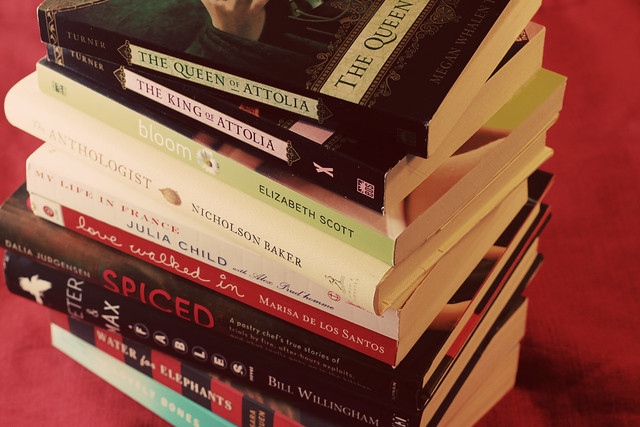
Does your TBR pile look like this or maybe even ten times worse?
If so, you probably don't need to buy that new book
as badly as you think you do.
Sure, you get one fewer book than you'd get if you bought from Amazon, but look around you: you're probably surrounded by brand-spanking-new books you bought months or even years ago when you told yourself you just couldn't live if you didn't buy that book right then. And now it's still lying there, unread, among dozens of other books in the same situation. You don't need that one book immediately; read the ones you already own, put that one on your shopping list for next time, and see if you still need that book as badly the next time you buy books. Frugal Retail Therapist advice: Before purchasing that thing you think you absolutely must have, put it back "on the shelf" for a week, thus giving you the time to think about whether or not you truly need that item ASAP.

Furthermore, when you buy from Amazon, little to none of your money goes toward your community; when you buy indie, more than 40% of what you pay goes back into that bookstore so they can stay in business and do cool things do make your bookwormy self happy, like author signing events, book clubs, etc. And, as I've said before, these community-oriented features are really what make indies so precious and worth keeping around.
Does Amazon throw you Mockingjay midnight release parties?
OR BAKE YOU TEAM HUNGER GAMES COOKIES???
To wrap up this long post: we need to be aware of these goings-on in the industry, and of how our consumerist choices affect our community. Games played by corporate bigshots may not seem to directly affect our everyday lives, but everything is connected. Support community; buy indie. You CAN do it. We're all behind you.

Wednesday, March 6, 2013

Why Indie Bookstores Will Survive the Apocalypse

By "apocalypse" here, I mean, of course, the advent of online shopping and the effect it's been having on brick-and-mortar stores. It is an apocalypse of sorts: great establishments full of personality and community have been shuttered down to the monolithic rise of virtual behemoths lacking in character. It's not just limited to the bookselling industry, either, as with the recent shifting around or closings/consolidations of Office Max, Staples, Borders, Linens-N-Things, and more. Remember those? The mall nearest my home in New Jersey has these giant spaces where Borders and Linens-N-Things once were, and it's been years and still nothing has replaced those gaping holes, because brick-and-mortar stores are a bleeding market that few are willing to put their money in anymore.

It's hard with our limited "individual human" perspective to see where any there's any bright spot here for anyone besides the corporate behemoths. As the Big Six in the publishing industry undergoes some really nerve-wracking restructuring and mergers, and there has even been talk of B&N closing some stores, it's hard to stay optimistic. Can there actually be a light at the end of the tunnel?
www.bookstorepeople.com
I say yes. Giant corporations and online shopping can provide a plethora of conveniences--selection, shipping, recommendations and products related to what you're interested in--but it truly cannot replace the joy of face-to-face conversation, of walking into a small, independent bookstore and finding other like-minded individuals there with you. Humans are naturally social creatures, and we can deal with decreasing communities for a generation or too, but sooner or later the lack of community support, along with a continually blustering global economy, will cause entire races to realize the value of community, and go back to those local, "homemade" roots.

I'm no historian or economist, but I see signs that this is the way our society will go in the way that the currently rare community collective is portrayed wistfully and enviously. It may not happen in our lifetime, and it will be drawn-out and ugly: the corporate behemoths will have to devour themselves or be devoured by their own greed before this revolution will occur. A lot of people--good, honest, hard-working people--will suffer until we get to that point, where corporate greed finally turns around and the spirit of the community finally triumphs.
www.litreactor.com
As bookstores and libraries scramble to find a new role for themselves in the twenty-first century, what will make them last is the continued emphasis on community, and optimism in the belief that humanity's desire to create small and beloved communities for themselves will eventually triumph, once the flashiness of corporate-owned but faceless services passes.

I have faith that when the Corporate Age ends, a new age will begin, and it will be the Community Age. 
www.boston.com

Tuesday, October 4, 2011

Battling Publisher Prejudice

I'm going to admit something that probably will make some people angry: I am kind of biased when it comes to deciding which books to review or read, based on their publisher. I give much more consideration to books published by the three or four biggest publishing companies, and rarely, if ever anymore, accept for review books published by smaller publishing houses or via self-publication.

I'm conflicted about this decision process of mine. On the one hand, there has to be some way for me to sort through the plethora of books that are published each year: I can't possibly read all the thousands of books published annually, and so I have to narrow my pool somehow, and the ways in which I do this may not be the fairest, or the best way. But it is a way--it is my way. And after my first year of blogging, experience taught me that the books I enjoyed the most were the ones that were published by the major publishing houses.

In a way, I think that my "sorting system" makes sense, because the major publishing houses are the ones that have the money to snap up those rare but precious high-quality books that I love: the people who work at those houses are the ones who can recognize quality (and, okay, yes, financial success as well, but since my opinion on most YA bestsellers doesn't match that of the majority, I'll just be talking about my own reading preferences here), and who are in a position where they have the luxury of being able to choose the best of the best, the cream of the crop. Naturally, whether we readers, authors, and publishers wish to admit it or not, not everyone has equal amounts of talent, and not every book is equal in quality, which is extremely subjective anyway. So the major publishing houses get first pick of the potentially critically and/or commercially successful manuscripts (unfortunately those two elements are not mutually inclusive, sigh) and have the capacity to ensure that those chosen manuscripts receive the largest readership; smaller publishing houses get to choose from the remaining pool, and so on.

On the other hand, I do still feel bad that, in a way, I am judging books by elements other than simply the quality of the story and writing, by leaving it up to the (mostly) capable hands of professionals to do the "pre-selection" for me. For the most part, this decision of mine has worked well for me. Exceptions do occur: I have enjoyed books published by smaller houses in the past, and authors have opted out of the traditional publishing track for a successful attempt at self-publication and self-promotion. However, the writer in me doesn't feel too great about the fact that I cannot give each and every author's each and every book an equal chance to be read by me, because of the basic fact that I do not have infinite amounts of time, energy, or patience; I barely even have enough energy left over after work to keep up my blog.

Nowadays, more small and independent publishing houses are coming out with their own YA imprints, but I have yet to be motivated to pick up any of their books. (I admit that one small publishing house nearly gets me with their absolutely breathtaking covers every time, but I have resisted, which turned out to be a good decision when I had a spare moment in a bookstore one day, picked up one of the house's books, and read the first chapter.) I have just found most of my experiences with independently published books to be a disappointment: those publishing houses, I think, either cater to a very specific audience, or they seek to ride the wave of YA's everchanging genre successes. Neither of which appeal to me very much. I admit that I am the worst publicist because I cannot find it in me to promote something that I don't strongly believe in--but, of course, when I do find that special and uncommon book, I will talk about it to all those whom I feel share my reading tastes, and who I want to share a good book with.

I've rambled on for long enough about a potentially divisive topic in a manner that I can't even tell is comprehendible or not. I'd love to hear what you think. Do you find yourself "biased" towards a particular publishing house, or group of publishing houses? How do you sort through all the review requests that you get, or the books available for you to read? How do you feel about smaller publishing houses, or self-publishing? If you're an author and have experience either with the major or smaller publishing houses, what insights would you like to share?

LinkWithin

Related Posts Plugin for WordPress, Blogger...