Showing posts with label sci-fi. Show all posts

Friday, March 7, 2014

Review: The Summer Prince by Alaya Dawn Johnson

Tags: young adult, dystopian, sci-fi, LGBT, POC, art

Summary

The lush city of Palmares Três shimmers with tech and tradition, with screaming gossip casters and practiced politicians. In the midst of this vibrant metropolis, June Costa creates art that’s sure to make her legendary. But her dreams of fame become something more when she meets Enki, the bold new Summer King. The whole city falls in love with him (including June’s best friend, Gil). But June sees more to Enki than amber eyes and a lethal samba. She sees a fellow artist.

Together, June and Enki will stage explosive, dramatic projects that Palmares Três will never forget. They will add fuel to a growing rebellion against the government’s strict limits on new tech. And June will fall deeply, unfortunately in love with Enki. Because like all Summer Kings before him, Enki is destined to die.

Pulsing with the beat of futuristic Brazil, burning with the passions of its characters, and overflowing with ideas, this fiery novel will leave you eager for more from Alaya Dawn Johnson.

Review

It is with regret that I say I couldn’t finish this book. I got within several dozen pages of the end, and even then I couldn’t make myself finish. This book has so much going for it: the world-building of a future South American enclosed society that’s extremely hierarchical and matriarchal and sci-fi is one of the best I have encountered in books marketed as YA, and as a result of this spectacular world-building, Johnson had a LOT she could work with in terms of exploring dystopian ideas and socially relevant themes of art and technology and race-based issues.

Unfortunately, what THE SUMMER PRINCE lacked for me was an emotional connection with the characters. In between Johnson’s sinfully sensuous prose and her attempts to portray Enki as this beautiful and irrepressible, yet enigmatic, near-mythical being, it seems like there was lost the ways in which readers could concretely grasp the characters’ traits and motivations and desires. Enki read too much like a MPDG (except a guy) to me, and I don’t really have a problem with MPDG characters, except Enki’s character was much too slippery and bright for me to even grasp at the edges.

Johnson is a talented writer, having already published several acclaimed works. But perhaps THE SUMMER PRINCE would have been better marketed as not-YA, for in this genre in which so much depends upon readers’ connections with the characters, THE SUMMER PRINCE will have to face an uphill battle despite all that it has going for it.

Similar Authors
David Levithan
Malinda Lo

Cover discussion: One of the best covers of 2013, hands down. Evocative of the book's thematic content of art, technology, race, and the future without being lurid. So, so, so beautiful.

Arthur A. Levine / Mar. 1, 2013 / Hardcover / 304pp. / $17.99

Borrowed from library.

Tuesday, July 2, 2013

Review: Scarlet by Marissa Meyer

Lunar Chronicles, Book 2

Book 1: Cinder review

Tags: young adult, sci-fi/fantasy/dystopian, France, retelling

Summary

Scarlet Benoit’s grandmother has gone missing. Everyone tells her to not worry about it, there’s nothing she can do, her grandmother is an individualistic kind of person, but Scarlet thinks there’s something more insidious behind her grandmother’s disappearance. The only person who will help her is a soft-spoken street fighter named Wolf, whom Scarlet hopes she can trust, but who may have an agenda of his own. Answers are discovered, but more questions raised, when they cross paths with Cinder, whose recent and widely publicized escape from a New Beijing prison just might start the war that the ruthless Lunar Queen has been waiting for.

Review

Cinder was my unexpected enjoyable find of last year. After experiencing how effortlessly Marissa Meyer can weave together a convoluted yet exciting tale, I had high demands for the sequel, SCARLET. And in a way, SCARLET fulfilled them. In a way, it didn’t.

The good first: everything we liked about Cinder is in here, except perhaps even a notch better. In particular, the characters, old and new, major and supporting, are easy to cheer on. I mean, there are exceptions. Kai’s role is reduced to that of beleaguered new and helpless emperor under international pressure. Wolf, I’m sorry to say, did not appeal to me so much, not because I didn’t like his soft and shy personality (I did) so much as I have known many misunderstood love interests with wounded hearts of gold (see: many adult romance male leads). But when you weigh the slightly annoying—Kai and Wolf—against the good—Cinder’s resourcefulness and empathic internal struggle, Scarlet’s ferocity at protecting her loved ones, Thorne’s much-appreciated airheaded charm lightening the mood)—the good comes out on top.

That being said, one of the issues that some reviewers noted as a weakness in Cinder is even more apparent in SCARLET, and that is the world-building. I remember thinking the world-building in Cinder was decent, but in SCARLET I found it lacking. Don’t get me wrong: Meyer does a Richelle Mead-worthy job of setting up an elaborate yet believable backstory to the world’s current state, the one involving the Lunars and Princess Selene. But settings-wise, inadequate research and/or thought was glaringly apparent. At no point did the scenes in France distinguish themselves from what could’ve been going on in any other place in a future Earth. I wanted the book to show me its vision of what a future Earth divided into regions like the Eastern Commonwealth and European Federation, and experiencing strained relationships with Lunar, would look, feel, hear, taste, and smell like. What distinguishes Rieux, Scarlet’s hometown, from other places in the world? How does Paris fare several centuries from now, and how does its altered cityscape affect the characters’ movements and experiences?

Still, SCARLET was fast-paced and exciting. My attention started wavering around the end when everyone was running around killing each other in a very blankly drawn future Paris, but I’m still curious enough about how the Lunar/Princess Selene conflict will play out that I think I’ll continue to hang around this series. Read at the surface level, SCARLET is a successful rollicking good read. But I hope the series will pick up a bit on its world-building, for fear that those cracks will end up pulling the books down.

Similar Authors
Richelle Mead

Cover discussion: Oh hey, look, a publisher that didn't feel compelled to arbitrarily change the cover from hardcover to paperback. Hooray! I do like how this cover matches the one for Cinder, which I felt was memorable and powerful in its simplicity.

Feiwel & Friends / Feb. 5, 2013 / Hardcover / 464pp. / $17.99

Personal copy.

Wednesday, March 13, 2013

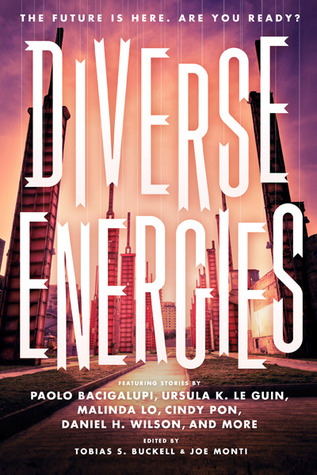
Review: Diverse Energies edited by Tobias Bucknell and Joe Monti

Tags: science fiction, fantasy, dystopian, POC, short story anthology

Summary

“No one can doubt that the wave of the future is not the conquest of the world by a single dogmatic creed but the liberation of the diverse energies of free nations and free men. No one can doubt that cooperation in the pursuit of knowledge must lead to freedom of the mind and freedom of the soul.” —President John F. Kennedy, from a speech at University of California, March 23, 1962

 In a world gone wrong, heroes and villains are not always easy to distinguish and every individual has the ability to contribute something powerful. In this stunning collection of original and rediscovered stories of tragedy and hope, the stars are a diverse group of students, street kids, good girls, kidnappers, and child laborers pitted against their environments, their governments, differing cultures, and sometimes one another as they seek answers in their dystopian worlds. Take a journey through time from a nuclear nightmare of the past to society’s far future beyond Earth with these eleven stories by masters of speculative fiction. Includes stories by Paolo Bacigalupi, Ursula K. Le Guin, Malinda Lo, Cindy Pon, Daniel H. Wilson, and more. [summary from Goodreads]

Review

DIVERSE ENERGIES is like a Halloween trick-or-treat bag: you get some real good ‘uns, but you also get some duds that you always kind of throw back into the bag and hope that you don’t pull out again in your next swipe. It’s definitely a worthwhile read for those interested in the intersection of SFF with POC (hah, so many acronyms), particularly if you enjoy or don’t mind short stories. However, I’m not sure it had the comprehensive punch required for it to break out of its niche for the time being.

Here are some thoughts for most (though unfortunately not all) the short stories:

“Last Day” by Ellen Oh - I felt like this story didn't add anything new to the category of "tales about Japanese people in wartime." The "shocking reveal" towards the end was too sudden to actually move me. 3/5

"Freshee's Frogurt" by Daniel Wilson - Rebellious, murderous robots! Quick, intense, eerily believable. 4/5

"Uncertainty Principle" by K. Tempest Bradford - Attention-holding storytelling. The science aspect felt a little underexplained, though. 4/5

"Pattern Recognition" by Ken Liu – So that’s how one can write about modern China's characteristics. The timeline jumped around a little too abruptly for me, but I felt the idea of this was quite realistic. 3.5/5

"Gods of Dimming Light" by Greg van Eekhout - Bad. Ass. Viking legends? Genomics? Short and fast, but fun! 3.5/5

"Next Door" by Rahul Kanakia - I liked the characters and the world but the pacing was uneven, especially towards the end, when it felt like things rushed to a premature conclusion. 3/5

"Good Girl" by Malinda Lo - Good, controlled balance between emotion, plot, and world-building. Little actually happened and questions were left unanswered at the end, but in a way that felt natural to the MC's understanding of things. 4/5

"A Pocket Full of Dharma" by Paolo Bacigalupi - Great worldbuilding; recognized a lot of elements of the modern China I know in here. The concept of having a person's consciousness in a datacube was fascinating, and the villains were scary. 4/5

"Blue Skies" by Cindy Pon - It's cool to read about a future version of Taipei. Unfortunately, the kidnapping plot felt a bit contrived, which lessened the impact the story's setup could've had for me. 3/5

"What Arms to Hold" by Rajan Khanna - Really wished the story had been slightly more specific as to its setting. 'Twas okay, but forgettable. 3.5/5

"Solitude" by Ursula K. LeGuin – This is the best of the bunch, even though it’s a reprint. But I’m glad the editors decided to include this, because I don’t know if I would’ve heard of this short story otherwise, and it’s brilliant. This is spot-on, a chilling yet fully understandable depiction of communication problems ("CP") between different cultures. 5/5

Cover discussion: I kinda like how the cover doesn't attempt to do anything fancy in terms of designs or symbolic representations of the future, and just lets the focus be simply on the title and the names of authors.

Tu Books / Oct. 1, 2012 / Hardcover / 368pp. / $19.95

e-galley received for review from publisher and NetGalley.

Wednesday, October 17, 2012

Review: Adaptation by Malinda Lo

Adaptation, Book 1

Tags: YA, sci-fi, aliens, LGBT, love triangle

Summary

Reese and her debate partner David are about to fly home from a national debate tournament when shocking bird strikes make planes fall out of the sky and ground all North American air travel. In trying to get home to San Francisco via rental car, Reese and David get into a terrible accident and receive medical treatment that heals them, but requires them to sign a strict nondisclosure agreement.

Returned to San Francisco and forced to act as if nothing out of the ordinary happened to them, Reese and David nevertheless discover that they are not quite the same as they used to be. Any injuries they sustain heal impossibly quickly, and there are other, stranger qualities they’ve developed that they find difficult to talk about. In the meantime, Reese struggles to understand herself as her romantic feelings are pulled in two unexpectedly different directions. But for whatever reason, the government refuses to let her and David go, and they race against the infinitely superior resources of the government to figure out what’s happened to them, and what will happen to them next

Review

Malinda Lo takes her readers way outside her previous fantasy genre with her third novel, ADAPTATION, which I suppose I would describe as “sci-fi lite.” While the events of ADAPTATION were at times hard for me to immerse myself in, Lo adds a refreshing LGBTQ element to her story that may encourage readers typically reluctant to pick up sci-fi to give this a try.

Part 1 was mind-blowingly awesome. Scary events—bird strikes downing planes, people forgetting their humanity in the face of their impending mortality, Reese and David struggling to make it home as transportation unravels around them—unfolded in an ominously quick fashion reminiscent of apocalyptic movies. I hardly breathed as I followed Reese and David through a “road trip” fraught with danger, one that led them right up to the accident that changed their lives forever.

…And then the rest of the book becomes…weird, and awkwardly paced. Obviously there’s a speculative element to the story, as the story hints of weird things occurring to Reese and David’s bodies and minds—though nothing is confirmed until the end of the book, in a manner that seemed rather far-fetched despite all the hints that were dropped throughout. In Part 2 and beyond, ADAPTATION loses the steam it had been so excellently accumulating, and becomes a plodding and seemingly endless period of rising action where little happens and the characters run into more and more questions but don’t get any answers. Why is this so often a symptom of YA novels, for which I thought good pacing was key? Little (with the exception of one thing, which I will discuss next) happens in the middle third or so of this book, and the effect of cramming all the information-revealing actions into the last few chapters of the book was that I was left unpleasantly disoriented and unprepared for the shocking curves the story threw us at the end.

I have mixed feelings about Reese’s romantic conflicts in ADAPTATION. On the one hand, what Lo always does well in her stories is give lesbian interactions and relationships the full consideration and respect they deserve. This is especially significant in a current publishing world where heterosexual romances often seem written into a story for the sake of having a romance, not because the MC actually learns anything through the experience of a romantic relationship. It adds some well-appreciated novelty to the typical YA love triangle trope. On the other hand, the balance between ADAPTATION’s romantic and sci-fi plotlines felt uneven—most especially in the nothing-happens-sci-fi-wise section of Part 2—and the two seemed to come too easily together in the end for me to believe that these characters and their predicaments could exist outside the realm of fiction.

And that, I think, is my ultimate feeling toward ADAPTATION. It’s a technically precise YA thriller with LGBTQ aspects, but its uneven pacing never let me forget that I was reading a YA novel that would probably better enthrall a younger audience that may not yet appreciate the shockingly possible dystopian worlds of books like 1984 or The Hunger Games. It fits the current trend of YA sci-fi-ish thrillers with more-or-less plausible premises that nevertheless rely on their assumption of your investment in the book’s “mystery” to keep reading.

Similar Authors
R. J. Anderson (Ultraviolet)
Robin Brande (Into the Parallel)

Cover discussion: I'm not sure how much it has to do with the actual story, but it looks pretty cool nevertheless.

Little, Brown / Sept. 18, 2012 / Hardcover / 400pp. / $17.99

e-galley received from publisher and NetGalley.

Tuesday, September 20, 2011

Review: Into the Parallel by Robin Brande

The Parallel Series, Book 1

Tags: YA, sci-fi, astrophysics, string theory

Summary

Budding astrophysicist Audie Masters makes the greatest discovery of her time when she figures out how to jump into a parallel universe…and meets her other half! In this other universe, Hallie Markham is a famous world traveler, and Audie has a serious inferiority complex as she unravels the extent of her physics discovery…

Review

Robin Brande takes readers into a new dimension—literally—with her YA sci-fi, INTO THE PARALLEL. While various elements of the story, such as plot and characters, don’t feel as tight as her YA contemporary novels, INTO THE PARALLEL is nevertheless an enjoyable story that draws only lightly on advanced scientific concepts.

The majority of INTO THE PARALLEL unfolds through dialogue: Audie talking to Hallie and trying to figure out what’s going on, Audie talking to the professor, Audie lying to her mom…really, the amount of information that’s revealed through stationary dialogue is rather disconcerting, as you realize that there’s not much going on in terms of plot. Due to the talky nature of the story, little seems to be at stake: about halfway through the story, I found myself wondering, okay, so are we ever going to get to the gritty conflict? Alas, I felt like no such thing ever appeared—INTO THE PARALLEL was really just an exploration of a new situation, with little else driving the story.

The characters all seem to suffer from various symptoms of character flatness. Audie is a pretty straightforward protagonist, but sometimes she bugged me because her thoughts and behavior were at odds with her supposed intelligence. Honestly? This is one girl who will not be getting into Columbia, her dream school—and if she does, I will be tempted to chalk it up to fictional wish fulfillment (sigh). Hallie’s unwillingness to draw attention to herself and her accomplishments is at least consistent and admirable, if a little boring. As for Audie’s love interests, well, not much distinguishes them either. I feel like the character development relied too much on dialogue, at the expense of actually allowing readers’ connections to the characters, and the characters’ connections to one another, to unfold more naturally.

INTO THE PARALLEL tackles the fascinating possibilities that quantum mechanics and string theory offer, but it does so in a way that is rather elementary: in fact, the story could’ve done without the astrophysics element and still worked. Therefore, I’d say that it is a less sci-fi and more just a series of events that unfolds in parallel universes. Nevertheless, I give Robin Brande credit for all her research into this fascinating topic, and for writing a killer of a cliffhanger ending that, fortunately, can be immediately remedied, as the sequel is now out online. Will I be reading it? Hmm. Perhaps. INTO THE PARALLEL was lacking in a number of elements that are important to me in an enjoyable and well-written story, but everyone has those few authors they make exceptions for, and Robin’s one of them for me.

Similar Authors
Myra McEntire

Cover discussion: Well, uh, thankfully I don't have to look at it too often because I have an e-copy?

Ryer Publishing / July 9, 2011 / Paperback / 392pp. / $15.99

Received for e-review from the author.

Saturday, September 17, 2011

Review: Ultraviolet by R.J. Anderson

Tags: YA, paranormal, sci-fi, synesthesia, mental hospitals

Summary

Alison Jeffries is a synesthete—a person whose senses are “crossed” so that she experiences multiple sensory experiences whereas most people just experience one—but she doesn’t know this. All she knows is that she’s been this way her whole life, and has to hide her ability, and that this condition may or may not have killed her classmate, Tori Beaugrand. Locked in a mental institute, Alison struggles to understand who she is and what she’s done, but it’s not until the arrival of a sympathetic researcher that she finally begins to understand…and, in doing so, has her world turned upside-down.

Review

R. J. Anderson steps away from faeries and tackles an entirely new genre and writing style in her latest novel, ULTRAVIOLET. ULTRAVIOLET is weird and crazy, but surprisingly, this genre-defying novel is an enjoyable success.

The less you know about ULTRAVIOLET before you read it, the better your reading experience will most likely be. ULTRAVIOLET’s plot doesn’t quite twist and turn, per se, but reader engagement is primarily predicated on unexpected revelations. This means that the characters feel somewhat lacking. Alison doesn’t stand out as a protagonist, though she is, fortunately, not a damsel-in-distress. Supporting characters take on rather one-dimensional roles: you’ve got yourself a plethora of fairly stereotypical mental patients, and the lifelong tension between Alison and her mother feels undeveloped.

Fortunately, the odd appeal of the story makes up for lackluster characters. While the writing is elementary, the story inexplicably sucks you in: you’re right there alongside Alison, having your mind blown and trying desperately to figure out where in this new version of the world you fit. Just when you thought the story couldn’t get any stranger, R. J. Anderson throws you another curveball. It’s pretty incredible, actually, how far she manages to stretch the story while still making everything fit together logically!

Overall, ULTRAVIOLET is not a masterpiece, but it was an entertainingly crazy read. Definitely recommended to readers who look more for originality in their reads.

Similar Authors
Myra McEntire
Robin Brande

Cover discussion: I am, apparently, shallow and love all photographic covers that are extremely detailed and play intriguingly with light and shadow. Tee.

Carolrhoda Books / Sept. 1, 2011 / Hardcover / 306pp. / $17.95

Received for review from NetGalley.

Friday, March 4, 2011

Review: Singing the Dogstar Blues by Alison Goodman

Tags: YA, science fiction, aliens, time travel

Summary

17-year-old Joss Aaronson is an irreverent harmonica player, a first-year student in the time-jumping program at Australia’s Centre for Historical Studies, and a stealthy player in the game against authority. When the Centre’s first alien student, a Chorian named Mavkel, chooses her as his time-jumping partner, the two form an unlikely alliance. For Chorians need to be part of a pair to survive, and Mavkel has lost his birth-pair.

Joss tackles prejudiced teachers, heavy security, a distant mother, and her own enigmatic background, but when Mavkel begins to waste away, Joss knows that the only way to save him is to go back in time and discover her own lineage. The result is a startling discovery that will rock what everyone believes of the Centre.

Review

It’s been a while since I’ve read a straight-up science-fiction YA novel, and yet SINGING THE DOGSTAR BLUES proves to be one of the best of its genre. With a great protagonist and a fully realized world, this small book will suck you in so fast you won’t even realize when you’ve lost your heart to it.

Joss is, without a doubt, my kind of girl. A bit jaded, a bit too smart for her own good, she is thoroughly entertaining to read about. Her tongue-in-cheek observations and flagrant disregard for Centre rules make her the opposite of the passive protagonist I typically dread in YA lit, and yet she’s not so rebellious as to be unrelatable. She is, in a sense, the kind of “bad girl” most readers have secretly imagined themselves being.

Science fiction is difficult to write because it involves creating a thorough world and to consider the implications of adding any detail to the story. Luckily, Alison Goodman’s world in SINGING THE DOGSTAR BLUES is remarkably believable and “real”: I could very nearly see all that Joss sees through the sharp and precise writing.

The one complaint I had about this book was the predictability of the ending. I figured out how things were going to unfold several chapters before Joss did. This is a recurring weakness in Goodman’s novels (her YA fantasy Eon: Dragoneye Reborn had the same thing happen), and yet doesn’t majorly detract from my utter delight in reading this book. Overall, I can solidly recommend SINGING THE DOGSTAR BLUES as one of the best YA science fiction novels ever written. Don’t miss out on this one!

Writing: 5/5
Characters: 5/5
Plot: 4/5

Overall Rating: 4.5 out of 5


Cover discussion: 3 out of 5 - I've seen better, and I've seen worse. I can see that as Joss, particularly as she is of mixed ethnicity, and that rebellious look on the model's face fits well with my idea of Joss.

Penguin / Nov. 2004 (reprint) / Paperback / 272pp. / $7.99

Personal copy.

Tuesday, January 18, 2011

Review: Across the Universe by Beth Revis

Tags: YA, sci-fi, dystopian, mystery, murder, secrets

Summary

Amy wasn’t planning on being nearly killed when she, her parents, and 97 other people are cryogenically frozen for a 300-year journey aboard a massive spaceship. But someone unfreezes her 50 years early, and she finds herself aboard a ship run by a tyrannical leader named Eldest. As Amy spends time with Eldest’s successor, a teenage boy named Elder, she discovers that the ship contains many secrets. What is Eldest hiding? Why is someone still killing the cryogenically frozen passengers? What’s wrong with the zombielike behavior of the ship’s residents?

Review

ACROSS THE UNIVERSE is a heartpounding sci-fi/mystery by debut author Beth Revis. Whether or not you are a fan of science fiction, you’ll be pulled into the mysteries that the Godspeed contains, and this future world that Beth has so stunningly created for us readers.

Perhaps most impressive about this book is the development of the ship, Godspeed, and its inner workings and secrets. From reproduction to crop control to emotional stasis, the people who run this ship have created an eerily controlled dystopian environment. No concept is too complicated for a non-science person to understand. It creeps you out yet keeps you glued to the pages.

Amy and Elder are enjoyably well-rounded. Amy is headstrong but not annoyingly so, as many female protagonists have a tendency to be when faced with dramatic situations. Elder, likewise, is a sweetheart, with both his vulnerabilities and leadership. Other characters occasionally fall a bit unbelievably flat, such as Eldest’s unconvincingly one-dimensional villainy. Still, the pacing moves the story along nicely. Beth Revis makes use of the actual space on the page and crafts her sentences to appropriately reflect the amount of tension in the situations, adding to the mood.

The conclusion of ACROSS THE UNIVERSE is explosive yet satisfyingly so, leaving you wanting the sequel. This book just might convince many readers to be interested in science fiction. I’m looking forward to seeing what happens to Amy, Elder, and Godspeed next!

Similar Authors
Orson Scott Card

Writing: 4/5
Characters: 4/5
Plot: 4/5

Overall Rating: 4 out of 5


Cover discussion: 4 out of 5 - The opposing heads kind of freak me out a little, but that sky is GORGEOUS. The astrophysics nerd within me swoons into a puddle of my own drool.

Razorbill / Jan. 11, 2011 / Hardcover / 400pp. / $17.99

ARC requested from author/publisher.

Saturday, December 4, 2010

Review: Black Hole Sun by David Macinnis Gill

Tags: YA, sci-fi, Mars

Summary

Durango is a self-employed ex-Regulator on the scrappy future colony of Mars. He has an AI implanted in his brain and does random odd jobs in his hi-tech “armor” suit. His next job leads him to a group of miners trying to protect themselves from the Draeu, scary human-like creatures with a penchant for violence and distruction. Should be no sweat, right?

But even Durango can’t prepare for what he’s gotten himself into.

Review

Have you heard of Firefly, the sci-fi/western Joss Whedon-directed TV show that’s arguably one of the best shows ever produced? BLACK HOLE SUN is very much like Firefly, which is both good and challenging: the book has a similar sense of humor, characterization, and setting, but is hard-pressed to live up to its fantastic inspiration.

The best thing about BLACK HOLE SUN is hands-down Durango’s voice. He’s a definite Captain Mal Reynolds: once an accomplished academy member turned self-employed rogue, with all the snarkily pragmatic disaffection that such a position nurtures. He and his AI, his cheeky former boss Mimi, provide neverending amounts of conversational back-and-forths, you know, the sort you always wish you could engage in in real life but could never real pull off except with multiple revisions. Durango’s witty dialogue takes center stage and never fails to leave you chuckling, even as the plot plods and the other characters don’t shine as brightly.

Indeed, BLACK HOLE SUN sometimes feels like it relies too much on the appeal of Durango’s voice to pay more attention to other important elements of story. It’s slow-going, the plot: the main conflict doesn’t even arise until almost halfway through the book, and even then it meanders so much that oftentimes I found myself scratching my head and wondering if there was anything, anything at all, going on. The supporting characters are way less developed. With the exception of Vienne, Durango’s right hand and maybe-maybe-not love interest, the other characters don’t really stand out or make much of a lasting impression.

If you read BLACK HOLE SUN, read it for its brilliant voice, one of the most unique ones out there currently in YA lit. It’s no Firefly, but if you’re okay with a slower plot, then you get to focus on the brilliance that is Durango’s character.

Writing: 4/5
Characters: 4/5
Plot: 3/5

Overall Rating: 3.5 out of 5


Cover discussion: 3.5 out of 5 - I like how it's simple and straightforward in that block-text sort of way, only without the blocky-ish text. But you have got to check it out in person. It's printed on some sort of black paper that turns streaks of rainbow when you hold it up to a light at the right angle. So ridiculously cool.

HarperCollins / Aug. 24, 2010 / Hardcover / 340pp. / $16.99

Copy bought.

Saturday, May 29, 2010

Review: The Gardener by S. A. Bodeen

Tags: YA, sci-fi, thriller, biotechnology

Summary

Mason lives with his mother, and the only thing he knows of his father is a faceless figure reading from a children’s book on a DVD. His mother first played it for him when Mason was younger and had his face mauled by a dog, and since then it’s always been comforting for him.

When Mason plays the DVD in front of a group of comatose teens his mother is carrying for on her job, one of them, a beautiful girl, miraculously wakes up. She immediately warns Mason that they have to run away from TroDyn, the company based in town. Who is this mysterious girl with the horrifying scars all down the backs of her legs, and what does TroDyn want with her? As Mason aids the girl in evading TroDyn, he stumbles across a shocking experiment that might change the future of mankind…

Review

I have not yet read S.A. Bodeen’s first book, THE COMPOUND, although I’ve heard it’s excellent in an almost creepy way. And after reading THE GARDENER, I’m willing to read anything she writes. THE GARDENER is a high-quality sci-fi thriller that will appeal to both male and female readers.

Mason is a readily understandable and likable protagonist. Scarred from a young age, this hulking football player nevertheless has something akin to a hero complex: he will go to great lengths to help others out, and once he starts helping he won’t stop until it’s finished. The uniqueness of his character makes his subsequent adventures with the girl and TroDyn follow almost naturally. He’s the perfect protagonist, with bits of both underdog and hunk in him.

THE GARDENER rides the line between sci-fi and dystopian. The futuristic aspects of this novel are well-researched and presented in a reasonably comprehensible manner: the book isn’t striving to educate us on biotechnology, but it also doesn’t plop us into the middle of a woefully underdeveloped world. We can figure out everyone’s motivations—with the exception of the story’s true villain, who pops up rather suddenly and with little preparation.

THE GARDENER isn’t perfect, with its caricaturesque villain and uneven pacing, but it is nevertheless a satisfying read that had me on the edge of my seat and flipping pages far into the night. I highly recommend this book if you’re looking for a unisex “softcore” sci-fi thriller.

Similar Authors
Scott Westerfeld

Writing: 4/5
Characters: 4/5
Plot: 4/5

Overall Rating: 4 out of 5


Cover discussion: 3.5 out of 5 - It is eerily appropriate for this book... but it actually scares me quite a bit if I look at it too long. You should read the book to find out how it's related to the story!

Feiwel & Friends / May 25, 2010 / Hardcover / 240pp. / $16.99

ARC gifted from Talya, also received from publisher for review. Thanks to both!

Thursday, December 17, 2009

Review + GIVEAWAY: When You Reach Me by Rebecca Stead


Tags: MG, YA, sci-fi, NYC, mystery

Rating: 4.5 out of 5


Summary

By the sixth grade, Miranda has learned how to get by in New York City. She and her only friend Sal walk to school together, avoiding the big loud boys in front of the garage and the laughing man on the corner. But then one of the boys punches Sal, and everything starts to change. Sal refuses to hang out with Miranda anymore, and she is forced to make new friends and explore different things in school.

Miranda also starts receiving mysterious letters from a person who knows eerily too much about her life and the future. Who is this person who wants Miranda to write an explanatory letter, claiming that she knows who he is? He claims to know how to save her friend’s life…but who is in danger, and what will become of them all if Miranda either ignores or acknowledges the letter-writer?

Review

Every once in a while there comes along a book that is so unique, so awe-inspiring, that you have to immediately rave about it to everyone around who reads books. WHEN YOU REACH ME is such a book. Rebecca Stead’s second novel is a middle-grade treasure that people will hopefully stumble upon and love all their lives.

My favorite part about this book was, of course, the sci-fi aspect, which was seamlessly woven into a coming-of-age story set in post-Vietnam War New York City. WHEN YOU REACH ME references Madeleine L’Engle’s A Wrinkle in Time heavily, a joy for hardcore fans of Meg and Charles Wallace. It also means that it will appeal to about 95% of readers, though Stead’s appeal is less fantasy and more about how seemingly impossible concepts can fit smoothly into our conceptions of our world. It’s not often that you get to read a science-y book that blows away all your expectations and predictions.

Besides for the sci-fi aspect, WHEN YOU REACH ME is also a charming coming-of-age novel with memorable characters. Miranda deals wonderfully with her family and classmates: she’s at that stage where she struggles to figure out who she thought she was in new situations. Perhaps the characters could’ve been developed slightly more, but readers come out of the experience very much impressed, and will have difficulty finding anything lacking.

In short, WHEN YOU REACH ME is one of 2009’s not-to-be-missed novel. Its lovely blend of realism and sci-fi makes it truly stand out, and Stead’s impeccable writing draws us right into Miranda’s world. Be sure to get your hands on a copy of this book in any way possible!

Similar Authors
Madeleine L'Engle
E. L. Konigsburg
Sharon Creech

Writing: 5/5
Characters: 4/5
Plot: 5/5

Overall rating: 4.5 out of 5


Cover discussion: 3 out of 5 - It's charming in its own way, but does not really evoke the feel of the story for me. Oh well! It's distinctive, and the story will make an impression on you. What more do you need?

Random House / July 2009 / Hardcover / $15.99

-

GIVEAWAY!

OH HEY LOOK! A chance to win one of 2 copies of When You Reach Me, right here on my blog, thanks, once again, to the generosity of Random House!!! When I said that this was one book you can't miss, even I didn't realize how soon you would have the opportunity to read and own your very own copy, hehe.

To enter, leave a comment with your email address and the answer to this question: Why are you interested in reading this book?

***No email address and no answer to the question, no entry into the giveaway.***

For extra entries:
+1 if you follow me
+1 if you blog/Facebook status/sidebar link to this giveaway (+1 for each)
+1 if you tweet about this giveaway and mention me (@stephxsu)

All entries can be typed into one comment. Since this is a publisher-sponsored giveaway, I am restricting it to US mailing addresses only, no PO boxes. Enter by Tuesday, Dec. 29, 2009. Good luck!

Monday, August 10, 2009

Review: The Rapture by Liz Jensen

Publication date: Aug. 11, 2009 (Doubleday)

Tags: adult, apocalyptic, science fiction, psychological thriller, paralysis

Rating: 3.5 out of 5

Summary

30-something-year-old Gabrielle Fox, wheelchair-bound after an emotionally and physically scarring car accident, works as an art therapist for some of Great Britain’s most mentally disturbed juveniles. One of her patients is Bethany Krall, charged with murdering her mother with a screwdriver. Bethany likes to talk about forthcoming geological disasters with scientific accuracy.

At first Gabrielle professionally ignores Bethany’s babble. But when Bethany’s predictions match up with real-life events and seem to point to a disaster of apocalyptic proportions, Gabrielle can no longer ignore her paranoia. Together with a few believing scientists, Gabrielle struggles to convince the rest of the world that a psychotic girl with murderous tendencies actually holds the key to preventing the annihilation of the human race.

Review

THE RAPTURE is an unusual though frighteningly scientifically plausible take on the apocalypse. It is not an easy read: Gabrielle’s colloquial narrative takes you right into her head, which may or may not be effective, depending on the reader. The first half of the book builds slowly, as it focuses more on developing Gabrielle and her relationship with the physicist. Bethany is supremely dislikable all throughout, but more so at the beginning.

Even with these minor complaints, however, Liz Jensen writes a story that’s full of scientific accuracy in a way that sucks you in. Apocalyptic tales only work when they’re done intelligently, and both THE RAPTURE and its author are well aware of and accomplish that. While I found the pacing of this novel a little odd—too slow in the beginning, too quickly building to its climax towards the end—it is still a masterfully suspenseful read in the end.

THE RAPTURE is not for the faint of heart, and it focuses more on Gabrielle’s emotional damage and the apocalyptic possibility of Bethany’s predictions than the actual psychological aspects of their relationship. However, for those who love speculative fiction and similar geological horror/thriller movies, this will be a good read.

Writing: 3/5
Characters: 4/5
Plot: 3/5

Overall Rating: 3.5 out of 5

Cover discussion: 3 out of 5 - It's quite interesting. I love the science-y-ness of it: the vectors making the shape of a tornado. Very cool! This would definitely grab my attention at the bookstore.

Thursday, February 5, 2009

Review: Unwind by Neal Shusterman

Tags: YA, dystopia, sci-fi, abortion issues, religion

In an alternate (or future) United States, the Heartland War between pro-life or pro-choice parties has been fought, and one of the compromises that the people have come up with is unwinding: any teen between 13 and 18 can be signed over by their parents to the government, to be "unwound" into parts for other people's bodies. It's not death, they say, because you remain in divided parts. But is it really living?

Connor is a troublesome teen whose parents are having him unwound. Risa is an orphanage at the overcrowded state home that is planning to cut costs by having a number of kids unwound. And Lev is a tithe--born and raised to fulfill his role of being an Unwind, and thus giving back to his god and the community.

The three teens are thrown together in a desperate adventure to save their own lives--and, eventually, the lives of thousands of other Unwinds. But the journey they must make is a dangerous one, one that can fall apart at any second through betrayal or bad luck. How much can they possibly do to undermine the system that threatens to dismantle them?

Unwind takes on a variety of challenging topics that to this day still have no clear answer: abortion, how to deal with unwanted pregnancies, religion, and the existence of souls. Thankfully, it provides no cut-and-dry answer to these issues, and instead presents them in a thrilling and approachable novel. While I was not particularly impressed by Shusterman's writing style (too much telling and not enough showing), the characters--especially Connor and Risa, but even some of the secondary characters--come across as strong, unique, and appealing. They are good protagonists for readers to follow in this book that will most certainly leave an impression on you.

You'll like this if you also like...
Suzanne Collins (The Hunger Games)
Michael Grant (Gone)
Margaret Peterson Haddix

Rating: 3.5/5

LinkWithin

Related Posts Plugin for WordPress, Blogger...