Showing posts with label review. Show all posts

Friday, March 7, 2014

Review: The Summer Prince by Alaya Dawn Johnson

Tags: young adult, dystopian, sci-fi, LGBT, POC, art

Summary

The lush city of Palmares Três shimmers with tech and tradition, with screaming gossip casters and practiced politicians. In the midst of this vibrant metropolis, June Costa creates art that’s sure to make her legendary. But her dreams of fame become something more when she meets Enki, the bold new Summer King. The whole city falls in love with him (including June’s best friend, Gil). But June sees more to Enki than amber eyes and a lethal samba. She sees a fellow artist.

Together, June and Enki will stage explosive, dramatic projects that Palmares Três will never forget. They will add fuel to a growing rebellion against the government’s strict limits on new tech. And June will fall deeply, unfortunately in love with Enki. Because like all Summer Kings before him, Enki is destined to die.

Pulsing with the beat of futuristic Brazil, burning with the passions of its characters, and overflowing with ideas, this fiery novel will leave you eager for more from Alaya Dawn Johnson.

Review

It is with regret that I say I couldn’t finish this book. I got within several dozen pages of the end, and even then I couldn’t make myself finish. This book has so much going for it: the world-building of a future South American enclosed society that’s extremely hierarchical and matriarchal and sci-fi is one of the best I have encountered in books marketed as YA, and as a result of this spectacular world-building, Johnson had a LOT she could work with in terms of exploring dystopian ideas and socially relevant themes of art and technology and race-based issues.

Unfortunately, what THE SUMMER PRINCE lacked for me was an emotional connection with the characters. In between Johnson’s sinfully sensuous prose and her attempts to portray Enki as this beautiful and irrepressible, yet enigmatic, near-mythical being, it seems like there was lost the ways in which readers could concretely grasp the characters’ traits and motivations and desires. Enki read too much like a MPDG (except a guy) to me, and I don’t really have a problem with MPDG characters, except Enki’s character was much too slippery and bright for me to even grasp at the edges.

Johnson is a talented writer, having already published several acclaimed works. But perhaps THE SUMMER PRINCE would have been better marketed as not-YA, for in this genre in which so much depends upon readers’ connections with the characters, THE SUMMER PRINCE will have to face an uphill battle despite all that it has going for it.

Similar Authors
David Levithan
Malinda Lo

Cover discussion: One of the best covers of 2013, hands down. Evocative of the book's thematic content of art, technology, race, and the future without being lurid. So, so, so beautiful.

Arthur A. Levine / Mar. 1, 2013 / Hardcover / 304pp. / $17.99

Borrowed from library.

Tuesday, December 3, 2013

Review: The Coldest Girl in Coldtown by Holly Black

Tags: YA, paranormal, vampires, romance

Summary
Tana lives in a world where walled cities called Coldtowns exist. In them, quarantined monsters and humans mingle in a decadently bloody mix of predator and prey. The only problem is, once you pass through Coldtown’s gates, you can never leave.

One morning, after a perfectly ordinary party, Tana wakes up surrounded by corpses. The only other survivors of this massacre are her exasperatingly endearing ex-boyfriend, infected and on the edge, and a mysterious boy burdened with a terrible secret. Shaken and determined, Tana enters a race against the clock to save the three of them the only way she knows how: by going straight to the wicked, opulent heart of Coldtown itself.

The Coldest Girl in Coldtown is a wholly original story of rage and revenge, of guilt and horror, and of love and loathing from bestselling and acclaimed author Holly Black.
Review

I'm not the type of reader to instantly dismiss all vampire stories out of vampire fatigue; as long as it's written well, I can enjoy it. And THE COLDEST GIRL IN COLDTOWN is written well. It brings me back to Holly Black's Tithe era, with its grungy urban landscapes full of disaffected, multiply pierced, dyed-haired teenage characters who are simultaneously cooler and yet more vulnerable than you'll ever be. Black's narrative swirls between settings and time periods and points of view in a style that I imagine is like what being on raver drugs must feel like. Slightly disorienting, swirls of more-than-they-seem interactions and side-goings-on piquing the corners of your vision, disorienting your understanding of reality so slyly, so insidiously, that when you pause to take a breather from reading this story, you blink and for more than a second think that Black's world could very well exist, unobserved, in your own. Gavriel, the male vampire love interest, even gets me hot and bothered just like the icy-hot Roiben (Rath Roiben Rye, Rath Roiben Rye) of Tithe did.

Verdict? If you love your vampire tales slightly darker and hipper and more insane, get up this alley. If, like me, you spent your formative years gorging on Holly Black's classic urban fantasy YAs, get at this one. If you like your paranormals more romance-y and plot-driven, then this will probably not be your cup of tea.

Cover discussion: ...Wow. Somehow, in the time between when I read this (on my Kindle) and now, I had completely forgotten about the cover. I guess there's some implication in there about how uneventful this cover is...?

Little, Brown / Sept. 3, 2013 / Hardcover / 421pp. / $19.00

e-galley offered by publisher for review. Thank you!

Thursday, September 5, 2013

Review: Rose Under Fire by Elizabeth Wein

Code Name Verity review

Tags: young adult, middle grade, historical fiction, World War II, pilots, concentration camps, poetry

Summary

While flying an Allied fighter plane from Paris to England, American ATA pilot and amateur poet, Rose Justice, is captured by the Nazis and sent to Ravensbrück, the notorious women's concentration camp. Trapped in horrific circumstances, Rose finds hope in the impossible through the loyalty, bravery and friendship of her fellow prisoners. But will that be enough to endure the fate that’s in store for her?

Elizabeth Wein, author of the critically-acclaimed and best-selling Code Name Verity, delivers another stunning WWII thriller. The unforgettable story of Rose Justice is forged from heart-wrenching courage, resolve, and the slim, bright chance of survival.

Review

For me, Code Name Verity's domination of the YA literary scene came about not from its compelling premise and thriller-like aspects, but from the strength of Elizabeth Wein's writing, of her writing voice. Which is why I never had a doubt that ROSE UNDER FIRE wouldn't be excellent. To have what the narrative voice that I associated with Julie/Maddie in CNV seemingly transplanted onto Rose was a little jarring at first for me--but then Rose's own unique brand of strength emerged, roaring, and fed my readerly sympathies and investment. She is smart, resilient, and a much more resonant writer than she gives herself credit for... in other words, exactly the kind of YA heroine that can win hearts anywhere.

ROSE UNDER FIRE deals with a particular dark chapter of World War II history: Nazi doctors performing torturous experiments in the name of "scientific advancement" on young prisoners. The very idea alone is chilling enough, but ROSE UNDER FIRE stays clear of historical moroseness and heavy-handed eulogizing by ensuring that its focus stays clearly on the characters. Rose is joined on the page by more admirable female supporting characters than I can keep track of. What Wein does so well in her two WWII historical novels is that she doesn't merely let the characters' predicaments demand readers' sympathies: rather, the characters--big-hearted, smart-mouthed, brave or frightened--and the empathy they deserve speak for themselves. These are characters we would like anywhere, in any story, in any time period.

Elizabeth Wein has accomplished what few YA writers have yet to do, and that is to make historical fiction popular and resonant. If she continues to write historical fiction, I'll for sure be glad, but I'd also be happy with whatever else she chooses to write in the future. Her surehanded characterization and narrative voice have made me a fan through everything.

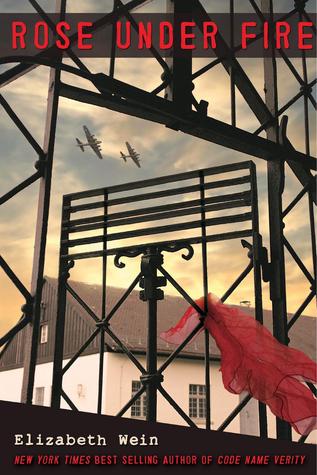
Cover discussion: I feel like it changed quite a bit from the hardback cover for Code Name Verity, and I don't know how I feel about it. Still, I appreciate that it's different from most of the other YA covers out there. Its illustrated quality belies the fact that most of the book takes place under the most chilling conditions.

Miramax / Sept. 10, 2013 / Hardcover / 368pp. / $17.99

ARC received from publisher for review. Thank you!

Friday, August 16, 2013

Review: Vessel by Sarah Beth Durst

Tags: young adult, fantasy, magic, desert, POC

Summary

Liyana has trained her entire life to be the vessel of a goddess. She will dance and summon her tribe's deity, who will inhabit Liyana's body and use magic to bring rain to the desert. But when the dance ends, Liyana is still there. Her tribe is furious--and sure that it is Liyana's fault. Abandoned by her tribe, Liyana expects to die in the desert. Until a boy walks out of the dust in search of her.

Korbyn is a god inside his vessel, and a trickster god at that. He tells Liyana that five other gods are missing, and they set off across the desert in search of the other vessels. The desert tribes cannot survive without the magic of their gods. But the journey is dangerous, even with a god’s help. And not everyone is willing to believe the trickster god’s tale.

The closer she grows to Korbyn, the less Liyana wants to disappear to make way for her goddess. But she has no choice--she must die for her tribe to live. Unless a trickster god can help her to trick fate--or a human girl can muster some magic of her own. [summary from Goodreads]

Review

I wanted this to be AMAZING. Because it’s Sarah Beth Durst. And there’s a stunning Asian model on the cover. But VESSEL didn’t blow me out of the water, though it was still a fine and unique fantasy geared more towards younger fantasy fans rather than jaded, crotchety SFF readers with high demands for world-building, plot, and characterization (a.k.a. me).

Right out of the gate, VESSEL stands a head above others of its ilk because of its protagonist, Liyana. With her slightly snarky sense of humor, especially when she’s with family, Liyana drew me to her immediately…which helped through the rougher periods of the book, when the features that often drag down a quest-based plot—new characters introduced much too quickly to fully capture readers’ support, a whiplash-inducing quick pace that makes it more difficult for readers like me to remain invested in the story—reared their heads.

As with one of Durst's previous books, Enchanted Ivy, in VESSEL, I sometimes found that I had difficulty keeping the thread of what was going on. Didn’t they just arrive in Place B, and why do they have to move on to Place C so quickly? Weren’t he and she fighting only a few pages ago? The constant barrage of questions going on in my head as I struggled to figure out which of the many minor characters introduced were truly significant, what romance to focus on, which interactions were actually important to the overall plot, really took me out of the story, so that at the end of this swashbuckling desert magic tale I closed the book with a little, “Huh.” It was a decent enough read for me, but several months on from when I read the book, I’m not sure how much of it stayed with me at all.

Similar Authors
Juliet Marillier

Cover discussion: Do I even have to say anything? Do I really have to explain to you why I like--nay, love--this cover so much?

Margaret K. McElderry Books / Sept. 11, 2012 / Hardcover / 432pp. / $16.99

Review copy received from author and publisher. Thank you for giving me the opportunity to review it!

Tuesday, July 30, 2013

Review: Raven Flight by Juliet Marillier

Shadowfell, Book 2
Book 1: Shadowfell review

Tags: young adult, middle grade, fantasy, magic

Summary

With an accelerated timeline, Neryn is ready to seek out the four ancient Guardians of Alban to ask for their help in teaching her to become the best Caller she can be, in order to help the Rebel forces (and her friends) of Shadowfell to overthrow King Keldec. But the learning is not easy: Neryn struggles to come to terms with her power and influence, and can’t figure out where her feelings for Flint fit into this greater cause…if they can at all.

Review

RAVEN FLIGHT was not as engaging for me as Shadowfell—but the thing is, they’re not all that different from one another. Neryn is still this can-do-no-wrong protagonist who, if not liked instantly by all she meets, at least can quickly win them over with her earnest naivete. The plot is straightforward quest involving long distances traveled and new characters met.

In RAVEN FLIGHT, we learn more about what exactly makes Keldec so evil. And boy is the man frightening! In one of the most riveting scenes in the story, Neryn is forced to witness Keldec’s cruelties to his subjects from front-row seats. This insight into Keldec’s rule is horrifying, yet really upped the stakes for me as a reader in cheering the painfully perfect Neryn on to success.

Unfortunately, perfection gets old, and Neryn’s personality grated on me a lot more in this installment than previously. I think I’m past the age when I can immerse myself in a protagonist who’s flawless—not in that put-together way, but in the one-girl-can-defeat-the-whole-world way. This is a straightforward fantasy geared, I think, more towards readers new to fantasy than to any others.

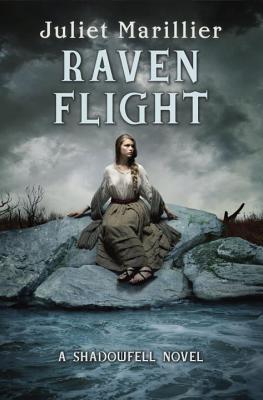
Cover discussion: *looks at it for the first time* Hah, kiddingbutnotreallykidding. Ah, I get it. It depicts a scene from the book, which is decent... but to be honest, I really just picked this up because it had JM's name on the cover. We should do a test to see what having JM's name on a book cover will enable me to overcome in terms of outrageous cover designs...

Knopf / July 9, 2013 / Hardcover / 416pp. / $16.99

e-galley received for review from publisher and NetGalley. Thank you!

Thursday, July 18, 2013

Review: Some Quiet Place by Kelsey Sutton

Tags: young adult, supernatural, abuse

Summary

Elizabeth Caldwell doesn’t feel emotions . . . she sees them. Longing, Shame, and Courage materialize around her classmates. Fury and Resentment appear in her dysfunctional home. They’ve all given up on Elizabeth because she doesn’t succumb to their touch. All, that is, save one—Fear. He’s intrigued by her, as desperate to understand the accident that changed Elizabeth’s life as she is herself.

Elizabeth and Fear both sense that the key to her past is hidden in the dream paintings she hides in the family barn. But a shadowy menace has begun to stalk her, and try as she might, Elizabeth can barely avoid the brutality of her life long enough to uncover the truth about herself. When it matters most, will she be able to rely on Fear to save her? [summary from Goodreads]

Review

Debut author Kelsey Sutton took a big risk in deciding to write about a protagonist who can’t feel any emotions. After all, one of the biggest criticisms of unsuccessful YA is about bland characters. And while there is an external reason for why Elizabeth is like a shell of a person, I am sorry to say that, instead of being a bold experiment in defying common YA problems by facing them head on, SOME QUIET PLACE merely fell into those very traps.

I’ll be straight with you: Elizabeth has no personality. And it’s not just her being her usual emotionless. She literally doesn’t have anything that distinguishes her from a blank slate other than what’s imposed on her from the outside. When describing Elizabeth, one has to resort to external descriptors: she has rotten parents, an absent brother, she likes to paint. This doesn’t tell us ANYTHING about Elizabeth. People need not be defined by the abuse of their families nor the fact that she paints with all the investment of one doing the dishes. Even sociopaths, who medically do not feel empathy, can have personalities. Elizabeth doesn’t, and that’s not a symptom of her problem.

The lack of personality is not just limited to the MC. Side characters are flat with (again) no personality of their own. Elizabeth’s father is the cardboard drunk and abusive character, while Elizabeth’s mother is the repressed and resentful housewife. Elizabeth’s best friend is the dying girl scared of dying. These are tropes, not to be confused with characteristics. With personality.

SOME QUIET PLACE furthermore falls into common YA pitfalls regarding its plot and mystery. Like too many other YAs that describe themselves as mysteries, SOME QUIET PLACE’s unfolding of its mystery is stuttering and unsatisfying. A great mystery reveals just enough hints in unexpected yet narratively consistent intervals to keep readers ensnared and invested. The “mystery” in this book—of what in Elizabeth’s past caused her to be the way she is—remains a mystery until its sudden anticlimax. The purported “hints” dropped throughout the book are not, actually, hints. “Hints” implies relevance to the plot and mystery; it’s not supposed to be a foray into a dull miniadventure leading into a dead end that the book insists to be a hint, but is in fact just pacing weakness, Insert Dramatic Red Herring Here. The so-called suspense in this book, unfortunately, was so unsatisfying as to frustrate me into apathy.

I could write more, but I’ll stop there and say this: It is completely possible to write from the point of view of a person who can’t feel emotions. But SOME QUIET PLACE was an amateur’s attempt, and sadly it wasn’t long before I realized that I could not feel anything towards Elizabeth and her predicament. And it’s not because I can’t feel emotions.

Similar Authors
Jackie Morse Kessler
Sarah Rees Brennan
Stephenie Meyer
Courtney Summers

Cover discussion: Isn't it luscious? I can practically feel the texture of that dress.

Flux / July 8, 2013 / Paperback / 336pp. / $9.99

e-galley received for review from publisher and NetGalley.

Tuesday, July 2, 2013

Review: Scarlet by Marissa Meyer

Lunar Chronicles, Book 2

Book 1: Cinder review

Tags: young adult, sci-fi/fantasy/dystopian, France, retelling

Summary

Scarlet Benoit’s grandmother has gone missing. Everyone tells her to not worry about it, there’s nothing she can do, her grandmother is an individualistic kind of person, but Scarlet thinks there’s something more insidious behind her grandmother’s disappearance. The only person who will help her is a soft-spoken street fighter named Wolf, whom Scarlet hopes she can trust, but who may have an agenda of his own. Answers are discovered, but more questions raised, when they cross paths with Cinder, whose recent and widely publicized escape from a New Beijing prison just might start the war that the ruthless Lunar Queen has been waiting for.

Review

Cinder was my unexpected enjoyable find of last year. After experiencing how effortlessly Marissa Meyer can weave together a convoluted yet exciting tale, I had high demands for the sequel, SCARLET. And in a way, SCARLET fulfilled them. In a way, it didn’t.

The good first: everything we liked about Cinder is in here, except perhaps even a notch better. In particular, the characters, old and new, major and supporting, are easy to cheer on. I mean, there are exceptions. Kai’s role is reduced to that of beleaguered new and helpless emperor under international pressure. Wolf, I’m sorry to say, did not appeal to me so much, not because I didn’t like his soft and shy personality (I did) so much as I have known many misunderstood love interests with wounded hearts of gold (see: many adult romance male leads). But when you weigh the slightly annoying—Kai and Wolf—against the good—Cinder’s resourcefulness and empathic internal struggle, Scarlet’s ferocity at protecting her loved ones, Thorne’s much-appreciated airheaded charm lightening the mood)—the good comes out on top.

That being said, one of the issues that some reviewers noted as a weakness in Cinder is even more apparent in SCARLET, and that is the world-building. I remember thinking the world-building in Cinder was decent, but in SCARLET I found it lacking. Don’t get me wrong: Meyer does a Richelle Mead-worthy job of setting up an elaborate yet believable backstory to the world’s current state, the one involving the Lunars and Princess Selene. But settings-wise, inadequate research and/or thought was glaringly apparent. At no point did the scenes in France distinguish themselves from what could’ve been going on in any other place in a future Earth. I wanted the book to show me its vision of what a future Earth divided into regions like the Eastern Commonwealth and European Federation, and experiencing strained relationships with Lunar, would look, feel, hear, taste, and smell like. What distinguishes Rieux, Scarlet’s hometown, from other places in the world? How does Paris fare several centuries from now, and how does its altered cityscape affect the characters’ movements and experiences?

Still, SCARLET was fast-paced and exciting. My attention started wavering around the end when everyone was running around killing each other in a very blankly drawn future Paris, but I’m still curious enough about how the Lunar/Princess Selene conflict will play out that I think I’ll continue to hang around this series. Read at the surface level, SCARLET is a successful rollicking good read. But I hope the series will pick up a bit on its world-building, for fear that those cracks will end up pulling the books down.

Similar Authors
Richelle Mead

Cover discussion: Oh hey, look, a publisher that didn't feel compelled to arbitrarily change the cover from hardcover to paperback. Hooray! I do like how this cover matches the one for Cinder, which I felt was memorable and powerful in its simplicity.

Feiwel & Friends / Feb. 5, 2013 / Hardcover / 464pp. / $17.99

Personal copy.

Thursday, June 20, 2013

Review: Wild Awake by Hilary T. Smith

Tags: young adult, contemporary, grief, music, piano, mental illness

Summary


When a strange caller informs young pianist Kiri Byrd he has the remains of her dead sister’s stuff—a sister who had been dead for years—Kiri’s life turns upside down. Kiri struggles to piece together what she’s learning about her sister, but doing so sets her on a crash course towards a breakdown, and only by acknowledging it can Kiri hope to live with it, to make it a part of herself.

Review

With the weight of the expectations I placed upon its spine after declaring its synopsis to be one of the best I’d ever encountered, Hilary T. Smith’s debut novel WILD AWAKE had a lot to live up to. Fortunately, it was more than up to the task. WILD AWAKE reminded me of the best type of our favorite and revered Aussie YA: it’s whimsical and more than a little odd, but ultimately grounded in the solid reality of common emotions.

WILD AWAKE has many strengths, one of which is its startling and beautiful prose. It startles you because Smith is, oftentimes, just noting in passing an everyday detail or thought—only she does so in a way that makes you pause and actually notice what you otherwise would not. The prose tinkles like water trickling over crystal. Its brightness combines with the darker undertones of Kiri’s situation for a full symphony of bass emotions and soprano wonder.

From the start, Kiri as protagonist stands out. She is many things, has many identities—a serious pianist, a quipper; a dutiful daughter, a monomaniac—but she owns them all unabashedly, deliberately. Unlike other, forgettable YA protagonists who claim to be artists or rebels or whatever, Kiri doesn’t say: she just is, and that makes her being genuine. She’s unafraid to plunge herself into making mistakes, with the result that she gets more out of life than those who hang back. The times when she descends into a whirlwind of monomania are thrilling yet terrifying to read, because you see why she does it, why she needs to let herself go like that, and yet despite how seemingly carefree she is in those moments, you know it’s barely masking a deep, deep hurt. I desperately wish Kiri was real, because I think that her fearlessness, whether or not it’s enviable or reckless, would make me a better person.

That being said, in the end, it’s difficult to say what this book is about. The synopsis emphasizes the mysterious circumstances of Kiri’s sister’s death, but besides for being the catalyst for what happens in the book, finding out more about Sukey and what happened to her becomes less and less of a priority as the book flows along, replaced by Kiri’s deterioriating mental state. Which is a fine direction for a story to go, but still, a little…disorienting.

Nevertheless, WILD AWAKE was a story that lived up to its promises. It is more than the sum of its parts, more than just delectable prose, sympathetic character, and endearing family mystery. Go in with no anticipation of conventions, and enjoy the wild-awake ride.

Similar Authors
Leanne Hall
Cath Crowley
Beth Kephart
Tara Kelly

Cover discussion: LOVE the colors. Not the biggest fan of the double exposure that is reminiscent of photography projects produced by emo/hipster-wannabe college students.

Katherine Tegen Books / May 28, 2013 / Hardcover / 384pp. / $17.99

e-galley received for review from publisher and Edelweiss. Thank you!

Monday, May 20, 2013

Review: Yellowcake by Margo Lanagan

Tags: young adult, fantasy, short story collection

Summary

Yellowcake brings together ten short stories from the extraordinarily talented Margo Lanagan--each of them fiercely original and quietly heartbreaking.

The stories range from fantasy and fairy tale to horror and stark reality, and yet what pervades is the sense of humanity. The people of Lanagan's worlds face trials, temptations, and degradations. They swoon and suffer and even kill for love. In a dangerous world, they seek the solace and strength that comes from family and belonging.

These are stories to be savored slowly and pondered deeply because they cut to the very heart of who we are. [summary from Goodreads]

Review

Quick—someone teach me how to review a short story collection. I’m afraid I didn’t take notes on individual stories as I read this, so just a few words on the collection as a whole.

The book’s afterword explains not only Lanagan’s inspiration for each of these stories, which I found interesting to read, but also that the majority of these stories have been previously published elsewhere. If you’ve been a dedicated YA short story anthology reader, particularly of the SFF kind, then you may have read some of these stories already. It’s probably a good idea to know this, in order to avoid buyer’s disappointment.

The best audience for YELLOWCAKE is devoted Lanagan fans, or readers who have read a book or two by her and are curious for more. I fall into the latter, perhaps moving into the former. Like her other books, the stories in YELLOWCAKE don’t seem like they should work, but they do. In each of them is a vague echo of something familiar: I felt like I had read the essence or the ideas of some of them before. But in Lanagan’s uniquely skillful hands, the ideas turn into phantasmal sights, old and new at the same time.

I’m not sure if there’s a connecting thread running through all these stories. Sometimes I felt like I could catch hold of a connection, but then the next story comes along and dashes my tentative theories into pieces. The best I can come up with is that this short story collection persuasively argues, in a peripheral, is-it-or-is-it-not kind of way, the importance of having a little more magic—however you define it—in our lives.

Cover discussion: In this age of movie-poster-clone book covers, this quiet and slightly mysterious one stands out.

Knopf / May 14, 2013 / Hardcover / 240pp. / $16.99

e-galley received for review from publisher and NetGalley.

Thursday, May 16, 2013

Review: Truth or Dare by Jacqueline Green

Truth or Dare, Book 1

Tags: YA, contemporary, mystery, suspense, thriller, betrayal

Summary

Echo Bay is a picture-perfect oceanside town with the expected batch of annual summer tourists and year-round privileged white teens. But it has an ominous claim to fame: several times in past Fall Festivals, a beautiful young woman mysteriously dies out in the water by Phantom Rock.

Little of this matters, however, with Tenley Reed’s arrival back in town. Wanting to claim her old life as the most popular and most desired girl in her grade, she throws one of her infamous house parties, complete with one of the Truth or Dare games for which she’s known. But this time, an unknown darer continues the game long past it’s time to end it. Three girls start receiving dares that they must follow through for fear of the darer exposing their deepest secrets: Tenley; her best friend Caitlin, the perfect All-American with the Harvard dream; and Sydney, the scholarship student. And for reasons they don’t know, the darer is not going to stop until they are all dead…

Review

I was hoping, when I picked this book up, that it would defy my expectations. With a synopsis that sounded like it had been lifted directly from a rejected Pretty Little Liars installment, I’ll admit that my expectations weren’t high. And while I did finish the book (which says something, I suppose, considering how I’m not afraid to DNF a book that I don’t have a chance of loving), I kind of wish that, well, I hadn’t.

Throughout the whole book, I kept on shaking my head and saying to myself, “What’s wrong with this, Steph? The writing is decent—it fulfills the basic requirements of a YA blockbuster—and yet, despite the fact that I am reading it, I have an utter lack of investment in the characters and their fates.” What, exactly, did TRUTH OR DARE lack that kept it only mediocre?

And then I realized: it was lacking a heart. There is no non-superficial reason for caring about the characters. Superficiality in fiction differs from superficiality in real life. In real life, superficiality refers to physical, tangible things like appearances or dress or money. In fiction, it refers to the lack of spark that makes the characters never read like anything more than a couple of puppets. And it doesn’t matter how many oh-so-sad tragedies you want to pile on a character—Tenley’s father, Sydney’s past, Caitlin’s kidnapping, Caitlin’s panic attacks, Caitlin’s everything—the fact is that the author did not succeed in making her characters come alive with personality quirks and turns of phrase and all those things that make a person unique. It doesn’t take a really jaded reader to notice this.

(Side note: TRUTH OR DARE is a product of Paper Lantern Lit, a company that essentially develops elaborate plots and then hires new authors to write the stories. I didn’t learn this until after I had already finished the book. The correlation between PLL-style books and—in my opinion—their general lack of heart has yet to be scientifically examined.)

Despite the lack of heart and my lack of investment in the characters, I still kept on reading, drawn by the idea that all would be revealed, and several hours’ worth of my time would be justified. That was before I got to the thoroughly unrewarding ending, which, compared to the tight plotting of the rest of the book, was sloppy, a slap-dash anti-climax put together as a weak payoff before the mystery continues painfully on to a Book Two. What the hell?! Is it too much to ask for some sort of payoff, some sort of conclusion, after trudging through 400 pages of drivel tailor-made for the nonthinking YA reader? There is no clearer sign that this was a concept created for purely financial reasons than such a cop-out ending that basically demands that if you wanted to be invested in the story, you had better be in it for the long haul. Too bad that wasn’t made clear earlier in the story for the rest of us who have no interest in making that sort of an investment in a forgettable teen mystery series.

Oh, I have no doubt that this book will find its audience. It’s just the sort of mediocre copycat drivel that drives the market nowadays.

Similar Authors
Sara Shepard
Kate Brian

Cover discussion: No comment. Next question.

Poppy / May 14, 2013 / Hardcover / 400pp. / $18.00

e-galley received from publisher and NetGalley for review.

Tuesday, May 14, 2013

Review: Art Girls Are Easy by Julie Klausner

Tags: young adult, contemporary, summer camp, art, friendship, sex

Summary

Fifteen-year-old Indigo Hamlisch is an art prodigy looking forward to her last summer at the Silver Springs Academy for Fine and Performing Arts for Girls. But her BFF Lucy Serrano is a C.I.T. this year, and that means she doesn't have to hang out with Indigo and the other campers anymore: she can mingle with the counselors -- including Indigo's scandalous and unrequited crush, paint-splattered art instructor Nick Estep. But it's not like anything is going to happen between Lucy and Nick... right? As Indy becomes more and more paranoid about what's going on between her best friend and her favorite counselor, Indy's life -- and her work -- spin hilariously out of control. Funny and bold, Art Girls Are Easy is a comedy of errors filtered through the wry, satirical eyes of a girl who's been there, done that, and is just looking for a little inspiration. [summary from Goodreads]

Review

The first line of this book reads: “Indigo Hamlisch stared out of the window of her father’s gray Mercedes Coupe and thought about sex.”

Personally I find this opening tasteless, like it’s attempting to be shocking and edgy but failing miserably, kind of like the wannabe screaming vulgar things at an intimate concert in an attempt to be cool and being met with dead silence by the much classier crowd. However, after suffering through the whole book, I duly acknowledge the utter appropriateness of this opening line: it perfectly represents how unsuccessfully the book attempts to discuss issues of sexuality, body image, friendship, art, inspiration, and privilege. On top of that, ART GIRLS ARE EASY had a jumbled plot and weak character development. All in all, a hot mess.

ART GIRLS ARE EASY wants to be cool. It wants to be the hip new thing that people are talking about, the story that owns criticism and commerciality, the trend that turns people’s thinking upside-down. Unfortunately, it had no idea where to begin doing so. What is the focus of this book, anyway? The jacket synopsis claims that it’s about Indigo and Lucy’s changing best-friendship, but the complexities of this new chapter in their lives hardly appear. Every once in a while, Lucy deigns to come find Indy, they exchange sweet nothings for a few lines, and then Lucy dashes off, leaving Indy behind to feel inferior and insecure. In theory this is what friends drifting apart is like—but the drifting apart needs to be apparent in the harmful way they interact with each other, to show an unhealthy relationship. This book is so confused about whether or not Lucy is the villain that it tries to do a little of everything, with (predictably) poor results: for 90% of the book, we’re led to believe that Lucy is the bad and selfish friend who is just using the less attractive Indy to bolster her own self-esteem, but then apparently their misunderstandings are cleared up in a matter of a few pages at the end, Lucy’s attractiveness is balanced out by Indy’s far superior artistic talent, and Lucy and Indy go skipping off into the sunset. Huh? This is a fine ending ideally, but little exists in the book to convince readers of the strength and veracity of their friendship.

In fact, Indy and Lucy’s friendship rollercoaster takes a side-seat to the main spectacle that is Indy falling apart due to her insecurities. Scenes of Indy eating her feelings, lashing out at others, and even hurting herself could’ve been a moving reflection on adolescent self-esteem. I mean, this is serious stuff! But apparently Indy’s behavior is invalid because her perfect best friend never wavered in her loyalty. Um, what? Are we not going to discuss how, sadly, too many wonderful girls like Indigo will also have body image issues and thoughts of self-mutilation? Are you really going to send the message that as long as the insecure girl is loved by her attractive, nice, and perfect best friend, everything is going to be fine?

But perhaps most infuriating of all—if such a thing can be decided from the myriad choices we have—is how ART GIRLS ARE EASY makes no acknowledgment of the way privilege works in the characters’ lives. Silver Springs is a summer art camp that will make your university look like an overpriced homeless shelter. Throughout the book, characters continuously flaunt their privilege to get their way. They discuss how they’ll use their parents’ money to get the camp to fire a teacher, their parents’ connections to nab them a starring role in such-and-such production alongside Meryl Streep. They acknowledge how they only go to camp in order to make the connections that will get them the careers they want. It’s like Harvard for artsy high schoolers, and the book does not even try to comment on the disgusting excess that is the privilege here. No character is immune from the benefits of privilege—including Indigo. The most the book says about the glutton of privilege that exists in the book is a throwaway passage at the end:
“In no way did [Indigo’s] dad’s money talk negate the sense of accomplishment she felt around her piece. But, she figured, his donation was probably relevant to her Fairness Committee verdict. For the first time, she felt she had a better insight into the machine that kept this place running. This odd, terrible, wonderful place.”
That’s it. No lesson learned about privilege. The book totally passed on the opportunity to open readers’ eyes up to the existence of privilege in our lives and the extreme social stratification that results.

The very fact that ART GIRLS ARE EASY so desperately tries to be cool upends any promise it had of being a halfway decent story. Its faux-edginess is only outdone by its inexcusable misunderstanding of teenage thoughts and feelings. And its unquestioning attitude towards privilege—unacceptable in today’s socioeconomic situation—is the rotten cherry on top of a shapeless, flavorless cake with all the nutritional content of a vat of high fructose corn syrup.

Poppy / May 7, 2013 / Paperback / 240pp. / $16.00

e-galley received from publisher and NetGalley for review.

Monday, April 22, 2013

Review: Quintana of Charyn by Melina Marchetta

Lumatere Chronicles, Book 3
Book 1: Finnikin of the Rock
Book 2: Froi of the Exiles review

Tags: YA, fantasy

Summary

Princess Quintana, carrying the child that prophecy predicts will be the one to break Charyn’s 18-year curse of barrenness, is in hiding. Numerous groups are trying to seek her out, whether it’s to kill her or take her unborn child in the power struggle for Charyn’s throne. But no one is looking for her more desperately than Froi, father of Quintana’s child, and whose recent discoveries about his own family history make him more confused than ever about his loyalties toward Lumatere, Charyn, and Quintana.

Review

How do you follow up perfection? It’s usually impossible—but this is Melina Marchetta we’re talking about, and she can do anything she wants to when it comes to writing. Still, when she actually managed to write a second book in a trilogy that was so astoundingly amazing, it was going to be a hard one to follow up for sure. While QUINTANA OF CHARYN didn’t do it for me as Froi of the Exiles did, it was still an overall satisfying ending to one of the most emotionally draining and ambitious YA fantasy series in recent publishing history.

QUINTANA OF CHARYN made me think for the first time in this series of why I like these characters when most of them can be so horrible, to themselves and to one another. Because in this installment, I think I was removed enough from their situations to be appalled at how they talked to and treated one another. If they were real, they’d be given restraining orders. We’d think they are off their rockers. We’d hiss in their faces about how they should be ashamed of themselves, about how saying you’d be willing to destroy yourself and others out of your love for her is more scary than romantic. Marchetta’s characters often seem like they’re acting out a dangerous dramatization of romance, one that borders on mentally abusive.

So how come Marchetta gets away with writing arguably abusive characters that we (hopefully) intelligent readers support fiercely, when we’re the ones who skewer portrayals of abusive characters as love interests in YA fiction? I don’t know. I’ve been turning this over and over in my head ever since I finished reading, and I still haven’t figured out why I’m okay with loving Froi, Quintana, Lucian, Isaboe, and the others, when in any other circumstance I would’ve condemned the sympathetic portrayal of such characters. Is it because I sympathize with their horrifying childhoods and feel that their experiences explain the way they interact with one another? (But the children of abusive upbringings can grow up to be positive role models.) Is it because they are good with no one except the few that they love with all their broken hearts? Possibly. Quite possibly that.

Reading what I’ve written, this probably doesn’t qualify as an actual review, more like my musings on my confusion over my feelings for the book. Stylistically and emotionally, QUINTANA was a lot like Froi of the Exiles for me: in the beginning I was frustrated with how unlikable so many of the characters were, and in the last hundred pages I was tearing up at every sentence on the page. While it didn’t have that Punch for me as Froi did, it’s still Melina Marchetta. It’s still the Lumatere Chronicles. It is so worth reading and falling for.

Cover discussion: I like the Australian cover a lot more than the US one. This is a pretty, calm, bashful model pretending to have the eerily raw fierceness that Quintana possesses. It's Quintana's strength that makes her alluring, not her outward appearances. And the Australian cover gets that.

Candlewick / April 23, 2013 / Hardcover / 528pp. / $18.99

e-galley received from publisher and NetGalley for review.

Monday, April 15, 2013

Review: The Emperor's Edge by Lindsay Buroker

The Emperor's Edge, Book 1

Tags: fantasy, assassins

Summary

Amaranthe Lokdon is one of the few female enforcers working for her emperor, but when she gets in the middle of a sinister plot that threatens the emperor’s life, she’s forced to drop everything from her old life in order to save herself—and possibly save the emperor. Amaranthe amasses a ragtag team, including Sicarius, a lethal assassin, to execute her crazy plan. But what if she can’t trust even her own team to have her back?

Review

To give credit where credit’s due, I kept on returning to this book after every time I decided to put it down because I found problems with the writing. So as far as self-published books go, this is a real nice free find. It has some of the problems that I’ve experienced in other self-published books—notably in pacing, world-building, and plot—but at its heart is a very delightfully strong protagonist and some chuckle-inducing dialogue.

Amaranthe is the type of woman that many protagonists think they are but aren’t really. With her enforcer training, she’s more than physically and intellectually competent. She’s also capable of getting herself out of sticky predicaments with creative thinking. Instead of saying all the time that she’s resourceful and smart and badass, she actually IS. Whenever I thought I was done with this because of some writing weaknesses, Amaranthe comes out with something that impresses me.

About those writing weaknesses… Well, it’s just the stuff that I’ve generally found to appear in self-published books. As in, the world makes sense in the author’s mind, but somewhere down the line, the author’s intended world doesn’t align with the words that actually end up on the page. THE EMPEROR’S EDGE claims to be a fantasy with steampunk elements, but besides for a few mentions of engines and mages and whatnot, it was difficult to distinguish what made this world so different than a medieval/contemporary mashup of our own. (At one point one of the characters calls out, “Yo!” I facepalmed like it was the end of the world.)

I also haven’t warmed up to the Amaranthe-Sicarius romance yet, primarily because Sicarius himself doesn’t demonstrate even a HINT of romantic gestures throughout the whole novel. Amaranthe, girl, you are really deluded if you’ve spotted anything even remotely resembling him caring for you in this episode of your life. However, I believe that the potential for romance is there, and it can pay off in the end, if that’s something that motivates your reading.

Nevertheless, THE EMPEROR’S EDGE exceeded my expectations for a free self-published novel. It’s got its flaws, but they’re not deal-breakers, not with great characters and an admirable female protagonist leading the charge. I may even consider reading on in the series sometime in the future. Snap up this free e-book and be prepared to be impressed with how much heart it’s got.

I got this e-book free on Amazon.

Sunday, April 7, 2013

Review: Mountains Beyond Mountains by Tracy Kidder

Tags: nonfiction, biography, global health

Summary

This powerful and inspiring new book shows how one person can make a difference, as Kidder tells the true story of a gifted man who is in love with the world and has set out to do all he can to cure it.

At the center of Mountains Beyond Mountains stands Paul Farmer. Doctor, Harvard professor, renowned infectious-disease specialist, anthropologist, the recipient of a MacArthur “genius” grant, world-class Robin Hood, Farmer was brought up in a bus and on a boat, and in medical school found his life’s calling: to diagnose and cure infectious diseases and to bring the lifesaving tools of modern medicine to those who need them most. This magnificent book shows how radical change can be fostered in situations that seem insurmountable, and it also shows how a meaningful life can be created, as Farmer—brilliant, charismatic, charming, both a leader in international health and a doctor who finds time to make house calls in Boston and the mountains of Haiti—blasts through convention to get results. [summary from Goodreads]

Review

You’re not supposed to love this book. To do so would be to fall to the seduction of blind idolatry, and Farmer, the book’s subject, even points out that this is not his goal: the goal isn’t to convince more people to BE like Farmer, but rather to think like him, to believe in what he believes. As a fiction reader/writer who only sporadically dabbles in nonfiction, I find it hard to consolidate the opinions of the two types of readers in me: the one who reads to learn the craft of writing, and the one who wants to be moved by new, eye-opening reading experiences.

Research aside, Kidder’s writing style and his way of creating “characters” is simplistic. He basically throws a million details, PIH-er vocabulary, Farmer quotes, and anecdotes at you and essentially commands you to be convincingly immersed in their world. And, if you don’t actually feel immersed, because the words and details on the page are basically deliberately arrhythmic, Kidder and Farmer will give you the steady “are-you-stupid” stare—you don’t get it, do you, because you’re not smart enough to get it, you will never be able to truly understand and get the inner workings of Farmer’s mind and soul.

Actually, Kidder addresses this in his book. I think it’s partly the reason for why he actually writes himself as a character into his book: because Paul Farmer is so easy to deify, with his nerdily bemused made-up vocabulary and quips, his grand visions, his inexplicable endless resource of energy, that we mere mortal readers need someone in the book with whom we can connect and empathize. Kidder is not especially likable in the book: he essentially takes on the role of Devil’s advocate and asks Farmer all the questions that we readers are thinking but would never dare admit that we’re thinking: Can you really do what you envision? How can you exist without a solid flow of monetary support? Is it really worthwhile for you to use your time and money to help someone with just a 5% chance of living past age thirty? Kidder places himself as the dumb normal man because that’s how we’re all feeling in the shadow of Farmer. And this leads to one of the ongoing emotional contradictions we have regarding this book: Farmer makes us feel guilty for not ourselves being a part of his cause, and then we feel angry that Farmer is making ourselves feel guilty by example, etc.

The debate over the best way to portray Farmer and his work aside (is a print book, with all its limitations and the conscious/subconscious selectivity of language, the best medium through which to convey Farmer’s beliefs and dreams?), the book’s message is one that grows on you, to ultimately become something you go back to, again and again. It doesn’t smack you over the head with itself: for most of the book, I was still struggling between what it is that Farmer and Kidder were trying to make me feel, and to believe in the feasibility of Farmer’s vision, not only as a reader believes in a book’s world but as a frustrated individual believes in the vision’s place in our real world.

 There are many different things that many different readers can take away from MOUNTAINS BEYOND MOUNTAINS. You could feel ridicule masking insecurity over Farmer’s and PIH’s actions. You could take the book as an inspirational call to arms—and then be stranded because you don’t know how to make the best use of your arms. You can say, that’s nice, this is a nice biography about a nice, good man, and then move on to the next book in your TBR pile. (The book—Farmer and Kidder—also preempts any seemingly original emotional and intellectual responses to itself because it works all these different possible responses into its narrative. The self-awareness of this book is super annoying at times!)

What I took away from this book, however, is this: the world is a sucky place, and most of the suckiness is the result of our—humans’—interferences with the natural state of things, by imposing structures and systems on everything and creating disparities. As Farmer says, suffering is a human creation, and then we devise ways to ease that suffering, but only for the people who contributed to the creation of that suffering in the first place. And it’s really easy for us individuals to feel frustrated and helpless in the face of such systems that claim, but fail, to benefit humanity (see: the big mess that is the United States congressional system).

 But rather than wrap ourselves in that helplessness and frustration, we should believe, first and foremost, in the power of the individual to help others, and then in the power of a collective of like-minded individuals to enact even greater changes, essentially beating the system and establishing their own system that is based upon actual observation and experience at the individual level. This is why Farmer continues to trek seven hours into the central plateau of Haiti in order to call on just one patient: without that focus on the individual, PIH’s system will become like every other system in history and the world that has failed in its missives, tangled up in bureaucracy and financial economy and the like. 

Focusing on the individual is doable, and essential, and I can do it, and you can do it, and everyone can do it, and this dream that the world can be an inexplicably better place, however opaque the path there is.

Random House / Aug. 31, 2004 / Paperback (reprint) / 322pp. / $16.00

Personal copy.

Monday, April 1, 2013

Review: This Is What Happy Looks Like by Jennifer E. Smith

Tags: YA, contemporary, romance, small towns

Summary

G emails E by accident and the two strike up a never-ending interaction that both feel is one-of-a-kind. There are only several problems that the two of them can’t work out. First, G is Graham Larkin, the hottest new Hollywood star with a bevy of teenaged female fans all around the world and an almost equally large crowd of paparazzi following him everywhere. And E is Ellie O’Neill, a dreamer-poet living in Middle-of-Nowhere, Maine, who has her own reasons for wanting to avoid the spotlight.

Review

I was head over heels for the first 25% of the book, and then meh for the rest of it. Oh, there’s nothing wrong with THIS IS WHAT HAPPY LOOKS LIKE at all, but immediately after the two main characters finally met up, the romantic anticipation fizzled and there was a sense of “what next?” floating among readers and the narrative.

Don’t get me wrong: Graham and Ellie are adorable, separately and together. They are the kind of people you want dating your best friends: they’re nice and well-read and like sunsets and cute animals and hand-holding. Yes, things in this book’s world are a bit tame, especially Graham’s oh-so-cutesy humor, but hey, I’m not going to hold that against the book: it’s rare that we find a YA romance where at least one party is not either TSTL or a jerk.

For the most part, THIS IS WHAT HAPPY LOOKS LIKE is a dream come true for readers who, like me, wished their whole lives for a squee-worthy romance between a nice movie star and a nice ordinary girl. But then, as in most Jennifer Smith novels, there’s the extra dimension of family problems. Again, there’s nothing inherently wrong with including family issues into a contemporary romance, but it just wasn’t what I wanted to read about when I picked this book up. I wanted the never-gets-old sparkly tension of falling in love with someone new, of gradually getting to know them through cheeky emails, of the first time seeing them and thinking to yourself, “Oh. I have been waiting for this my whole life.” Only all of that happened in the first quarter of the book, and then the rest of it didn’t seem to add much more to Graham and Ellie’s relationship. It just didn’t do it for me.

Nevertheless, I would still recommend THIS IS WHAT HAPPY LOOKS LIKE to readers looking for a light romance. The characters and the picture-perfect setting of small-town Maine make this the YA romance that a lot of readers are looking for.

Similar Authors
Kristan Higgins
Maureen Johnson

Cover discussion: I really like how Jennifer Smith's last two contemporary romances have gotten these related but still distinctive covers. They stand out from the stock-photo covers of other YA contemporary romances for their originality.

Poppy / April 2, 2013 / Hardcover / 416pp. / $17.99

e-galley received from publisher and NetGalley.

Monday, March 25, 2013

Review: A Corner of White by Jaclyn Moriarty

The Colors of Madeleine, Book 1

Tags: young adult, Aussie YA, England, alternate worlds, epistolary, he-said/she-said

Summary

14-year-old Madeleine Tully and her mother are living in Cambridge, England after running away from her father and their former glamorous life. When Madeleine spies a piece of paper peeking out from a random parking meter and writes back, she thinks it’s crazy that Elliot Baranski, the person at the other end of the letters, claims to be from another world called the Kingdom of Cello…

…but Cello is real, and so is Elliot. For a year now, Elliot has been obsessed with the mystery of his father’s disappearance. As things unfold, however, the more it seems like there are more things wrong with Cello than he realized—and it turns out that Madeleine and Elliot could use each other’s help.

Review

Jaclyn Moriarty and her epistolary novels were some of my favorites in my pre-blogging years. Did her latest offering live up to my now-admittedly-quite-jaded demands for quality fiction? A day after closing the book with a contented sigh, I am happy to say: yes, yes it did.

A CORNER OF WHITE possesses a sort of whimsy that is effortless and not overbearing. Reading this is not so much about understanding and relating to the main characters, or getting a complete picture of the world of Cello, but rather how Moriarty uses words that have existed elsewhere before and puts them together so that they look brand new. Her words are like color itself: surprising, vivid, and probably what we’ll remember most about the reading experience.

Many authors start their books off with attention-grabbing chapters and just sort of assume that readers will hang on through poor pacing and awkward plot twists. A CORNER OF WHITE has a fairly intriguing beginning, then doesn’t care whether or not you’re confused or ambivalent in the middle (you will be), then has a flawlessly put-together ending of Megan Whalen Turner proportions that will leave you gaping and swooning. Whether or not you understand or relate to Madeleine and Elliot, the way the story is laid out will ensnare you, so that even while you’re still exclaiming to whoever will listen that the story is confusing the heck out of you, you can’t stop turning the pages.

Not only was A CORNER OF WHITE a great reading experience for me, it also left me firmly invested in Madeleine and Elliot’s intertwined worlds and fates. The book ends satisfyingly, yet still opens up numerous possibilities to be explored in future books, which I will definitely be reading. Fans of Franny Billingsley, Catherynne Valente, Margo Lanagan, and Jasper Fforde’s writings will undoubtedly fall head over heels for this highly imaginative book.

Similar Authors
Franny Billingsley
Jasper Fforde
Catherynne Valente
Margo Lanagan

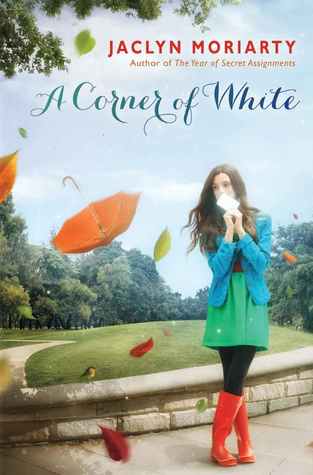
Cover discussion: I think it's easy to glance at this cover and think it too generic, but it's one of those kinds that grows on you more after you've read and adored the story. The whimsy and the eye-catching spots of color are all there.

Arthur A. Levine Books / April 1, 2013 / Hardcover / 384pp. / $17.99

e-galley received from publisher and NetGalley. Thanks!

Saturday, March 23, 2013

Review: Lonesome Dove by Larry McMurtry

Lonesome Dove, Book 1

Tags: American lit, Western, Wild West, cowboys, Pulitzer Prize

Summary

In the relatively calm years after the Civil War, two former Texas Rangers, Augustus McCrae and Captain Woodrow Call, grow restless with their uneventful life in Lonesome Dove, Texas, where the most exciting things that happen are their occasional runs into Mexico to re-steal the cattle and horses that the Mexicans had stolen from Texas. When their former mate, Jake Spoon, returns with tales of how open and rich the Montana plains are, Call decides to round up a gang of cowboys and cattle and set up a cattle ranch there. But the trail north is long and hard, and there will be lots of heartaches and surprises for everyone before they even make it halfway there.

Review

I’m not sure I can pull my thoughts and emotions together to write a full-fledged review for this book. LONESOME DOVE came onto my radar because it is one of my colleagues’ favorite books ever. He recommends it to every one of our students, he donated two copies to my company’s library, he borrows those very two copies that he donated every few months to pass around to friends. Finally I happened upon an ex-library copy at a book sale and decided that it’d probably be worth at least two dollars to check it out. I wasn’t expecting the invaluable find of one of the best books I’ve ever read, a stunning achievement of characterization set in the Old Wild West.

LONESOME DOVE’s strength lies in how effortlessly Larry McMurtry conjures up a varied cast of characters. Easily a dozen characters take turns narrating over 900+ pages, and some of these characters really pissed me off with how slow/idiotic/selfish they acted. And I loved all the emotions that McMurtry was able to stir up in me. Spending time with childish Jake Spoon, depressed and selfish Elmira, damaged Lorena, and others made me realize how little I read from the points of view of characters I don’t like, and how valuable it can be.

Oh, don’t worry: there aren’t only despicable characters in this book. But no one is perfect, and there’s not necessarily one protagonist to cheer on the whole way through. McMurtry breaks your heart by letting bad things befall good characters, or not letting bad characters receive their comeuppance. In the end, however, you understand why people are willing to follow Gus and Call in their endeavors: the two of them, so different in personality, are impressive leaders in action.

Most of us have seen a scene or two of the Wild Wild West, but Larry McMurtry really makes readers live it. McMurtry’s Old Wild West’s main feature is the variety of rough characters one comes across on the road or in saloons, whores and gamblers and trigger-happy cowboys. A writer can write as much as he or she wants on the setting, but it is the people in LONESOME DOVE that really make you feel the dust between your teeth, snowblindness in your eyes, wet boots and socks through powerful Midwestern storms.

The characterization in LONESOME DOVE is so strong that I’m almost reluctant to say anything critical about the book, because I can forgive just about everything in light of such splendid characterization. But if I had to make criticisms about the book, two things come to mind. The more minor one is how incomplete the ending felt. It seemed almost like McMurtry was writing along, and then, around the 900-page mark, got bored with his story, while at the same time also realizing how successful it could be, and thus raced through the end, slapped on a few satisfying conclusions but also left a lot of things frustratingly open for a sequel.

A more major concern I had was its treatment of POC characters. All the American Indians that appear in this book are heartless, cold-blooded murderers; Deets, the sole black man of the Lonesome Dove outfit, is wise, knowledgeable, and dutiful, one-with-the-earth in a prophetic way. I get it that the nineteenth-century American West was not the most non-racist period in American history, and while I felt that the characters behaved synchronously with their time, I was disappointed that a twentieth-century author couldn’t do better than rely on stereotypes for creating his POC characters.

Despite those quibbles, however, I still wholeheartedly recommend this book. LONESOME DOVE is an epic read that will easily be, if not the greatest book you’ve ever read in your life, then at least the best Western you’ll ever read in your life.

Cover discussion: Does it matter? It could have the worst cover ever and I'd still buy a copy for every bookworm I like.

Simon & Schuster / June 15, 2010 (reprint) / Paperback / 864pp. / $18.00

Personal copy, heyyooo.

Thursday, March 21, 2013

Review: The Diviners by Libba Bray

The Diviners, Book 1

Tags: young adult, historical, paranormal, 1920s

Summary

Evie O'Neill has been exiled from her boring old hometown and shipped off to the bustling streets of New York City--and she is pos-i-toot-ly thrilled. New York is the city of speakeasies, shopping, and movie palaces! Soon enough, Evie is running with glamorous Ziegfield girls and rakish pickpockets. The only catch is Evie has to live with her Uncle Will, curator of The Museum of American Folklore, Superstition, and the Occult--also known as "The Museum of the Creepy Crawlies."

When a rash of occult-based murders comes to light, Evie and her uncle are right in the thick of the investigation. And through it all, Evie has a secret: a mysterious power that could help catch the killer--if he doesn't catch her first.

Review

All hail Her Royal YA Highness Libba Bray, who can write about anything she wants in any genre or mix of genres and have it be a critical and commercial success. In her new series, which begins with THE DIVINERS, Bray returns to the stomping grounds that had first gotten her fans: a solid ensemble cast of characters with a dollop of very atmospheric paranormal elements.

Evie is a mouthy, flighty, manipulative, and sometimes silly ball of energy. She is, in short, whom part of you always wishes you could be like, and also everything you would never want to have to deal with in another person. Evie may drive you crazy with her impulsiveness and selfishness at times, but it is those characteristics of hers that allow her to be such a one-of-a-kind protagonist. Her lines and actions literally dominate the pages. If ever there was a character who was bigger than the words describing her, it would be Evie. And I’m sure she would be happy to hear that about herself.

Evie, however, is not the only star of this book. Her new friends are strong characters in their own right. In THE DIVINERS, Evie’s friends and acquaintances don’t seem to be in the book for the sole purpose of convenient info-dumping or plot-hopping: it’s not difficult to see them as protagonists of their own stories—Theta, the glamorous Ziegfeld girl with the troubled past; Memphis, the golden boy from Harlem; Mabel, who is just coming out of the shadow of her idealistic, revolutionist parents; Jericho, strong and silent with a secret that could blow apart everyone’s conception of humanity; and Sam, the pickpocket whose suave exterior hides a grimly driven purpose. Along those lines, the dash of romance in this book will surprise and, I hope, delight you. Bray does not go the expected route, and neither does the romance impose upon the main plot in any way. Dare I say that this is one YA romantic setup that I actually can’t wait to see play out in the sequel?

Speaking of “main plot,” though…Well, sometimes it’s hard to tell what that is. The synopsis sells the premise of a supernatural serial killer, but that’s just the surface—fitting, for a 600-page book. The languid, almost irresponsibly lazy pace of the first half of the book nearly killed it for me. It’s necessary setup for future books in the series, and I appreciate that because of this thorough setup the future books will not beat a finished plot to death, but boy did it divide this book for me.

Overall, an extremely enjoyable novel, particularly for Libba Bray fans but also for those new to her books.

Similar Authors
Sarah Rees Brennan
Maureen Johnson
E. Lockhart

Cover discussion: It's unique! But, um, I feel like it didn't take the opportunity to make the most out of the characters' quirkiness and Bray's rich depictions of the times.

Little, Brown / Sept. 18, 2012 / Hardcover / 592pp. / $19.99

e-galley received from publisher and NetGalley.

Friday, March 15, 2013

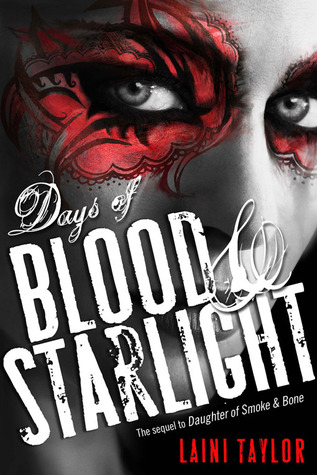
Review: Days of Blood and Starlight by Laini Taylor

Daughter of Smoke and Bone, Book 2

Tags: YA, fantasy, angels, demons, love, war

Review

…And here, my interest in this series comes to an end. Daughter of Smoke and Bone was a heart-pounding whirlwind of an introduction into a magically complex double-world and a fascinating protagonist. DAYS OF BLOOD AND STARLIGHT took all that and beat it into the ground until it turned into dust. All. At. A. Very. Slow. Pace.

I think my interest started waning upon Karou and Akiva breaking the wishbone in Book 1. Since then, the narrative has drowned in a pathetic ocean of romantic angst. I don’t mind moping so long as there are other things going on in the story, but there’s nothing—repeat, nothing—to alleviate the patheticness that continues to emanate from Karou and Akiva. Karou spends the whole of Book 2 basically a prisoner in an isolated “castle” in the deserts of Morocco, helping Thiago exact his brutal plan of revenge against the angels. And yet I couldn’t bring myself to feel sorry for her. I probably could have if it seemed like there was more to her than just her apocalyptic feelings regarding Akiva’s betrayal. But I didn’t see it.

Taylor’s writing tries to take on this objective “observer” tone to allow readers to feel their own horror at the scenes of warfare that unfold. It only sort of works. A heart-wrenching chapter or two in the midst of more plot, more action would have been great. It would have been the literary equivalent of poignant silence in the midst of a Hollywood warfare movie. Instead, DAYS OF BLOOD AND STARLIGHT chooses to string several dozen of these chapters together to make up the majority of the book—with the result that its attempt to move readers into lingering contemplation over the horrors of the war gets drowned.

Poignant chapters, great love, and musings over war are all great, and necessary, but they need to be done in moderation. DAYS OF BLOOD AND STARLIGHT did not do any with moderation. And as a result it made what should have been an enjoyable, moving, and tear-jerking read into a slog.

Similar Authors
Holly Black
Cassandra Clare

Cover discussion: It makes for a cool movie-esque poster, but I don't really associate these titles with the books without those titles written in such a large font.

Little, Brown / Nov. 6, 2012 / Hardcover / 528pp. / $18.99

e-book received for review from publisher and NetGalley.

Wednesday, March 13, 2013

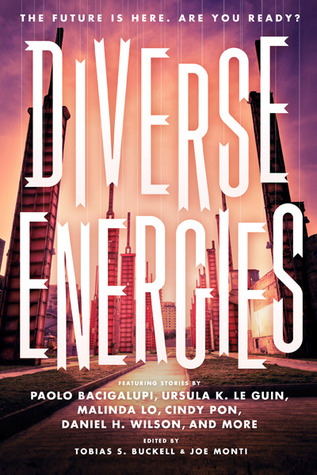
Review: Diverse Energies edited by Tobias Bucknell and Joe Monti

Tags: science fiction, fantasy, dystopian, POC, short story anthology

Summary

“No one can doubt that the wave of the future is not the conquest of the world by a single dogmatic creed but the liberation of the diverse energies of free nations and free men. No one can doubt that cooperation in the pursuit of knowledge must lead to freedom of the mind and freedom of the soul.” —President John F. Kennedy, from a speech at University of California, March 23, 1962

 In a world gone wrong, heroes and villains are not always easy to distinguish and every individual has the ability to contribute something powerful. In this stunning collection of original and rediscovered stories of tragedy and hope, the stars are a diverse group of students, street kids, good girls, kidnappers, and child laborers pitted against their environments, their governments, differing cultures, and sometimes one another as they seek answers in their dystopian worlds. Take a journey through time from a nuclear nightmare of the past to society’s far future beyond Earth with these eleven stories by masters of speculative fiction. Includes stories by Paolo Bacigalupi, Ursula K. Le Guin, Malinda Lo, Cindy Pon, Daniel H. Wilson, and more. [summary from Goodreads]

Review

DIVERSE ENERGIES is like a Halloween trick-or-treat bag: you get some real good ‘uns, but you also get some duds that you always kind of throw back into the bag and hope that you don’t pull out again in your next swipe. It’s definitely a worthwhile read for those interested in the intersection of SFF with POC (hah, so many acronyms), particularly if you enjoy or don’t mind short stories. However, I’m not sure it had the comprehensive punch required for it to break out of its niche for the time being.

Here are some thoughts for most (though unfortunately not all) the short stories:

“Last Day” by Ellen Oh - I felt like this story didn't add anything new to the category of "tales about Japanese people in wartime." The "shocking reveal" towards the end was too sudden to actually move me. 3/5

"Freshee's Frogurt" by Daniel Wilson - Rebellious, murderous robots! Quick, intense, eerily believable. 4/5

"Uncertainty Principle" by K. Tempest Bradford - Attention-holding storytelling. The science aspect felt a little underexplained, though. 4/5

"Pattern Recognition" by Ken Liu – So that’s how one can write about modern China's characteristics. The timeline jumped around a little too abruptly for me, but I felt the idea of this was quite realistic. 3.5/5

"Gods of Dimming Light" by Greg van Eekhout - Bad. Ass. Viking legends? Genomics? Short and fast, but fun! 3.5/5

"Next Door" by Rahul Kanakia - I liked the characters and the world but the pacing was uneven, especially towards the end, when it felt like things rushed to a premature conclusion. 3/5

"Good Girl" by Malinda Lo - Good, controlled balance between emotion, plot, and world-building. Little actually happened and questions were left unanswered at the end, but in a way that felt natural to the MC's understanding of things. 4/5

"A Pocket Full of Dharma" by Paolo Bacigalupi - Great worldbuilding; recognized a lot of elements of the modern China I know in here. The concept of having a person's consciousness in a datacube was fascinating, and the villains were scary. 4/5

"Blue Skies" by Cindy Pon - It's cool to read about a future version of Taipei. Unfortunately, the kidnapping plot felt a bit contrived, which lessened the impact the story's setup could've had for me. 3/5

"What Arms to Hold" by Rajan Khanna - Really wished the story had been slightly more specific as to its setting. 'Twas okay, but forgettable. 3.5/5

"Solitude" by Ursula K. LeGuin – This is the best of the bunch, even though it’s a reprint. But I’m glad the editors decided to include this, because I don’t know if I would’ve heard of this short story otherwise, and it’s brilliant. This is spot-on, a chilling yet fully understandable depiction of communication problems ("CP") between different cultures. 5/5

Cover discussion: I kinda like how the cover doesn't attempt to do anything fancy in terms of designs or symbolic representations of the future, and just lets the focus be simply on the title and the names of authors.

Tu Books / Oct. 1, 2012 / Hardcover / 368pp. / $19.95

e-galley received for review from publisher and NetGalley.

LinkWithin

Related Posts Plugin for WordPress, Blogger...